


























Views
Downloads
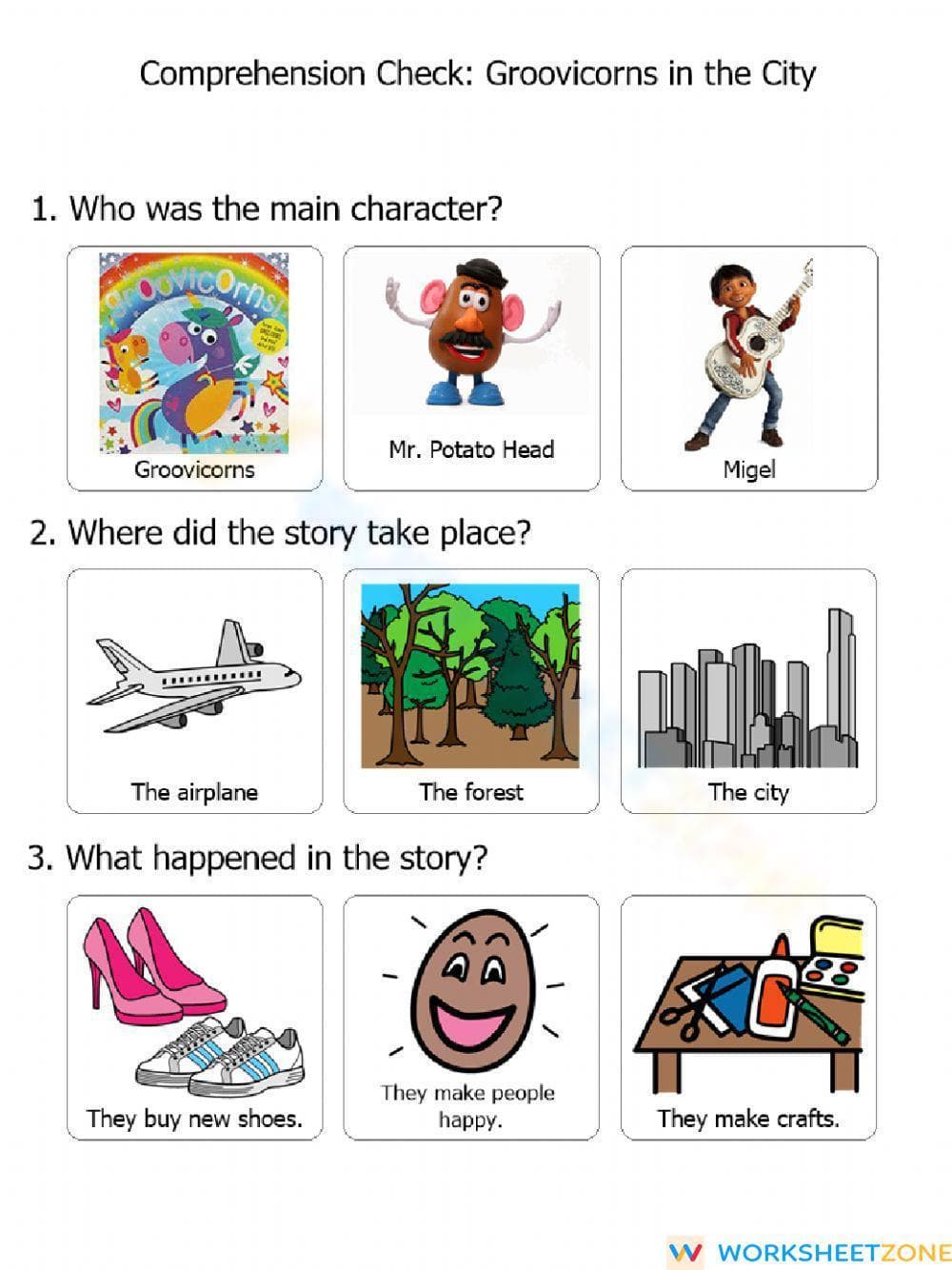

Printable Groovicorns in the City Comprehension | Grade K-2
Paste this activity's link or code into your existing LMS (Google Classroom, Canvas, Teams, Schoology, Moodle, etc.).
Students can open and work on the activity right away, with no student login required.
You'll still be able to track student progress and results from your teacher account.
This printable Groovicorns in the City comprehension check helps early readers identify characters, setting, and plot events. After listening to the story, students answer three visual multiple-choice questions to demonstrate understanding. This targeted practice ensures students recall important details while building foundational literacy skills for Kindergarten through Grade 2 learners.
At a Glance
- Grade: K-2 · Subject: ELA
- Standard:
CCSS.ELA-LITERACY.RL.1.3— Describe characters, settings, and major events in a story using key details.- Skill Focus: Story Elements & Comprehension
- Format: 1 page · 3 problems · Answer key included · PDF
- Best For: Listening centers or independent practice
- Time: 5–10 minutes
What's Inside
This one-page PDF features three high-interest questions based on the story "Groovicorns in the City." Each question is supported by colorful illustrations that serve as visual cues. Students select the correct image representing the character, setting, and event. A complete answer key is provided to facilitate quick teacher review or self-correction, making it a versatile tool for any classroom.
Zero-Prep Workflow
The zero-prep design allows for an efficient three-step workflow. First, print the single-page document (30 seconds). Second, distribute it to students after a read-aloud session (1 minute). Third, review the visual answers collectively or using the included key (1 minute). With less than three minutes of total preparation, this worksheet is an ideal solution for busy educators and substitute plans.
Standards Alignment
This resource is primary aligned to CCSS.ELA-LITERACY.RL.1.3, requiring students to describe characters, settings, and major events in a story. It also supports RL.K.3 by providing visual scaffolding for Kindergarteners to identify elements with minimal prompting. Both standard codes can be copied directly into lesson plans, IEP goals, or district curriculum mapping tools to ensure rigorous alignment with state and national requirements.
How to Use It
Use this worksheet as a formative assessment following a whole-group reading of the picture book. During the activity, observe if students independently associate illustrations with the narrative. It is also effective as a stationary task in a literacy center where students listen to the audio version of the story. Completion typically takes five to ten minutes, allowing for seamless integration into existing reading block schedules.
Who It's For
This activity is designed for Kindergarten, First, and Second Grade students developing their literary analysis skills. The heavy reliance on visual prompts makes it an excellent choice for English Language Learners and students requiring additional support. It pairs naturally with the picture book and can be used alongside a story elements anchor chart to reinforce essential vocabulary like "setting," "character," and "plot" events.
According to Fisher & Frey (2014), the use of visual scaffolding and graphic cues in early literacy assessments significantly improves the accuracy of comprehension measurement for emergent readers. This Groovicorns in the City worksheet employs these evidence-based strategies by providing students with clear pictorial options for identifying characters, settings, and plot events. By aligning with CCSS.ELA-LITERACY.RL.1.3, the resource ensures that even students with developing decoding skills can successfully demonstrate their ability to recall and describe key narrative details. Research from the NAEP highlights that early mastery of these foundational story elements is a strong predictor of later reading success. This worksheet provides the repetitive, low-stakes practice necessary for students to build confidence in their literary analysis. The three-question format is specifically designed to minimize cognitive load while maximizing the signal for student understanding, making it an essential tool for diverse elementary classroom environments.


