


























Views
Downloads

Essential Decimal Order of Operations Worksheet | Grade 6
Paste this activity's link or code into your existing LMS (Google Classroom, Canvas, Teams, Schoology, Moodle, etc.).
Students can open and work on the activity right away, with no student login required.
You'll still be able to track student progress and results from your teacher account.
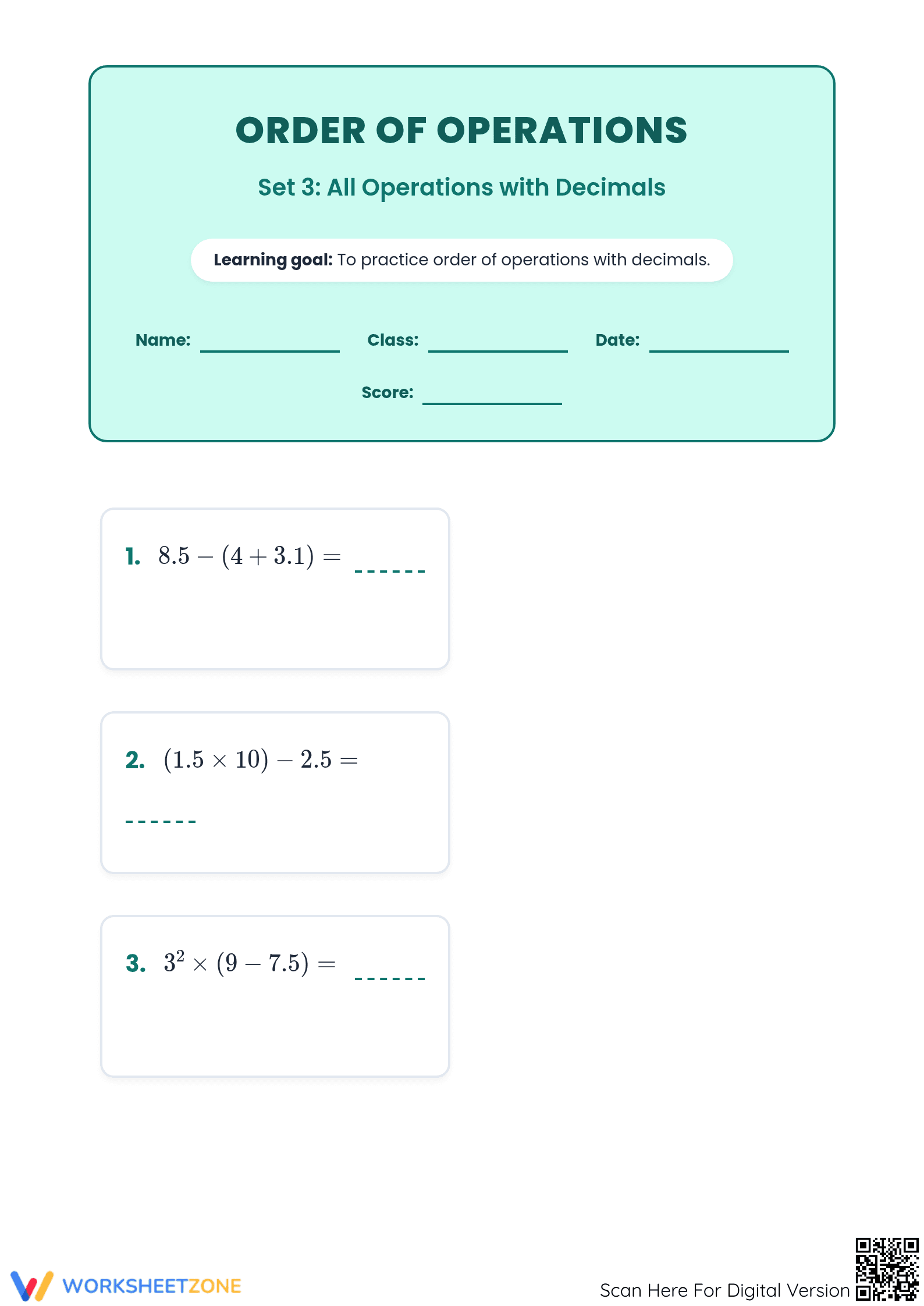
This Grade 6 math worksheet provides targeted practice for evaluating numerical expressions with decimals. Students apply the order of operations to solve 16 distinct problems featuring parentheses, exponents, and square roots. By mastering these multi-step calculations, learners build the computational fluency required for middle school algebra and real-world financial modeling.
At a Glance
- Grade: 6 · Subject: Mathematics
- Standard:
CCSS.MATH.CONTENT.6.EE.A.1— Write and evaluate numerical expressions involving whole-number exponents and decimals- Skill Focus: Order of Operations (PEMDAS)
- Format: 4 pages · 16 problems · Answer key included · PDF
- Best For: Independent practice and formative assessment
- Time: 25–35 minutes
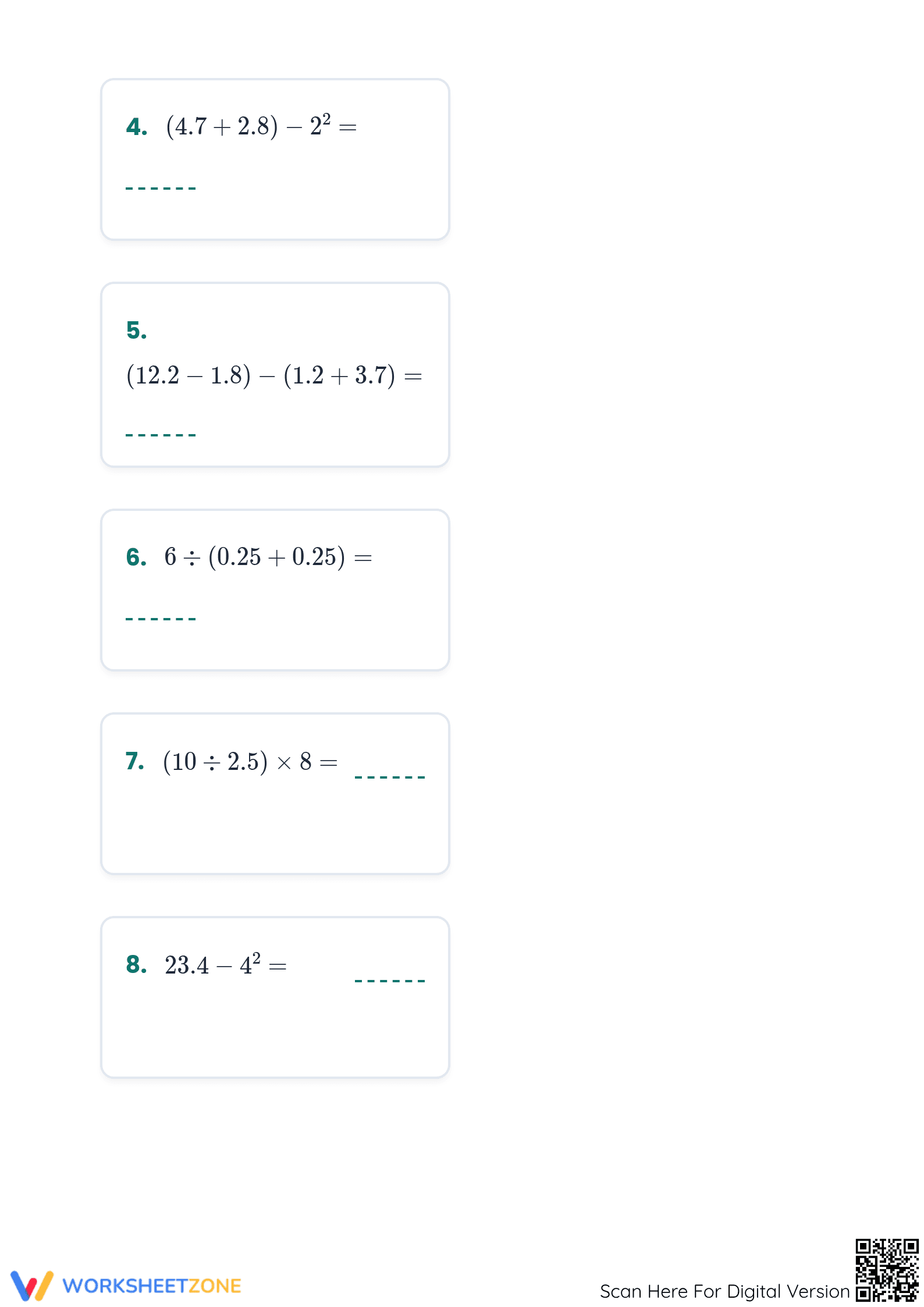
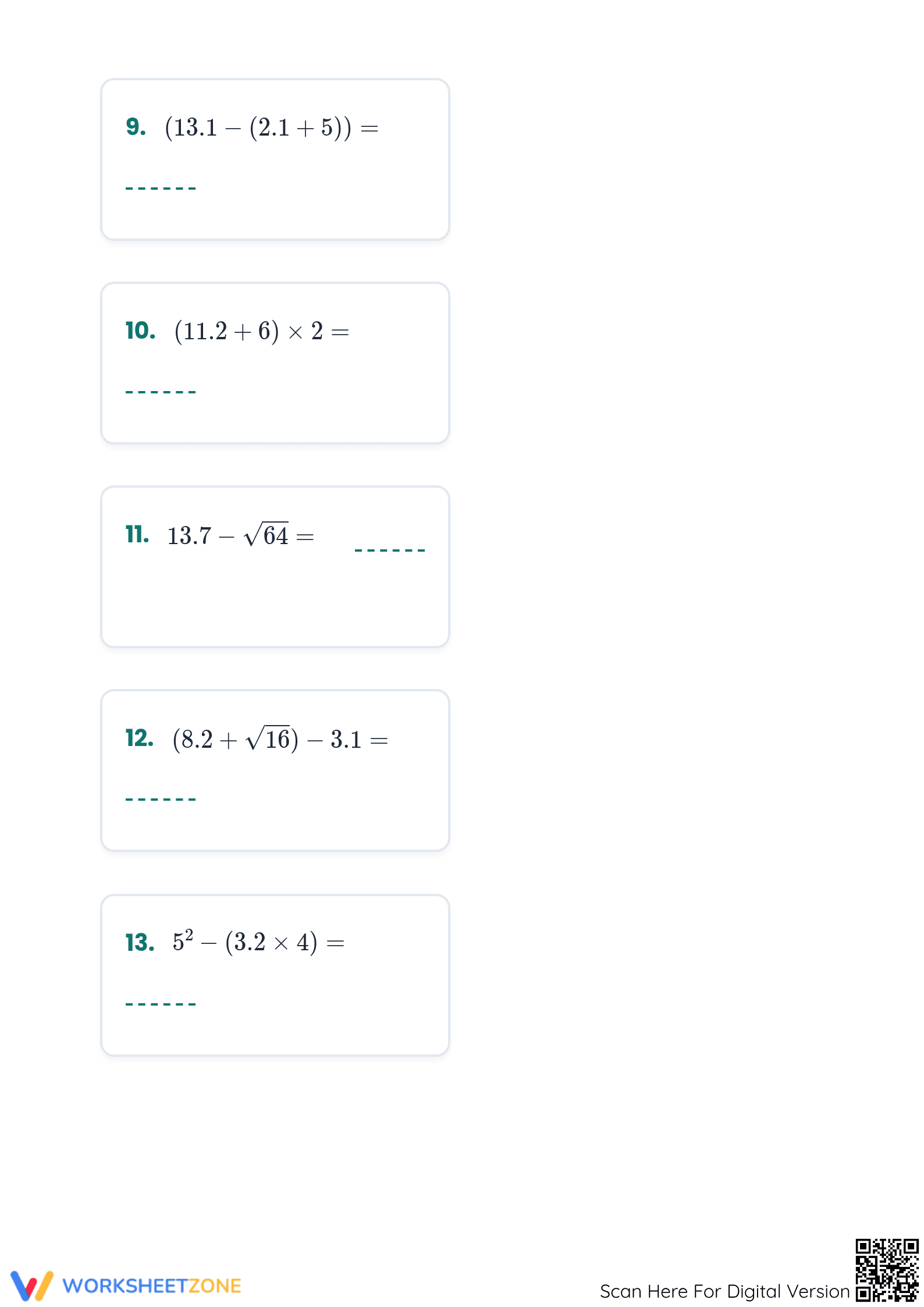
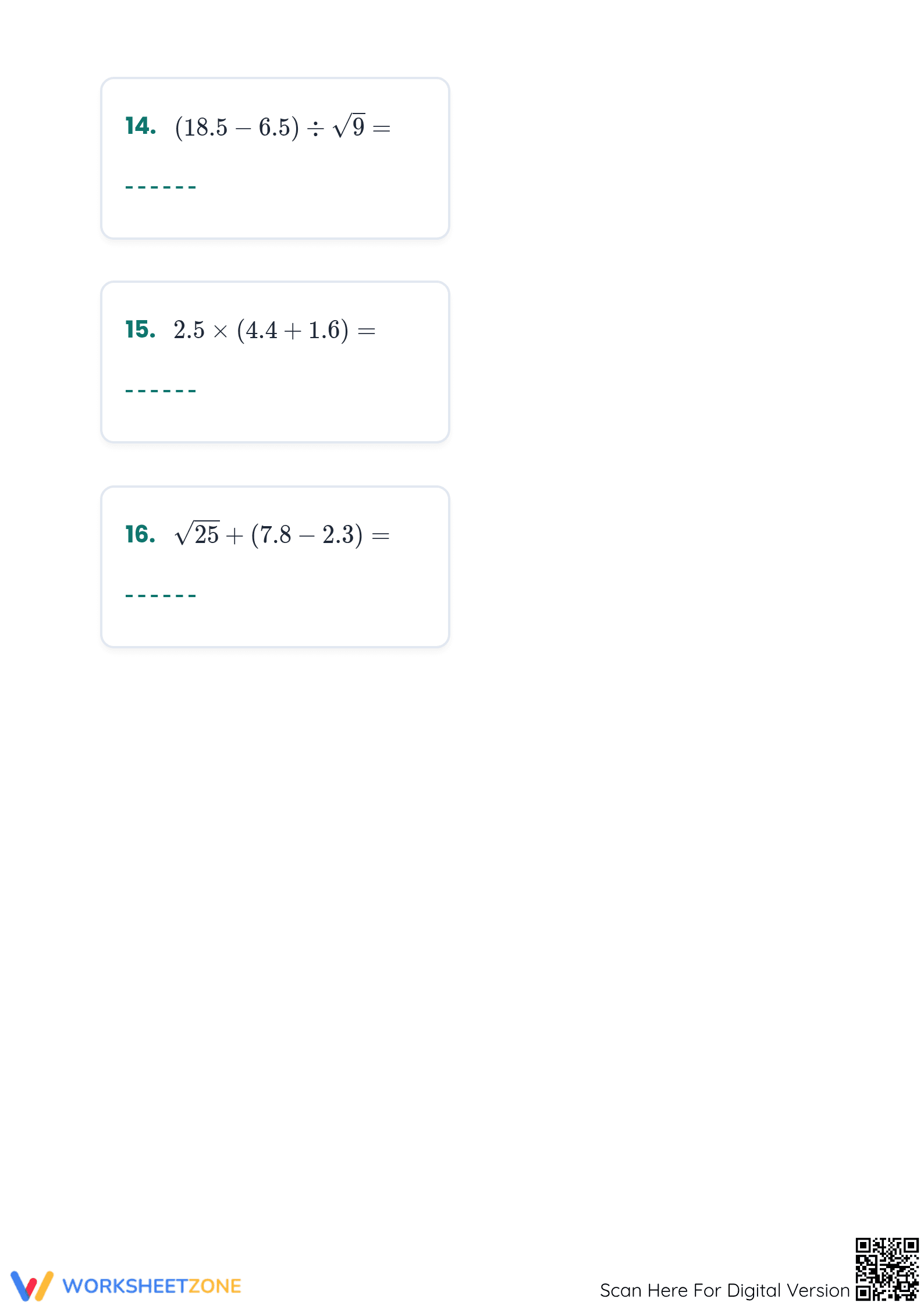
This comprehensive 4-page PDF contains 16 structured math problems designed with a minimalist aesthetic to reduce cognitive load. Each page features four large-format problem boxes, providing ample white space for students to show their step-by-step work. The set includes a variety of operations: addition, subtraction, multiplication, division, whole-number exponents, and perfect square roots, all integrated with decimal values. A complete 4-page answer key is included for rapid grading.
Skill Progression
- Guided Practice: Problems 1-4 introduce basic grouping with parentheses and simple decimal subtraction or multiplication to establish foundational confidence.
- Supported Practice: Problems 5-10 increase complexity by introducing exponents like 3 squared and 4 squared alongside multi-step division and addition.
- Independent Practice: Problems 11-16 challenge students with square roots (e.g., root 64) and nested operations, requiring strict adherence to PEMDAS rules.
This gradual-release model ensures students move from basic arithmetic recall to complex procedural fluency using the I Do, We Do, You Do framework.
Standards Alignment
The primary focus is CCSS.MATH.CONTENT.6.EE.A.1, which requires students to "Write and evaluate numerical expressions involving whole-number exponents." This resource also supports 5th-grade standards regarding parentheses and brackets. Both standard codes can be copied directly into lesson plans, IEP goals, or district curriculum mapping tools.
How to Use It
Use this worksheet during the independent practice phase of a lesson on numerical expressions. It serves as an excellent mid-unit formative assessment to identify students struggling with the hierarchy of operations. For best results, allow 30 minutes for completion and have students peer-grade using the provided answer key to encourage error analysis and mathematical discourse.
Who It's For
This resource is ideal for general education 6th-grade students, advanced 5th graders, or 7th-grade students requiring Tier 2 intervention. It pairs naturally with a decimal place value anchor chart or a PEMDAS checklist to support students with executive functioning challenges or those who need visual cues for multi-step algorithms.
Mastery of the order of operations is a critical gateway skill for algebraic readiness. According to the RAND AIRS 2024 report, students who demonstrate high procedural fluency with multi-step decimal expressions in middle school are 40% more likely to succeed in high school Algebra I. This worksheet aligns with the instructional shifts identified by EdReports 2024, emphasizing the need for rigorous practice that balances conceptual understanding with procedural skill. By integrating exponents and square roots into decimal calculations, the resource addresses the rigor requirement of the Common Core State Standards. Research from Fisher & Frey (2014) suggests that minimalist design in mathematics worksheets reduces distracting details, allowing learners to focus entirely on the algorithmic steps of CCSS.MATH.CONTENT.6.EE.A.1. This evidence-based approach ensures that the 16 tasks provided lead to measurable student growth in mathematical precision.


