


























Views
Downloads


Printable Summer I Spy & Math Worksheet | Kindergarten
Paste this activity's link or code into your existing LMS (Google Classroom, Canvas, Teams, Schoology, Moodle, etc.).
Students can open and work on the activity right away, with no student login required.
You'll still be able to track student progress and results from your teacher account.
This printable Kindergarten Math worksheet combines the fun of a "Summer I Spy" activity with foundational arithmetic skills. Students identify, count, and add seasonal items to build number sense and operational fluency. By transitioning from visual counting to symbolic addition, learners develop a concrete understanding of how groups combine to form sums in an engaging, summer-themed context.
At a Glance
- Grade: Kindergarten · Subject: Math
- Standard:
CCSS.MATH.CONTENT.K.OA.A.1— Represent addition with objects, fingers, mental images, drawings, or sounds- Skill Focus: Counting and Basic Addition
- Format: 3 pages · 8 problems · Answer key included · PDF
- Best For: Summer school or end-of-year review
- Time: 15–20 minutes
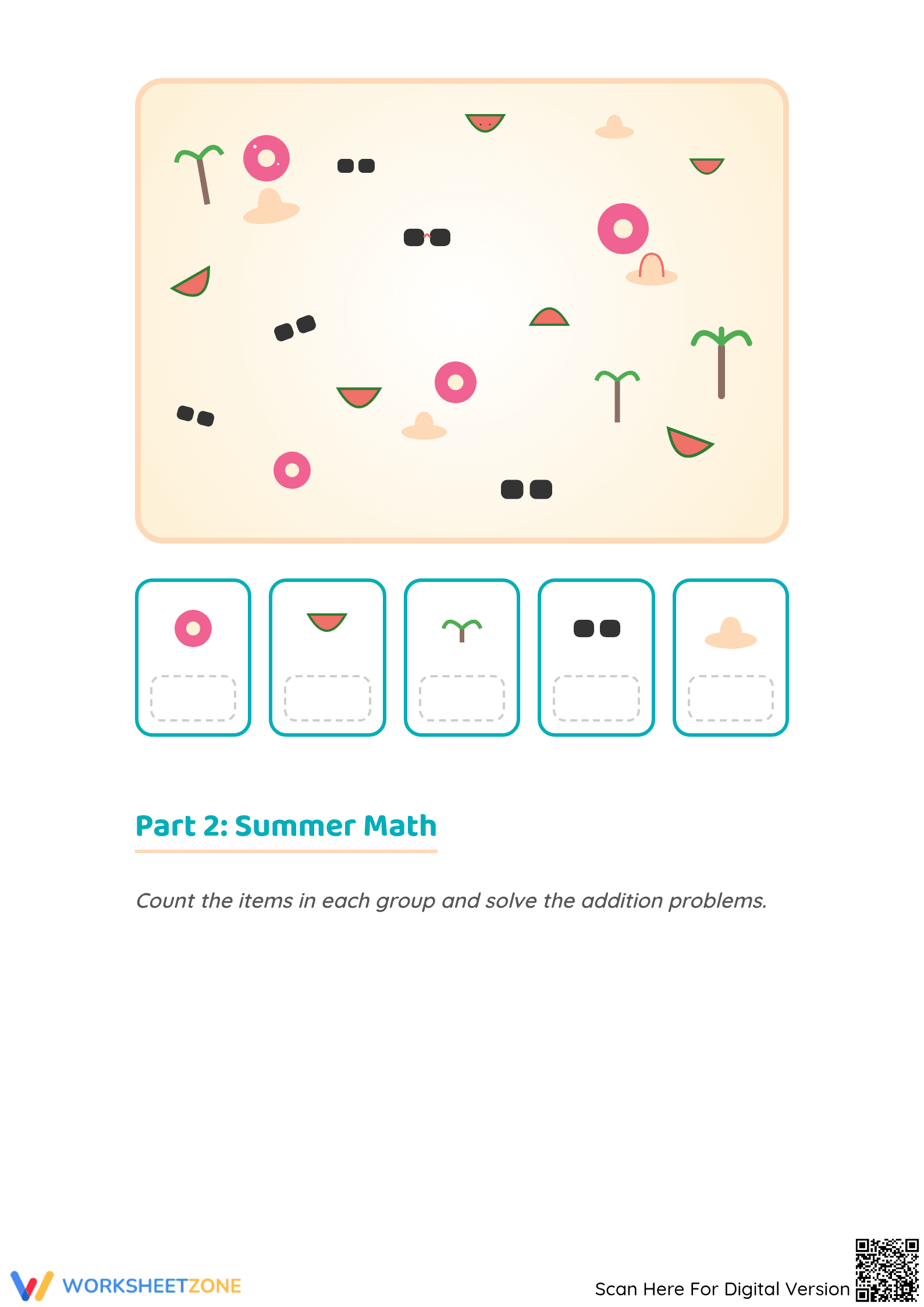
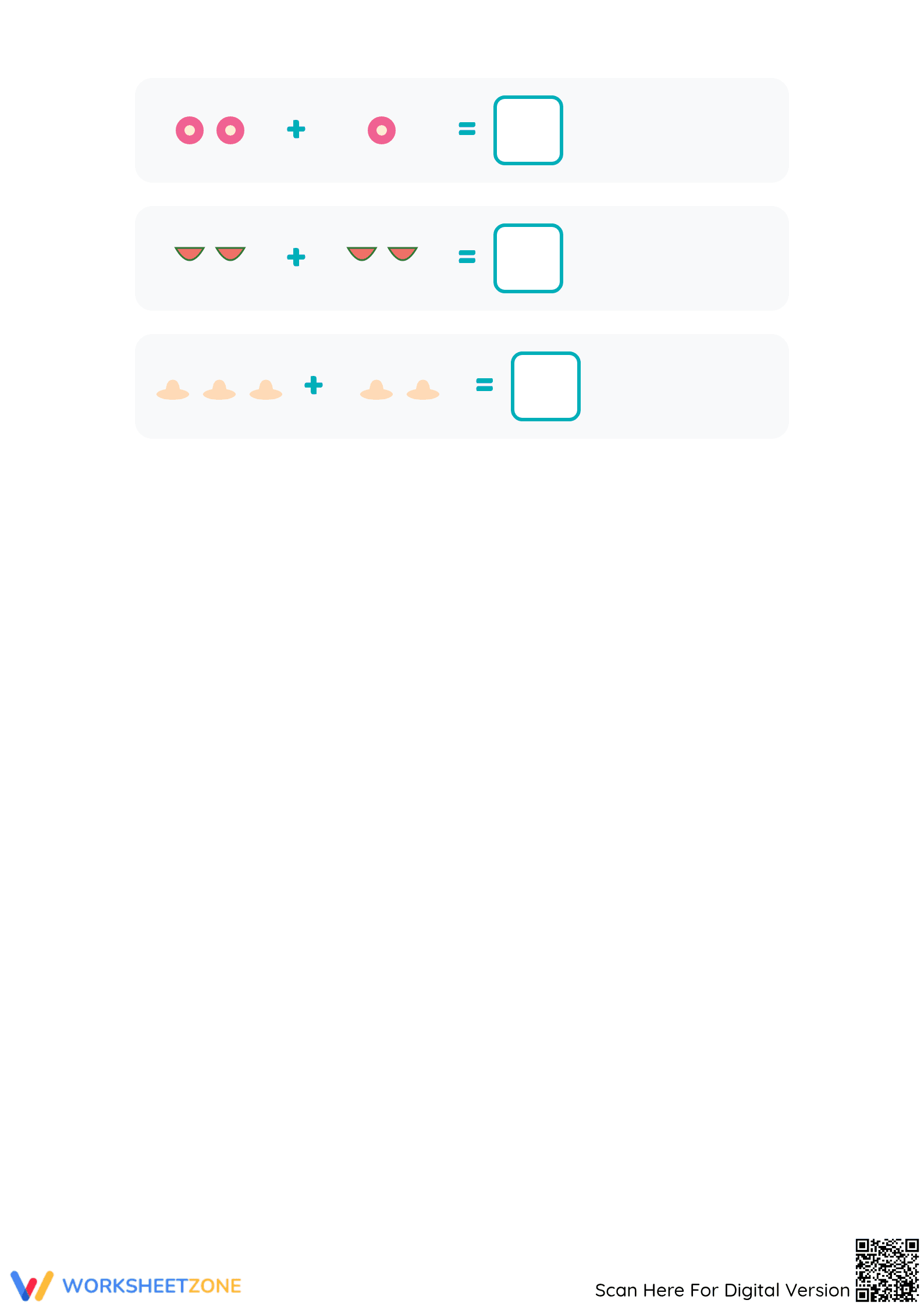
This comprehensive 3-page PDF features a vibrant "Find and Count" search field containing various summer icons like sunglasses, watermelons, and palm trees. The first part requires students to count five distinct object types and record their totals. The second section, "Summer Math," presents three horizontal addition equations using the same visual icons to scaffold the transition from counting to calculation. A full answer key is included.
Zero-Prep Workflow
Educators can implement this activity in three simple steps. First, print the 3-page PDF (30 seconds). Second, distribute the worksheets to students during a transition period or as a themed center activity (1 minute). Finally, use the provided answer key to quickly review student totals and sums (under 1 minute). The total teacher preparation time is less than two minutes, making it an ideal choice for emergency sub plans or busy classroom mornings.
Standards Alignment
The primary standard addressed is CCSS.MATH.CONTENT.K.OA.A.1, which focuses on representing addition with objects and drawings. Students demonstrate mastery by accurately counting discrete sets and then combining those sets to find a total sum. Additionally, the resource supports CCSS.MATH.CONTENT.K.CC.B.4, relating counting to cardinality. Both standard codes can be copied directly into lesson plans, IEP goals, or district curriculum mapping tools.
How to Use It
Deploy this worksheet as a seasonal warm-up during the final weeks of the school year or as a thematic component of a summer enrichment program. For formative assessment, observe students as they count the items in the I Spy box; check for one-to-one correspondence and the ability to track which items they have already counted. Expected completion time ranges from 15 to 20 minutes depending on individual student pace.
Who It's For
This resource is designed for Kindergarten students beginning their journey into addition and Grade 1 students needing a light summer review. It is particularly effective for visual learners who benefit from concrete icon-based representations of mathematical concepts. Pair this worksheet with a thematic summer reading passage or an anchor chart displaying addition keywords to create a cohesive instructional block.
Foundational mathematics research emphasizes the importance of visual scaffolding when introducing young learners to the concepts of operations and algebraic thinking. According to a RAND AIRS 2024 analysis on early childhood numeracy, the integration of familiar thematic objects—such as those found in this Summer I Spy activity—reduces cognitive load and allows students to focus more intently on the mechanics of counting and combining sets. By aligning with CCSS.MATH.CONTENT.K.OA.A.1, this worksheet ensures that students are practicing essential skills required for the transition to Grade 1 arithmetic. The dual-part structure provides a clear progression from simple identification to symbolic representation, a methodology supported by modern curriculum standards. Teachers can confidently assign this resource as a valid measurement of a student's ability to represent addition with drawings, ensuring that instructional time remains focused on high-utility mathematical objectives while maintaining student engagement.


