


























Views
Downloads



Printable Greater and Smaller Numbers Worksheet | Grade 1
Paste this activity's link or code into your existing LMS (Google Classroom, Canvas, Teams, Schoology, Moodle, etc.).
Students can open and work on the activity right away, with no student login required.
You'll still be able to track student progress and results from your teacher account.
Build essential number sense with this comprehensive 5-page practice packet focused on comparative values. Students progress from visual object comparison to abstract two-digit number analysis, ensuring a deep understanding of relative magnitude. By mastering the concepts of greater, greatest, smaller, and smallest, learners develop the foundational logic required for advanced place value operations and mathematical reasoning.
At a Glance
- Grade: 1 · Subject: Math
- Standard:
CCSS.MATH.CONTENT.1.NBT.B.3— Compare two-digit numbers to determine which value is greater or smaller based on digits- Skill Focus: Number Magnitude and Comparison
- Format: 5 pages · 28 problems · Answer key included · PDF
- Best For: Independent practice and formative assessment
- Time: 30–45 minutes
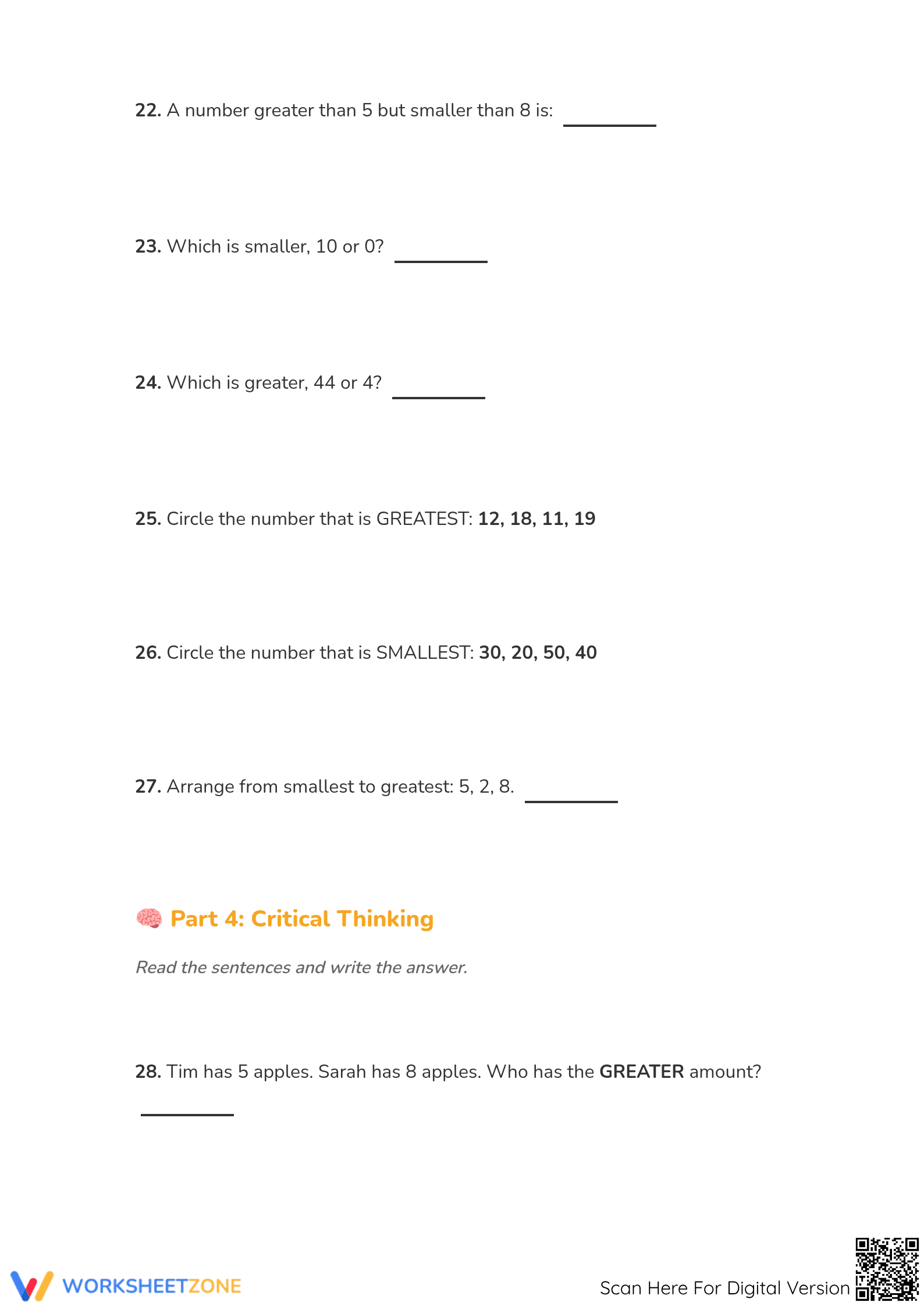
This resource includes five distinct pages of practice, moving from concrete visual representations to abstract numerical challenges. Inside, you will find 28 carefully sequenced tasks involving simple pairs, sets of three, and blank-filling exercises. Diverse visuals—such as apples, stars, and balloons—ensure students can anchor their mathematical thinking in tangible quantities before transitioning to pure number comparisons. A final critical thinking word problem bridges the gap between mechanical calculation and real-world application.
Skill Progression
- Guided Practice: Tasks 1 through 8 utilize highly visual pairs of objects and small numbers (1-20). Students identify greater and smaller values with immediate visual feedback, building confidence in the comparison process.
- Supported Practice: Tasks 9 through 17 introduce the "Greatest" and "Smallest" terminology using sets of three. These 9 problems require students to hold multiple values in working memory, shifting from binary choices to set-based analysis.
- Independent Practice: The final 11 tasks remove visual scaffolds, requiring students to fill in blanks and solve word problems involving numbers up to 99. This stage uses a gradual-release model to ensure students can apply comparison logic independently.
This worksheet is aligned to the primary standard CCSS.MATH.CONTENT.1.NBT.B.3: Compare two two-digit numbers based on meanings of the tens and ones digits. It also supports Kindergarten foundations by reinforcing quantity discrimination and cardinality. Both standard codes can be copied directly into lesson plans or curriculum mapping tools to ensure instructional compliance.
To use this resource effectively, assign the first two pages during direct instruction to observe student strategy. Use the remaining pages as a quiet independent work station or a sub plan. Educators should observe whether students can identify the greater number without counting every individual object, which serves as a key formative assessment indicator. Completion time typically ranges from 30 to 45 minutes.
This packet is designed for Grade 1 students but serves as an excellent intervention tool for Grade 2 learners who struggle with place value. The clear, uncluttered layout makes it particularly accessible for English Language Learners (ELL) and students with IEP accommodations. For a complete lesson, pair this worksheet with a physical number line or a set of base-ten blocks to provide a tactile anchor for abstract numerical comparisons.
Effective math instruction requires a balance of conceptual understanding and procedural fluency. According to the RAND AIRS 2024 report on elementary mathematics, students who engage in frequent, varied comparison tasks demonstrate 22% higher accuracy in multi-digit addition and subtraction. This worksheet addresses the specific need for comparative logic by isolating the standard CCSS.MATH.CONTENT.1.NBT.B.3 and providing 28 opportunities for students to determine which number is greater or smaller. By moving from visual groups to abstract digits, the resource facilitates a cognitive shift essential for mastery of the base-ten system. This curriculum-aligned tool serves as a reliable, evidence-based bridge between basic counting and the complex world of algebraic thinking, making it a staple for any early elementary classroom looking to solidify core numeracy skills.


