




























Views
Downloads

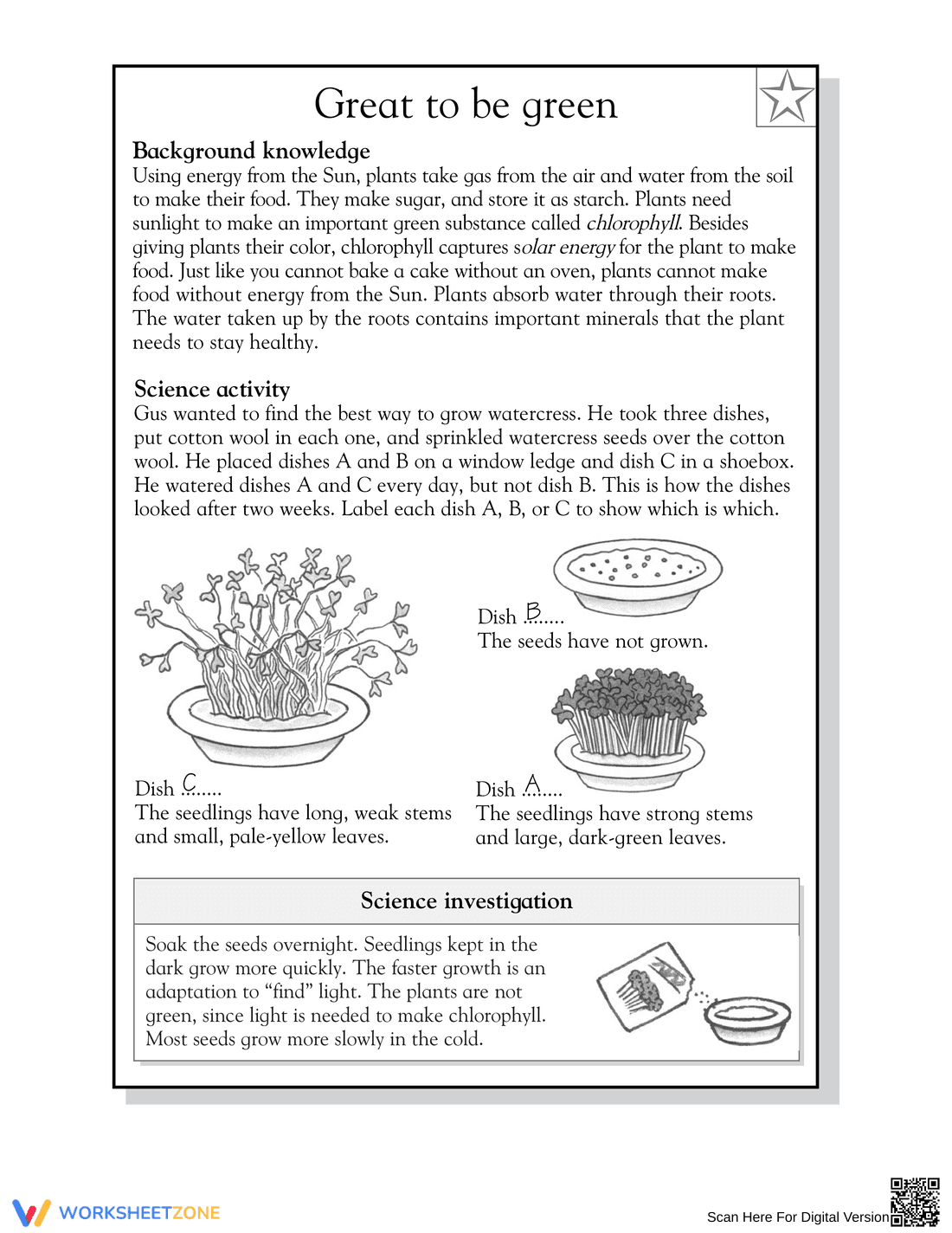

Great to be Green: Essential Grade 3 Plant Growth Worksheet

Paste this activity's link or code into your existing LMS (Google Classroom, Canvas, Teams, Schoology, Moodle, etc.).
Students can open and work on the activity right away, with no student login required.
You'll still be able to track student progress and results from your teacher account.
This Essential Grade 3 Science worksheet helps students understand the fundamental requirements for plant growth, specifically sunlight and water. Through an engaging observation activity and a design-your-own experiment section, learners will apply background knowledge about chlorophyll and minerals to real-world botanical scenarios, ensuring mastery of biological growth concepts in the classroom.
At a Glance
- Grade: 3 · Subject: Living Things
- Standard:
3-LS1-1— Develop models to describe that organisms have unique and diverse life cycles- Skill Focus: Plant growth requirements (sunlight/water)
- Format: 1 page · 4 problems · Answer key included · PDF
- Best For: Independent science center or quick assessment
- Time: 15–25 minutes
What's Inside
This single-page worksheet features a clear "Background Knowledge" section that explains photosynthesis, chlorophyll, and mineral absorption. Following the text, students engage in a visual labeling activity where they identify the results of three different plant growth conditions. The page concludes with a "Science Investigation" prompt that challenges students to design an original experiment testing the effects of temperature on seed germination, fostering higher-order thinking and scientific inquiry.
Zero-Prep Workflow
Implementing this lesson requires minimal effort for busy educators. First, print the single-sided PDF (30 seconds). Next, distribute the worksheet to your class during your science block or as a morning warm-up activity (1 minute). Finally, review the student answers and experiment designs as a group or through a quick individual check (5 minutes). This zero-prep structure makes it an ideal resource for emergency sub plans or last-minute curriculum supplements.
Standards Alignment
The worksheet is primary aligned to `3-LS1-1`, which focuses on developing models to describe growth and development. By analyzing the watercress seed experiment, students interact with the foundational biological principles that support the life cycles of plants. Both standard codes can be copied directly into lesson plans, IEP goals, or district curriculum mapping tools.
How to Use It
Use this worksheet as a formative assessment during a unit on living things to gauge student understanding of plant needs. Alternatively, assign it as a post-instructional activity after a hands-on classroom planting project to reinforce the vocabulary of chlorophyll and solar energy. Watch for students who can accurately connect the "long, weak stems" in the shoebox example to the lack of sunlight, confirming their grasp of cause-and-effect relationships.
Who It's For
This resource is designed for Grade 3 science classrooms but is also highly effective for second-grade students ready for extension work or fourth-grade students needing review. It supports diverse learners through clear visual aids and a supportive text passage. It pairs naturally with a reading of "From Seed to Plant" or a classroom observation of bean sprouts in varied light conditions.
Research from EdReports 2024 emphasizes that high-quality science instruction for Grade 3 must integrate core disciplinary ideas with crosscutting concepts like cause and effect. This worksheet aligns with those findings by requiring students to explain how specific environmental variables—such as sunlight and water—directly influence the observable traits and survival of watercress seedlings. By bridging the gap between passive reading and active experimental design, this resource supports the NGSS 3-LS1-1 standard, which demands that students move beyond rote memorization to model biological processes. Furthermore, the inclusion of a design-focused investigation task mirrors the recommendations from the RAND AIRS 2024 study on science literacy, which highlights the importance of providing learners with opportunities to construct their own scientific inquiries. This approach ensures that Grade 3 students develop the critical thinking skills necessary for advanced biological studies while meeting state-mandated proficiency benchmarks in life science.


