


























Views
Plays
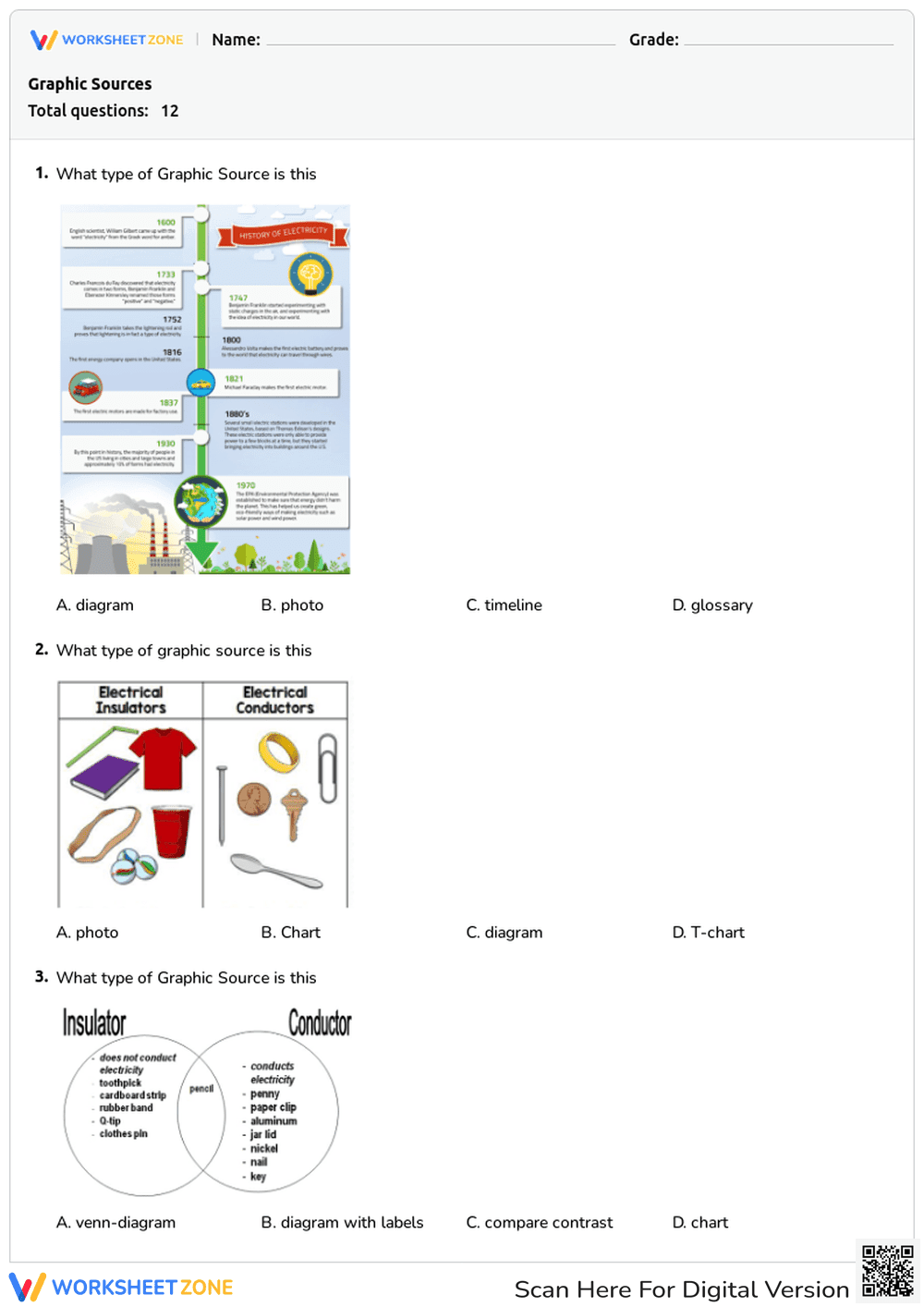


Graphic Sources Worksheet | Grade 2-3 Essential
Paste this activity's link or code into your existing LMS (Google Classroom, Canvas, Teams, Schoology, Moodle, etc.).
Students can open and work on the activity right away, with no student login required.
You'll still be able to track student progress and results from your teacher account.
This Grade 2-3 ELA worksheet helps students master the identification and interpretation of various graphic sources. By analyzing timelines, Venn diagrams, and bar graphs, learners develop the critical ability to extract information from visual aids. This resource ensures students can explain how images clarify complex informational texts effectively.
At a Glance
- Grade: 2-3 · Subject: ELA
- Standard:
CCSS.ELA-LITERACY.RI.2.7— Use information from images and text to demonstrate understanding.- Skill Focus: Interpreting Graphic Sources
- Format: 4 pages · 12 problems · Answer key included · PDF
- Best For: Formative assessment or sub plans
- Time: 20–30 minutes
The packet contains four pages of multiple-choice questions focusing on diverse visual media. Students interact with a history of electricity timeline, an electrical insulators T-chart, a Venn diagram, a cloud formation diagram, and a hearing range bar graph. The clear layout and high-quality images provide a professional look for classroom distribution.
Zero-Prep Workflow
- Print: Select the 4-page PDF and print enough copies for your class (30 seconds).
- Distribute: Hand out the worksheets as a warm-up or independent practice session (1 minute).
- Review: Use the included answer key to grade or facilitate a whole-class discussion on visual literacy (5 minutes).
Total teacher prep time is under two minutes, making this an ideal emergency sub plan for elementary educators.
Standards Alignment
This resource aligns with `CCSS.ELA-LITERACY.RI.2.7`: "Explain how specific images (e.g., a diagram showing how a machine works) contribute to and clarify a text." It also supports RI.3.7 by requiring students to use information gained from illustrations to answer specific questions. Both standard codes can be copied directly into lesson plans, IEP goals, or district curriculum mapping tools.
How to Use It
Use this worksheet during the "We Do" phase of a lesson on informational text features to model how to read a legend or axis. Alternatively, assign it as a summative exit ticket after a unit on non-fiction text structures. Observe if students struggle more with quantitative data (graphs) versus sequential data (timelines) to guide future small-group instruction.
Who It's For
This resource is designed for general education students in grades 2 and 3, as well as English Language Learners who benefit from visual-heavy assessments. It pairs naturally with an anchor chart on text features or a direct instruction lesson on reading diagrams.
According to the RAND AIRS 2024 report, graphic literacy is a foundational component of modern reading comprehension, as students are increasingly required to synthesize information across multiple modalities. This worksheet targets CCSS.ELA-LITERACY.RI.2.7 by challenging students to identify specific graphic sources—such as timelines, Venn diagrams, and bar graphs—and then apply that visual data to answer comprehension questions. Research from Fisher & Frey (2014) emphasizes that explicit instruction in reading non-textual elements significantly improves a student's ability to navigate complex informational texts. By providing 12 structured tasks across 4 pages, this resource offers the repeated exposure necessary for students to move from simple identification to higher-order interpretation. The inclusion of diverse scientific and historical topics ensures that the skill practice remains engaging while reinforcing cross-curricular knowledge in science and social studies.


