


























Views
Downloads
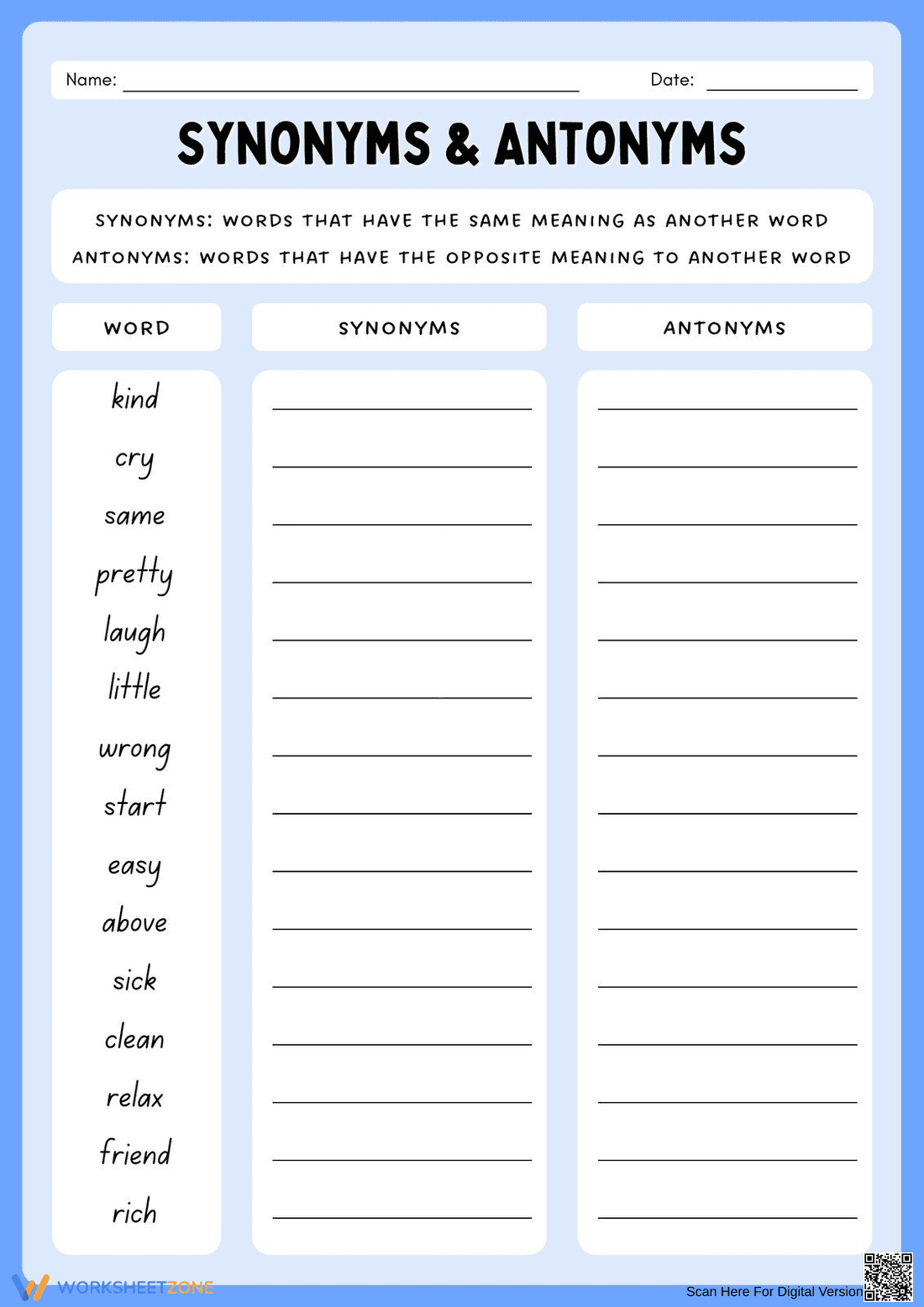

Grade 4 Synonyms & Antonyms — Printable No-Prep Worksheet
Paste this activity's link or code into your existing LMS (Google Classroom, Canvas, Teams, Schoology, Moodle, etc.).
Students can open and work on the activity right away, with no student login required.
You'll still be able to track student progress and results from your teacher account.
This Grade 4 vocabulary worksheet provides immediate practice with synonyms and antonyms to expand student word choice and reading comprehension. By generating both similar and opposite words for common vocabulary, students strengthen their understanding of word relationships and build a more robust expressive vocabulary for writing.
At a Glance
- Grade: 4 · Subject: ELA
- Standard:
CCSS.ELA-LITERACY.L.4.5.C— Relate words to their opposites and similar meanings- Skill Focus: Synonyms and Antonyms
- Format: 1 page · 30 problems · Answer key included · PDF
- Best For: Independent practice and vocabulary building
- Time: 10–15 minutes
This single-page resource features a clear layout for immediate engagement. The header provides concise definitions for synonyms and antonyms as a quick reference. A three-column table lists 15 base words, such as "kind" and "laugh." Students write one synonym and one antonym for each, yielding 30 practice opportunities. A complete answer key is included.
Zero-Prep Workflow
This resource minimizes teacher preparation while maximizing learning time.
- Print (1 minute): The black-and-white PDF ensures fast, ink-friendly printing.
- Distribute (1 minute): Built-in definitions let students begin immediately without extensive instructions.
- Review (3 minutes): Use the answer key to quickly check understanding.
Total prep time is under two minutes, making this ideal for sub plans or morning work.
Standards Alignment
This worksheet is directly aligned to CCSS.ELA-LITERACY.L.4.5.C, which requires students to demonstrate understanding of words by relating them to their opposites (antonyms) and to words with similar but not identical meanings (synonyms). It also supports broader vocabulary acquisition goals by encouraging students to think critically about word choices. Both standard codes can be copied directly into lesson plans, IEP goals, or district curriculum mapping tools.
How to Use It
Use it as a warm-up before creative writing to encourage descriptive vocabulary, or assign it as independent practice during literacy centers. As a formative assessment tip, observe which column students complete first; those struggling with antonyms may need support with contrasting concepts. Expected completion time is 10 to 15 minutes.
Who It's For
This resource is primarily designed for fourth-grade students developing their vocabulary and language skills. It is also highly effective for third-grade students ready for an extension challenge, or fifth-grade students who need a quick foundational review. For differentiation, allow English Language Learners to use a visual dictionary or thesaurus to help generate words. This worksheet pairs perfectly with a direct instruction lesson on descriptive writing or an anchor chart detailing shades of meaning.
Mastering word relationships is a critical component of reading comprehension and expressive writing. According to Fisher & Frey (2014), explicit vocabulary instruction that emphasizes word connections significantly improves students' ability to decode complex texts and articulate their thoughts clearly. This worksheet directly supports CCSS.ELA-LITERACY.L.4.5.C by requiring students to actively relate words to their opposites and similar meanings. By generating synonyms and antonyms for 15 distinct terms, learners move beyond rote memorization and engage in the cognitive processing necessary for deep vocabulary acquisition. The structured format ensures that students can independently practice these essential language skills, reinforcing the semantic networks in their mental lexicon. Consistent practice with these word relationships not only boosts standardized assessment performance but also equips students with the linguistic tools needed for effective, nuanced communication across all academic subjects.


