


























Views
Downloads

Parts of Speech Worksheet — Grade 3 Printable
Paste this activity's link or code into your existing LMS (Google Classroom, Canvas, Teams, Schoology, Moodle, etc.).
Students can open and work on the activity right away, with no student login required.
You'll still be able to track student progress and results from your teacher account.
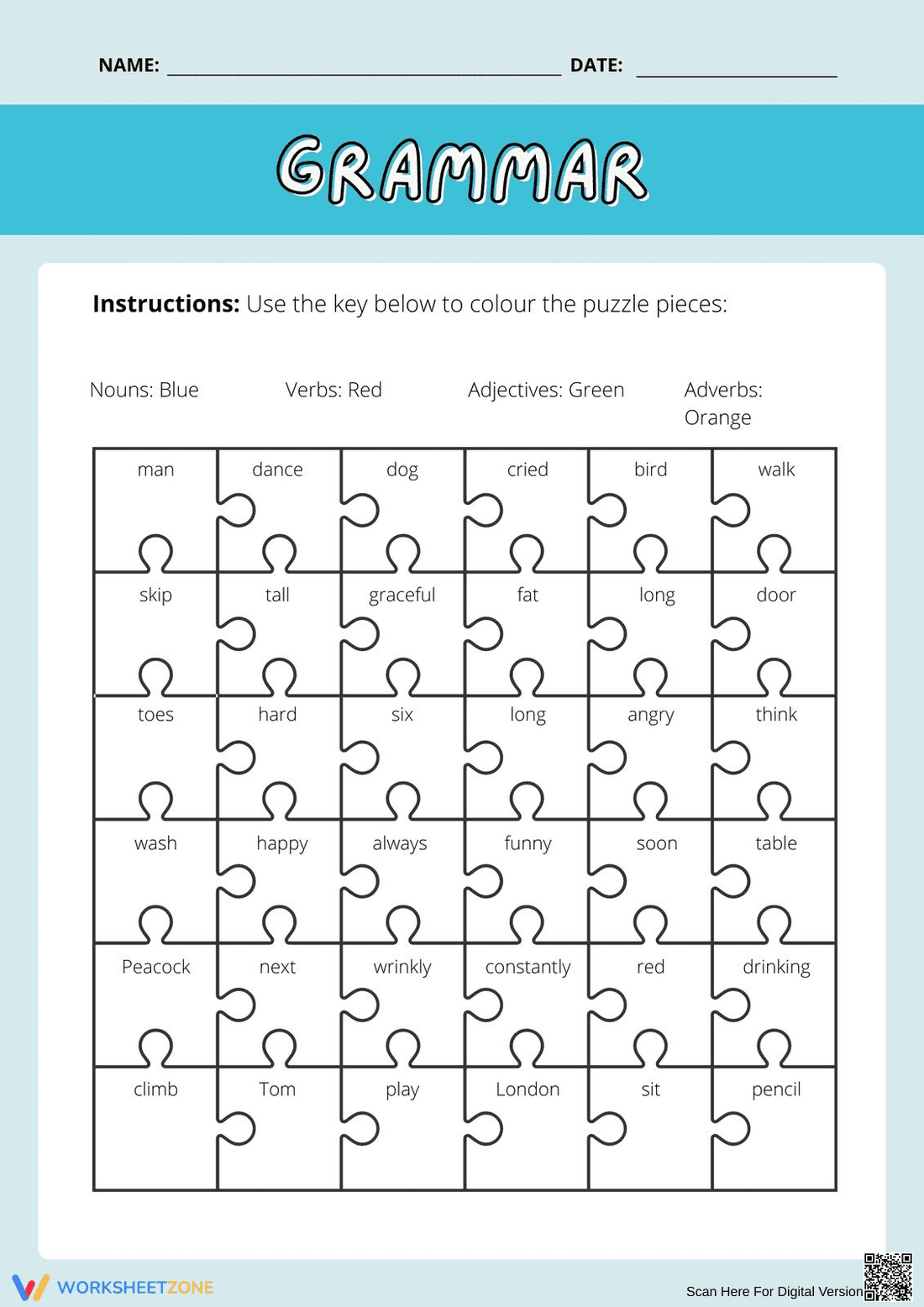
This Grade 3 grammar worksheet provides students with an engaging way to identify and categorize parts of speech. By coloring puzzle pieces according to a specific key, learners actively practice distinguishing between nouns, verbs, adjectives, and adverbs, reinforcing language skills required for strong writing and reading comprehension.
At a Glance
- Grade: 3 · Subject: ELA
- Standard:
CCSS.ELA-LITERACY.L.3.1.A— Identify and categorize nouns, verbs, adjectives, and adverbs.- Skill Focus: Parts of Speech
- Format: 1 page · 36 problems · Answer key included · PDF
- Best For: Independent practice and centers
- Time: 15–20 minutes
Inside this single-page resource, educators will find a 36-piece word puzzle grid. Each puzzle piece contains a single vocabulary word that students must classify. The top of the page features a clear, color-coded instruction key directing students to shade nouns blue, verbs red, adjectives green, and adverbs orange. A complete answer key is provided to ensure rapid grading and immediate student feedback.
Zero-Prep Workflow
- Print (30 seconds): Simply download the PDF and print a class set. The black-and-white design is highly printer-friendly.
- Distribute (30 seconds): Hand out the sheets along with blue, red, green, and orange crayons or markers.
- Review (1 minute): Read the four-color key aloud to ensure students understand the categorization task before they begin.
Total teacher preparation requires under two minutes, making this an ideal, self-explanatory activity for emergency sub plans or quick morning work.
Standards Alignment
This activity is directly aligned to CCSS.ELA-LITERACY.L.3.1.A, which requires students to explain the function of nouns, pronouns, verbs, adjectives, and adverbs in general and their functions in particular sentences. By isolating these word classes in a visual format, students build the automaticity needed to meet this standard. Both standard codes can be copied directly into lesson plans, IEP goals, or district curriculum mapping tools.
How to Use It
This resource works exceptionally well as an independent literacy center activity during guided reading rotations. Alternatively, assign it as a quiet Friday afternoon review task after a week of direct instruction on grammar rules. As a formative assessment observation tip, watch which colors students reach for when encountering tricky words like "constantly" or "wrinkly" to identify who needs a quick reteach on adverbs versus adjectives. Most third graders will complete this puzzle in 15 to 20 minutes.
Who It's For
This worksheet is designed for third-grade general education students, though it serves as excellent review material for fourth graders needing foundational grammar reinforcement. For students requiring accommodations, teachers can highlight the suffixes "-ly" to provide a visual scaffold for identifying adverbs. Pair this coloring activity with a classroom anchor chart detailing the definitions of the four targeted parts of speech to maximize student independence.
Mastering the ability to identify and categorize nouns, verbs, adjectives, and adverbs is a critical milestone in elementary language arts. According to Fisher & Frey (2014), providing students with structured, visual categorization tasks significantly improves their ability to transfer isolated grammar knowledge into independent writing. This resource targets CCSS.ELA-LITERACY.L.3.1.A by forcing learners to actively evaluate 36 distinct words and assign them to their correct grammatical category using a color-coded system. This method of active engagement prevents the passive guessing often seen in standard multiple-choice grammar drills. By embedding this foundational skill practice within a puzzle format, educators lower the affective filter, increasing task persistence among developing readers. Consistent practice with these core parts of speech builds the syntactic awareness required for complex reading comprehension and effective written communication.


