




























Views
Downloads

Personification Worksheet | Grade 6 ELA Printable

Paste this activity's link or code into your existing LMS (Google Classroom, Canvas, Teams, Schoology, Moodle, etc.).
Students can open and work on the activity right away, with no student login required.
You'll still be able to track student progress and results from your teacher account.
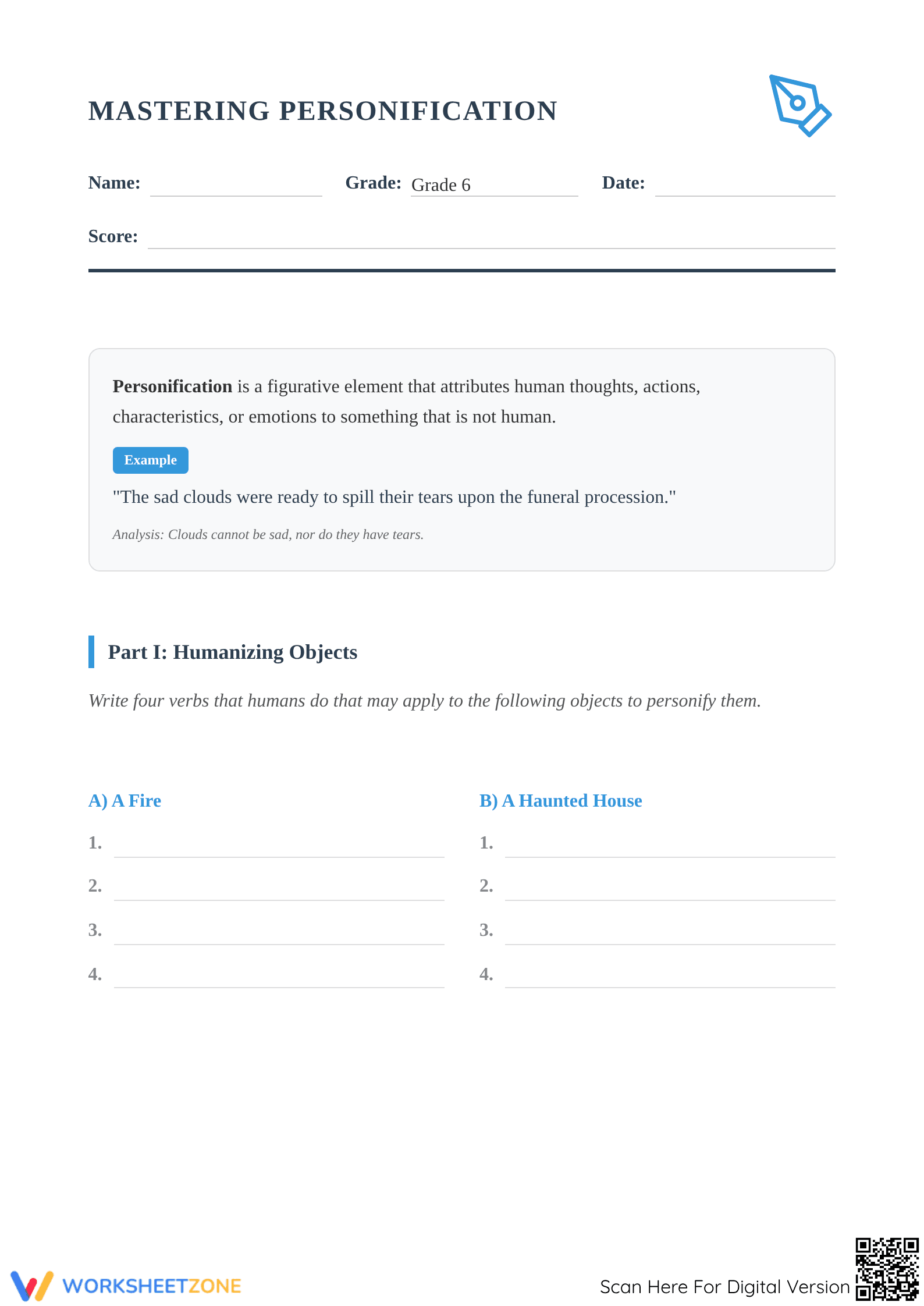
This Grade 6 personification worksheet helps students master figurative language by attributing human traits to non-human objects. Through a structured progression of writing and identification exercises, learners will develop a deeper understanding of how personification enhances creative writing and descriptive imagery.
At a Glance
- Grade: 6 · Subject: ELA
- Standard:
CCSS.ELA-LITERACY.L.6.5.A— Interpret figures of speech in context- Skill Focus: Personification
- Format: 3 pages · 15 problems · Answer key included · PDF
- Best For: Independent practice and creative writing
- Time: 25–35 minutes
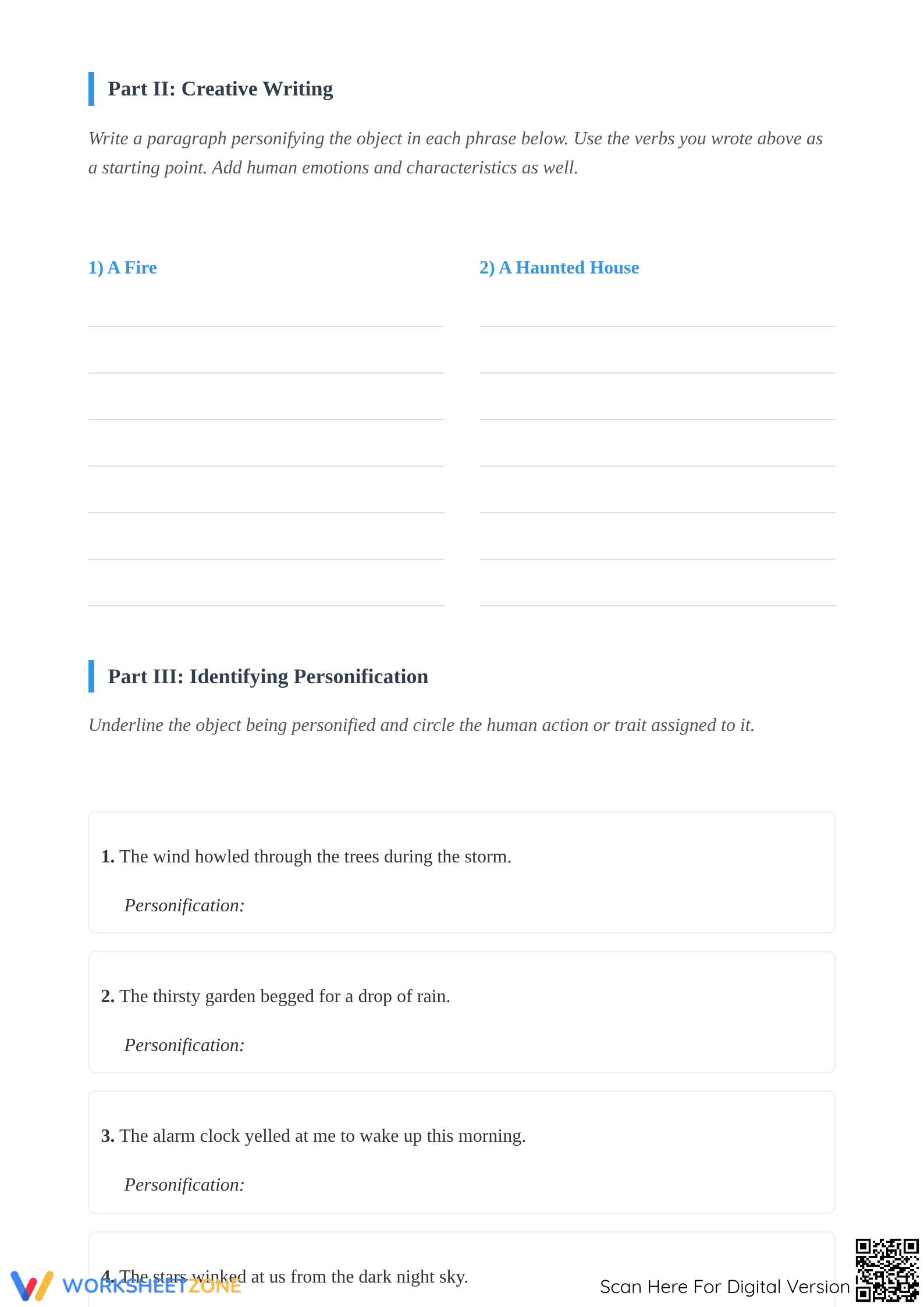
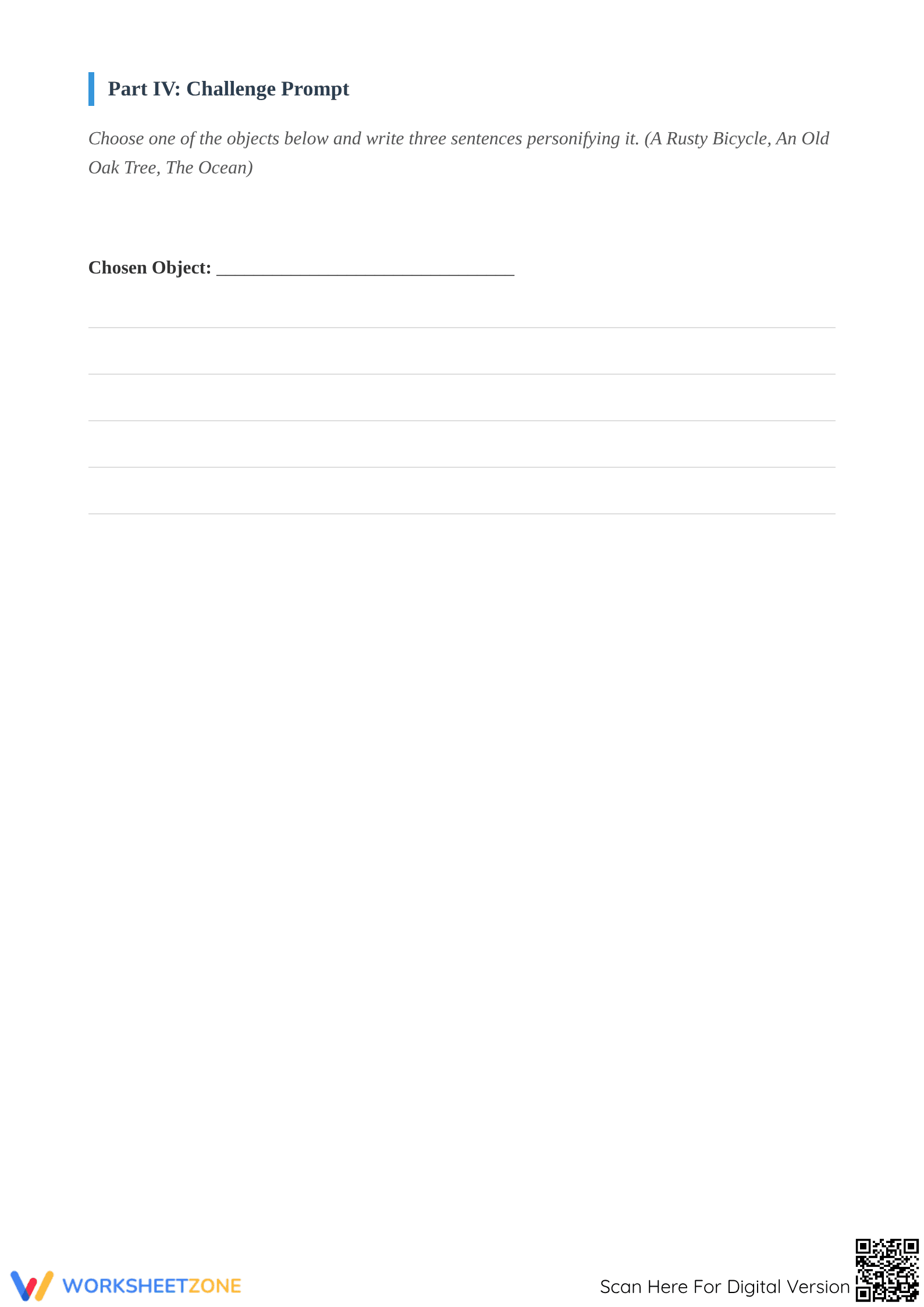
This comprehensive three-page packet includes a clear definition and worked example of personification to anchor student understanding. The resource features four distinct task types: brainstorming human verbs for inanimate objects, drafting creative paragraphs, identifying personification in context by underlining objects and circling human traits, and a final challenge prompt requiring original sentence generation. A complete answer key is provided to streamline grading.
- Guided practice: Students begin by brainstorming human verbs for specific objects (a fire, a haunted house), building foundational vocabulary with heavy scaffolding.
- Supported practice: Learners transition to writing short paragraphs and analyzing pre-written sentences to identify both the object and the human trait assigned to it.
- Independent practice: The final challenge prompt requires students to select an object and independently write three original sentences using personification.
This gradual-release approach ensures students confidently move from the "I Do" phase of reading examples to the "You Do" phase of independent creative writing.
This resource is strictly aligned to CCSS.ELA-LITERACY.L.6.5.A, requiring students to interpret figures of speech (e.g., personification) in context. It also supports broader writing standards by encouraging the use of descriptive details and sensory language. Both standard codes can be copied directly into lesson plans, IEP goals, or district curriculum mapping tools.
Deploy this worksheet during the middle of a figurative language unit, immediately following direct instruction on personification. It serves excellently as an independent practice station or a focused homework assignment. As a formative assessment tip, review the brainstorming section (Part I) before students move on to paragraph writing; if they struggle to list appropriate human verbs, provide a brief reteach using a familiar object like a car or a tree. Expect students to complete the entire packet in 25 to 35 minutes.
This resource is designed for sixth-grade ELA students developing their creative writing and literary analysis skills. The explicit examples and structured brainstorming make it highly accessible for students who need additional scaffolding, while the open-ended challenge prompt provides a natural extension for advanced writers. Pair this worksheet with a descriptive reading passage so students can immediately hunt for published examples of personification.
Mastering figurative language is a critical component of middle school literacy development. According to Fisher & Frey (2014), explicit instruction in literary devices, combined with structured, gradual-release practice, significantly improves students' reading comprehension and expressive writing capabilities. This resource directly targets CCSS.ELA-LITERACY.L.6.5.A, ensuring students can accurately interpret figures of speech in context. By requiring learners to both identify and generate personification, the worksheet bridges the gap between passive recognition and active application. Providing students with targeted opportunities to attribute human characteristics to non-human entities fosters deeper cognitive engagement with texts and enhances their overall descriptive vocabulary. This evidence-based approach ensures that learners build the necessary analytical skills to tackle complex literature and produce more sophisticated, engaging creative writing pieces throughout their academic careers.


