


























Views
Downloads
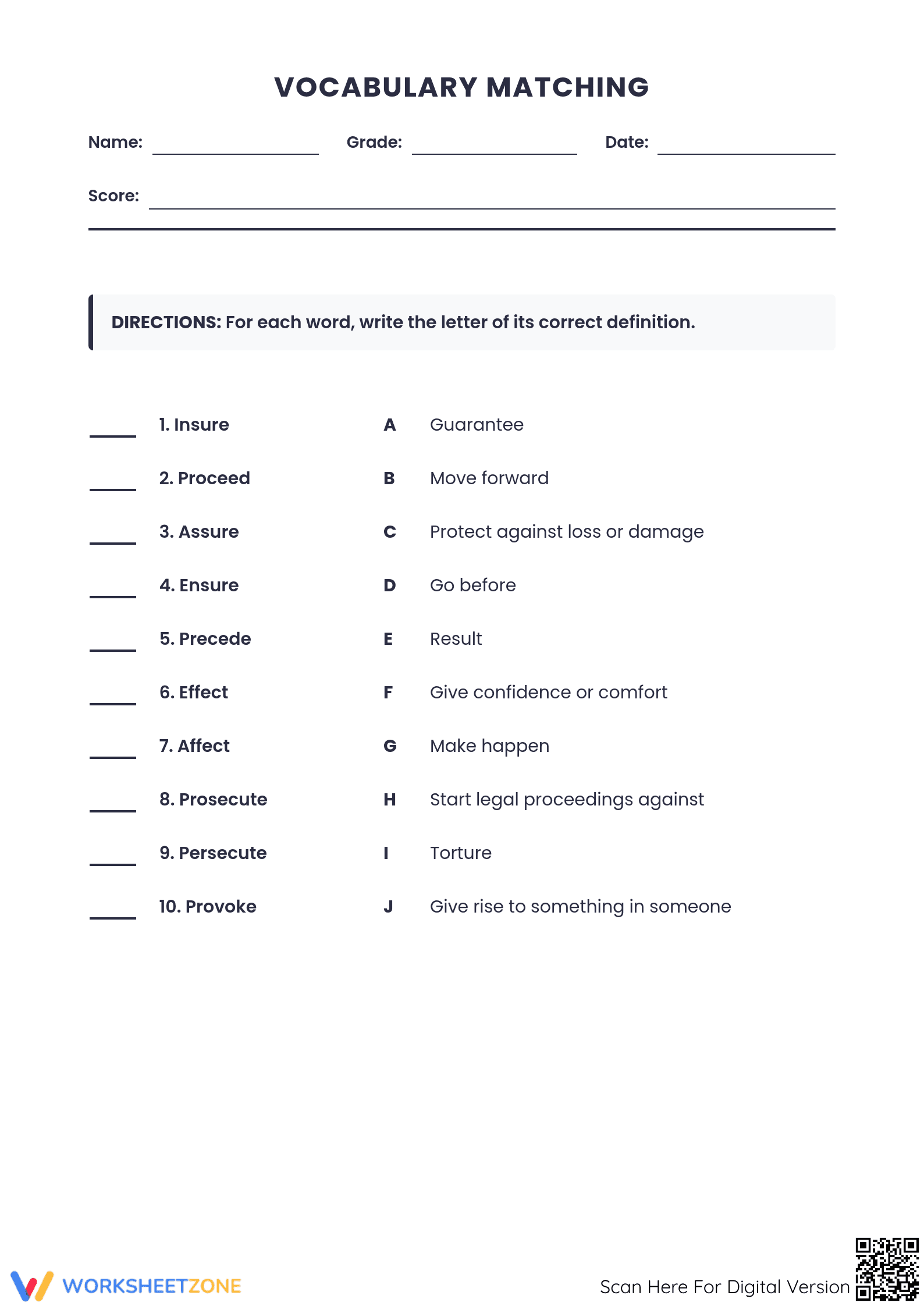

Grade 6 Vocabulary Matching | Essential Printable Practice
Paste this activity's link or code into your existing LMS (Google Classroom, Canvas, Teams, Schoology, Moodle, etc.).
Students can open and work on the activity right away, with no student login required.
You'll still be able to track student progress and results from your teacher account.
This Grade 6 vocabulary matching worksheet helps students distinguish between commonly confused words and refine their word choice. By matching 10 high-frequency terms to their precise definitions, learners build the linguistic precision required for middle school writing and reading comprehension. It provides a clear, focused path to mastering nuanced language differences.
At a Glance
- Grade: 6 · Subject: English Language Arts
- Standard:
CCSS.ELA-LITERACY.L.6.4— Determine or clarify the meaning of unknown and multiple-meaning words and phrases- Skill Focus: Vocabulary Acquisition & Precision
- Format: 1 page · 10 problems · Answer key included · PDF
- Best For: Quick assessment or bell-ringer activity
- Time: 10–15 minutes
This single-page PDF features a clean, distraction-free layout containing 10 vocabulary terms paired with a list of definitions. The word list includes challenging pairs such as "affect" vs. "effect" and "prosecute" vs. "persecute." A comprehensive answer key is provided to facilitate rapid grading or student self-correction.
Zero-Prep Workflow
- Print: Generate the single-page PDF in under 30 seconds for your entire class.
- Distribute: Hand out the worksheet as a focused warm-up or a quick exit ticket to gauge understanding.
- Review: Use the included answer key for a collective 1-minute review or individual grading.
This streamlined process ensures total teacher prep time remains under 2 minutes, making it an ideal choice for emergency sub plans or supplemental practice.
Standards Alignment
The worksheet aligns with CCSS.ELA-LITERACY.L.6.4, which requires students to determine or clarify the meaning of unknown and multiple-meaning words. It specifically addresses the nuances of word choice and definition accuracy. Both standard codes can be copied directly into lesson plans, IEP goals, or district curriculum mapping tools.
How to Use It
Assign this worksheet during the independent practice phase of a lesson on commonly confused words to check for individual understanding. Alternatively, use it as a formative assessment at the start of a unit to identify which word pairs require more direct instruction. Students typically complete the 10 matching tasks within 10 to 15 minutes.
Who It's For
This resource is tailored for Grade 6 students but serves as an excellent review for Grade 7 or a challenge for Grade 5. It is particularly helpful for English Language Learners (ELL) who need to distinguish between phonetically similar words. Pair this with a vocabulary anchor chart for additional support during the activity.
Research by Fisher & Frey (2014) emphasizes that vocabulary instruction is most effective when students are required to actively distinguish between similar terms rather than just memorizing isolated definitions. This worksheet supports that pedagogical approach by presenting 10 high-utility words, including homophones and near-homonyms, within a structured matching format. By aligning with CCSS.ELA-LITERACY.L.6.4, the resource ensures that Grade 6 students develop the precise word knowledge necessary for complex text analysis. Studies from EdReports 2024 indicate that frequent, low-stakes practice with academic vocabulary significantly improves long-term retention and application in student writing. This printable tool provides that essential practice in a concise, 1-page format that fits easily into any ELA curriculum. The inclusion of an answer key allows for immediate feedback, which is a critical component of the gradual release of responsibility model in literacy instruction.


