




























Views
Downloads

Grade 3 Weather Forecast Worksheet | Essential Science

Paste this activity's link or code into your existing LMS (Google Classroom, Canvas, Teams, Schoology, Moodle, etc.).
Students can open and work on the activity right away, with no student login required.
You'll still be able to track student progress and results from your teacher account.
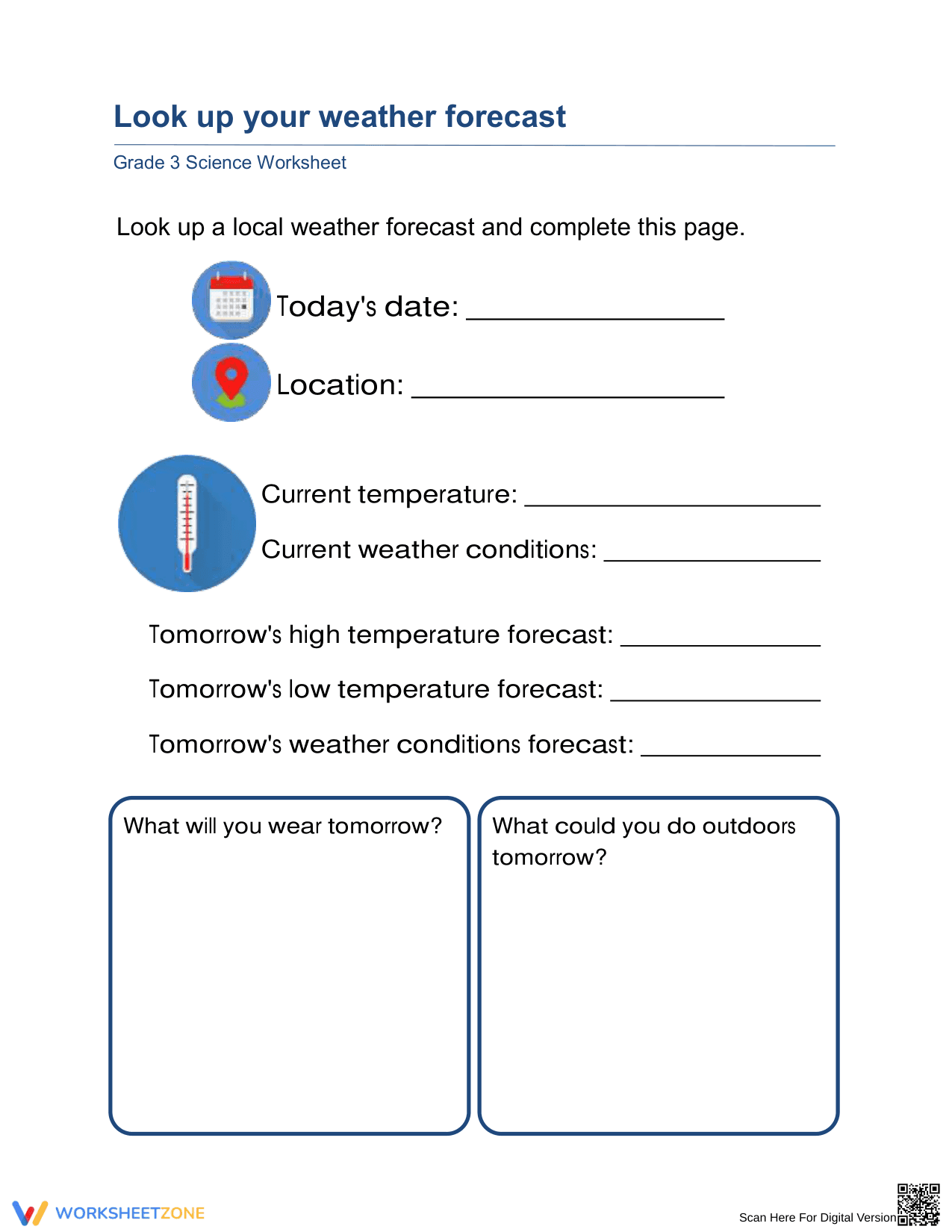
This Grade 3 weather forecast worksheet enables students to actively engage with meteorology by recording and interpreting local atmospheric data. By connecting current conditions with future predictions, learners develop a practical understanding of how weather impacts daily decision-making regarding clothing and outdoor safety. This activity bridges scientific observation and real-world application.
At a Glance
- Grade: 3 · Subject: Science
- Standard:
3-ESS2-1— Represent data in tables to describe typical weather conditions- Skill Focus: Meteorological Data Collection and Predictive Analysis
- Format: 1 comprehensive page · 8 data recording tasks · Answer key not applicable · PDF
- Best For: Independent practice, science centers, or homework
- Time: 15–20 minutes of recording and analysis
What's Inside
This single-page recording sheet features a structured layout designed for student independence. It includes dedicated sections for documenting the date and location, followed by technical fields for current temperature and conditions. The second half focuses on future-casting, requiring students to find tomorrow's high and low temperatures. Two integrative boxes prompt students to apply this data by choosing appropriate attire and outdoor activities.
Zero-Prep Workflow
The zero-prep workflow for this resource ensures immediate classroom utility. First, print the single-page PDF (30 seconds) and ensure students have access to a reliable local weather source. Second, distribute the sheets and have students spend 10 minutes recording their observations and tomorrow's predictions. Finally, spend 5 minutes reviewing responses as a group to discuss how temperatures influence daily choices, requiring zero teacher setup time.
Standards Alignment
Aligned to the Next Generation Science Standard 3-ESS2-1, this worksheet focuses on representing data to describe typical weather conditions. Students practice the foundational skill of obtaining and combining information from various sources to describe current and future weather states. This standard code can be copied directly into lesson plans, IEP goals, or district curriculum mapping tools to ensure rigorous alignment with national frameworks.
How to Use It
Use this worksheet as a formative assessment during a unit on Earth's systems or as a recurring "Weather Watcher" activity. It works exceptionally well as a morning work task or a homework assignment that connects school learning to the home environment. Teachers should observe if students can accurately distinguish between current and forecasted predictions to gauge their understanding of temporal data sets in science.
Who It's For
This resource is designed for third-grade students but is adaptable for second-grade learners requiring support or fourth-grade review. It is ideal for general education, English Language Learners who benefit from visual cues, and students with IEPs needing structured data entry. Pair this worksheet with a national weather map for a comprehensive hands-on science lesson.
According to a ScienceDirect TpT Analysis of primary science education, the use of structured data-recording sheets significantly improves retention of meteorological concepts compared to abstract lectures. This Grade 3 Science resource aligns with 3-ESS2-1 by requiring students to represent data in a table-like format to describe expected weather conditions. By identifying specific variables such as high/low temperatures and atmospheric conditions, students build the cognitive scaffolds necessary for later understanding of climate patterns and seasonal changes. The inclusion of open-ended application questions—relating weather to clothing and activities—supports the development of scientific literacy and critical thinking skills. This worksheet serves as a reliable instrument for evidence-based instruction, ensuring that learners meet the rigorous demands of national standards while participating in an engaging, zero-prep activity that is immediately applicable to their daily lives and local environment.


