


























Views
Downloads

Reducing Resources Worksheet | Essential Grade 3 Science
Paste this activity's link or code into your existing LMS (Google Classroom, Canvas, Teams, Schoology, Moodle, etc.).
Students can open and work on the activity right away, with no student login required.
You'll still be able to track student progress and results from your teacher account.
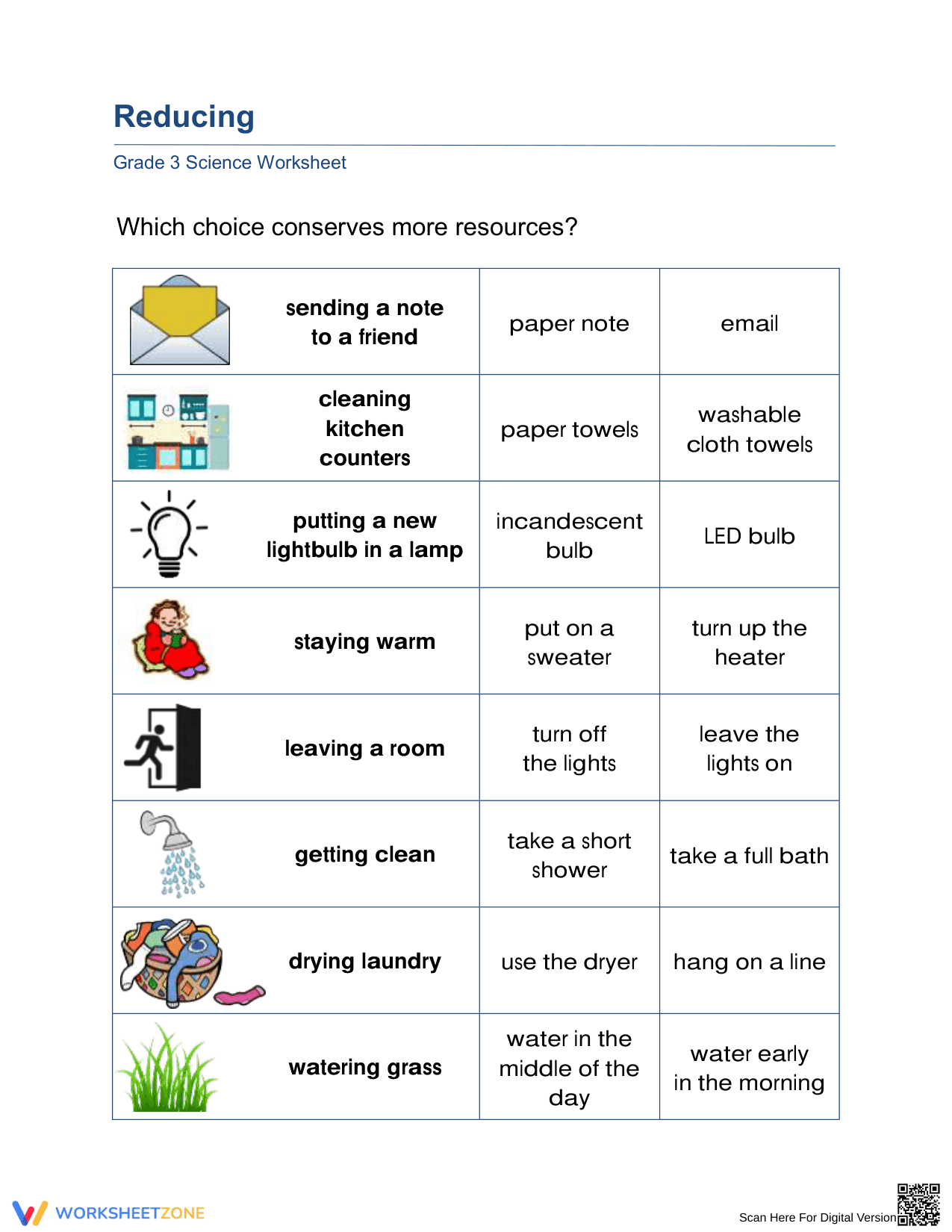
Help students understand resource conservation through practical, everyday choices. This worksheet focuses on the "Reduce" component of the Three Rs, challenging third-graders to evaluate eight scenarios and determine which action has a smaller environmental footprint. It is an effective tool for building environmental awareness and critical thinking skills during science units.
At a Glance
- Grade: 3 · Subject: Science
- Standard:
3-LS4-4— Evaluate the merit of solutions that help protect environments and natural resources- Skill Focus: Natural Resource Conservation & Reducing Waste
- Format: 1 page · 8 problems · Answer key included · PDF
- Best For: Individual practice or small group discussion
- Time: 15–20 minutes
What's Inside
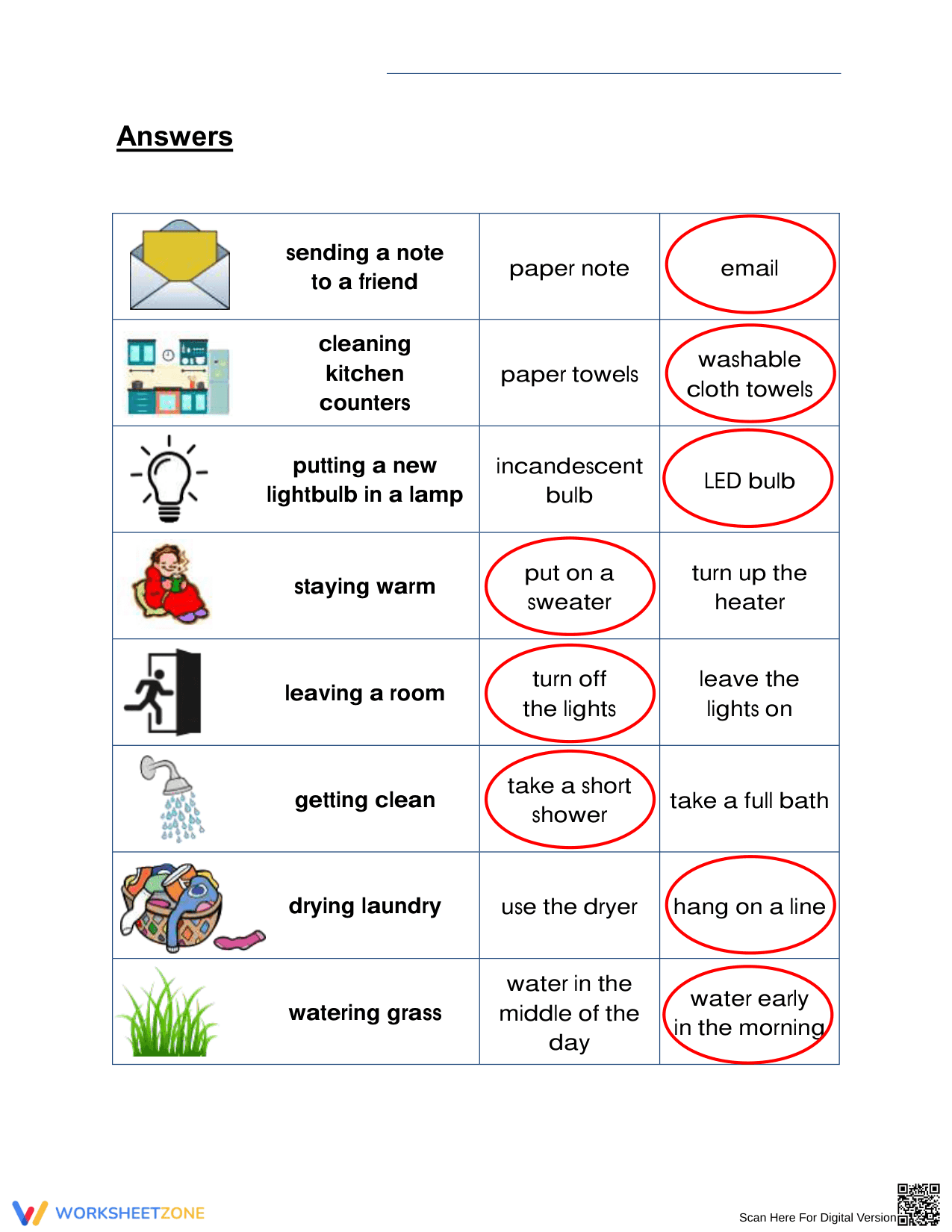
This single-page PDF features a clear layout with eight scenarios paired with visual icons. Students compare two distinct choices—such as paper towels versus cloth towels or incandescent versus LED bulbs—to identify the sustainable option. The visual cues support comprehension for diverse learners, and the included answer key ensures quick grading. Total task count is manageable for a single session.
Zero-Prep Workflow
This resource is designed for immediate integration. Simply print the worksheet (under 30 seconds), distribute it (1 minute), and facilitate a review (5 minutes) to discuss why specific choices conserve resources. The preparation cycle takes under two minutes, making it an ideal emergency sub plan or supplemental ecology activity. No teacher setup is required beyond basic printing and distribution.
Standards Alignment
Aligned to `3-LS4-4`, which requires students to evaluate the merit of environmental solutions. By choosing options like "take a short shower" versus "full bath," students evaluate small-scale solutions that reduce human impact on Earth’s systems. Standard codes can be copied directly into lesson plans, IEP goals, or curriculum mapping tools to ensure all instructional minutes are standards-aligned.
How to Use It
Use this worksheet during the "Explain" phase of a 5E lesson or as a warm-up activity for an ecology unit. It serves as a great formative assessment tool; observe if students struggle with technical comparisons, like lightbulb types, to identify where additional instruction is needed. Completion typically takes 15 to 20 minutes, including time for classroom discussion and reflection.
Who It's For
This resource is tailored for third-grade students exploring environmental science. It is helpful for visual learners and can be differentiated by pairing it with an anchor chart on the Three Rs. It naturally pairs with a reading passage on climate change or a hands-on waste audit. Suitable for English language learners due to the high-quality icon support provided.
Research highlights that integrating real-world scenarios into science instruction improves student retention. According to a ScienceDirect TpT Analysis, worksheets emphasizing decision-making—like choosing between lightbulb types—help bridge the gap between ecological theories and personal responsibility. This Grade 3 Science resource aligns with 3-LS4-4, focusing on identifying merit in environmental solutions. By evaluating eight scenarios, students move toward an applied understanding of resource conservation. Visual scaffolds ensure accessibility while maintaining standard rigor. This approach follows the Fisher & Frey (2014) model of gradual release, providing a structured framework to examine human impact through evidence-based choices. Such targeted practice is essential for mastery of natural resource stewardship as students learn to minimize waste in their daily lives. The specific focus on 'reducing' as a primary conservation strategy provides a concrete foundation for broader environmental literacy across the elementary science curriculum.


