


























Views
Downloads
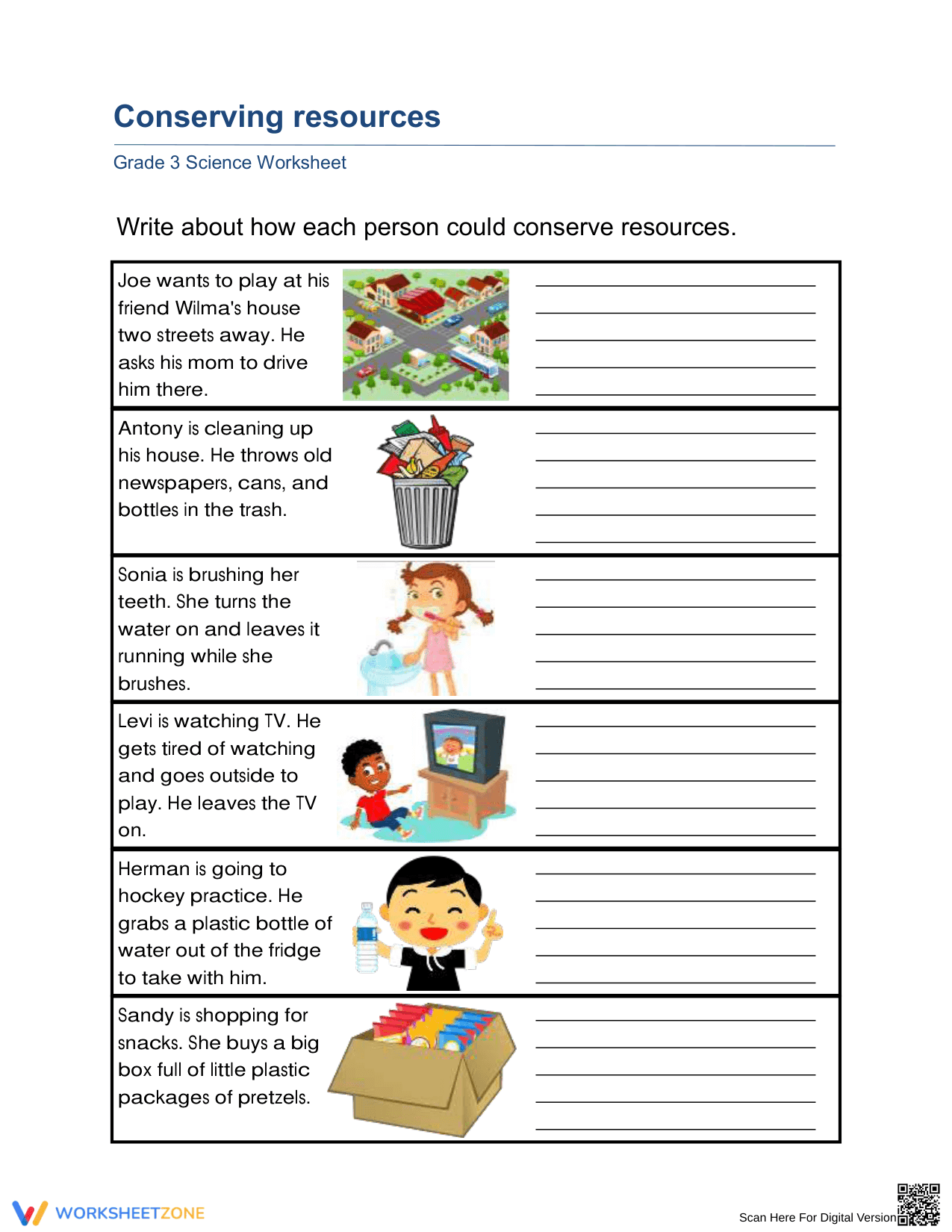

Grade 3 Conserving Resources — Printable No-Prep Worksheet
Paste this activity's link or code into your existing LMS (Google Classroom, Canvas, Teams, Schoology, Moodle, etc.).
Students can open and work on the activity right away, with no student login required.
You'll still be able to track student progress and results from your teacher account.
This Grade 3 science worksheet empowers students to identify and explain practical solutions for environmental conservation. By analyzing six real-world scenarios, learners apply the principles of reducing, reusing, and recycling to improve sustainability in daily life. This activity ensures students understand the human impact on Earth's resources and develop critical thinking skills.
At a Glance
At a Glance
- Grade: 3 · Subject: Science
- Standard:
3-LS4-4— Make a claim about the merit of a solution to environmental problems- Skill Focus: Resource conservation and sustainability
- Format: 1 page · 6 problems · Answer key included · PDF
- Best For: Individual practice or science center activity
- Time: 15–20 minutes
What's Inside
This focused resource contains a single-page worksheet featuring six distinct scenarios involving common household activities like brushing teeth, grocery shopping, and commuting. Each scenario is paired with a vivid illustration and dedicated writing lines, providing students with structured space to draft their conservation recommendations. A comprehensive answer key is included to facilitate quick grading or self-correction.
Zero-Prep Workflow
The Zero-Prep Workflow is designed for maximum efficiency. First, print the single-page PDF (30 seconds). Second, distribute the materials to your science class (1 minute). Third, review student work using the comprehensive answer key (5 minutes). Total teacher prep time is under 2 minutes, making this an excellent choice for sub plans or emergency science centers.
Standards Alignment
The content is rigorously aligned to `3-LS4-4`, which requires students to evaluate the merit of solutions to environmental challenges. By proposing ways to conserve water, reduce plastic waste, and save energy, students demonstrate their ability to conceptualize and justify sustainable interventions. Both standard codes can be copied directly into lesson plans, IEP goals, or district curriculum mapping tools.
How to Use It
Use this worksheet as a formative assessment following a direct instruction lesson on the 3 R's. It works exceptionally well as a collaborative partner activity where students debate the most effective conservation method for each character. Observe whether students can distinguish between reducing at the source versus recycling after use to gauge depth of understanding. The activity is expected to take approximately 20 minutes for most third-grade learners.
Who It's For
This resource is ideal for third-grade students exploring Earth science and human impact. It provides necessary scaffolding for English Language Learners through visual cues and familiar contexts. For advanced learners, pair this worksheet with a short reading passage on climate change or a local recycling guide to extend the conversation into community-wide action.
Research from EdReports 2024 emphasizes that high-quality science instruction must integrate real-world problem-solving to build lasting environmental literacy. This worksheet aligns with those findings by requiring students to move beyond simple definitions and instead apply the 3-LS4-4 standard to tangible scenarios like water conservation and waste reduction. By evaluating the merit of different conservation solutions across 6 specific tasks, students develop the analytical framework necessary for scientific inquiry and citizenship. The inclusion of visual scaffolds ensures that the plain-English skill of identifying sustainable habits remains accessible to all learners, supporting the gradual release of responsibility model described by Fisher & Frey (2014). Such structured practice is essential for meeting the rigor of modern science frameworks while ensuring students can articulate the reasoning behind resource management decisions in their own communities.


