


























Views
Downloads
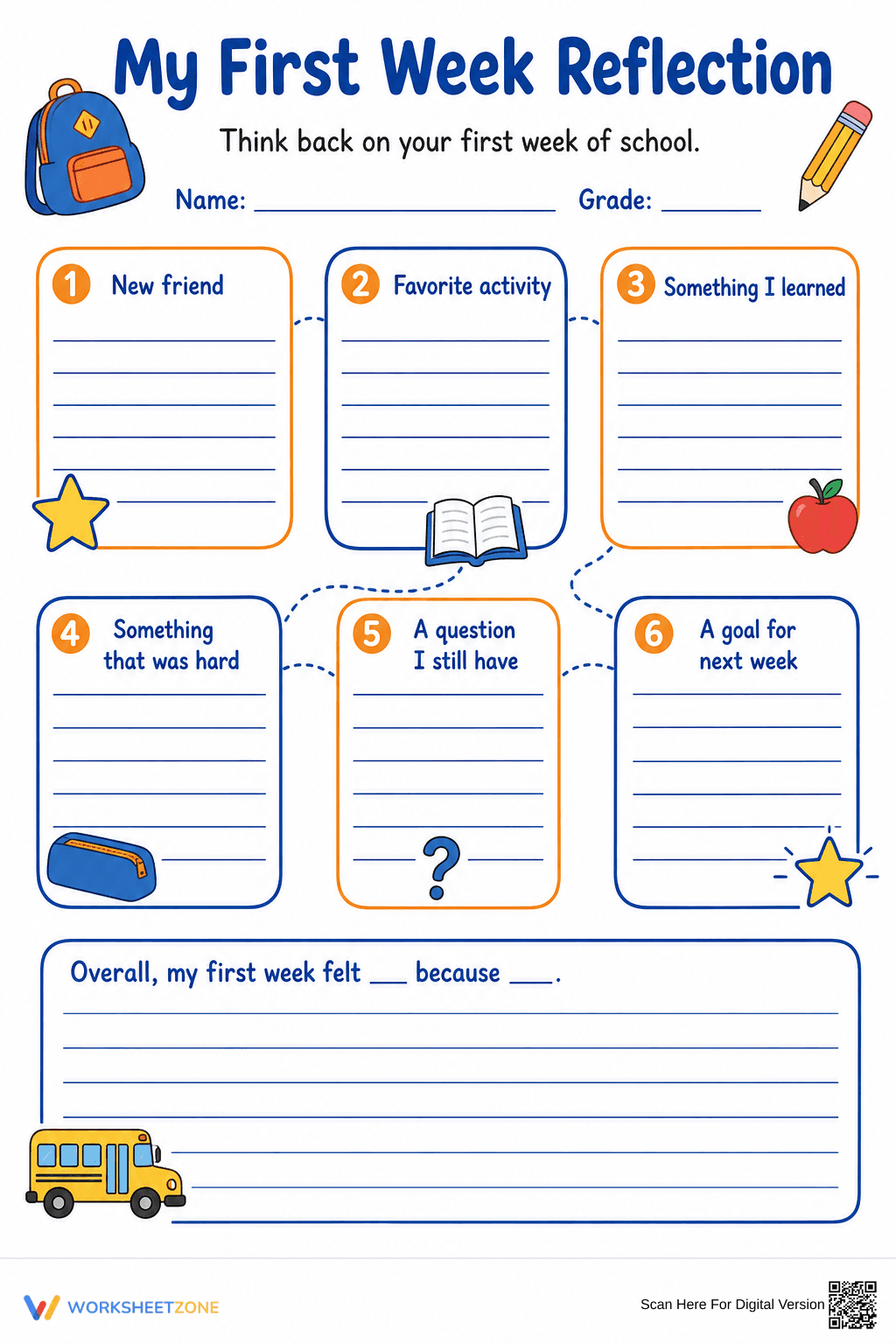

Grade 3 First Week Reflection — Printable No-Prep Worksheet
Paste this activity's link or code into your existing LMS (Google Classroom, Canvas, Teams, Schoology, Moodle, etc.).
Students can open and work on the activity right away, with no student login required.
You'll still be able to track student progress and results from your teacher account.
This Grade 3 first week reflection worksheet helps students process their back-to-school experiences through structured writing prompts. By completing seven targeted reflection tasks, learners articulate their feelings, identify new friendships, and set actionable goals for the upcoming week in a supportive, engaging format.
At a Glance
- Grade: 3 · Subject: ELA
- Standard:
CCSS.ELA-LITERACY.W.3.10— Write routinely for a range of tasks and purposes- Skill Focus: Personal reflection and goal setting
- Format: 1 page · 7 problems · No answer key · PDF
- Best For: Back-to-school morning work
- Time: 15–20 minutes
Inside this single-page resource, educators will find a highly visual reflection map featuring six distinct prompt boxes and one summarizing sentence frame. The prompts guide students to write about a new friend, a favorite activity, something they learned, a challenge they faced, a lingering question, and a goal for the next week. Because responses are entirely personal, no answer key is required.
This resource is designed for immediate classroom implementation with a streamlined zero-prep workflow:
- Print (1 minute): Simply download the PDF and print a class set.
- Distribute (1 minute): Hand out the worksheets during morning meeting or as a transition activity. The intuitive design requires minimal explanation.
- Review (0 minutes): Students complete the reflection independently. Teachers can collect these to read later, requiring zero immediate grading time.
Total teacher prep time is under two minutes, making this an excellent option for emergency sub plans or busy Friday afternoons.
This activity aligns with CCSS.ELA-LITERACY.W.3.10, which requires students to write routinely over extended time frames and shorter time frames for a range of discipline-specific tasks, purposes, and audiences. It also supports social-emotional learning objectives by encouraging self-awareness and self-management. Both standard codes can be copied directly into lesson plans, IEP goals, or district curriculum mapping tools.
Teachers can utilize this worksheet as a quiet Friday afternoon wrap-up activity at the end of the first week, allowing students to decompress and process their transition back to school. Alternatively, it serves as an excellent morning work assignment for the start of the second week. As a formative assessment observation tip, teachers can review the "Something that was hard" and "A question I still have" boxes to identify students who might need extra emotional or academic support. Expected completion time ranges from 15 to 20 minutes.
This resource is primarily designed for third-grade students, though the accessible language and visual supports make it highly appropriate for fourth through sixth graders as well. The structured boxes and sentence frames provide built-in differentiation for English Language Learners or students who struggle with open-ended journaling. It pairs perfectly with a whole-class read-aloud about first-day jitters or a morning meeting discussion about classroom community.
Integrating structured reflection into the early weeks of the academic year significantly impacts student engagement and classroom climate. This activity targets CCSS.ELA-LITERACY.W.3.10, focusing on the ability to write routinely for a range of tasks and purposes. According to a recent EdReports 2024 analysis, providing students with dedicated time to articulate their academic and social-emotional experiences fosters greater self-efficacy and helps establish a supportive learning environment. By prompting learners to identify both successes and challenges, educators can proactively address student needs before they escalate. This specific reflection framework encourages metacognition, allowing young writers to process their transition back to school while simultaneously practicing foundational expressive writing skills. Regular implementation of such reflective practices builds a foundation for continuous goal setting and personal growth throughout the entire school year.


