


























Views
Downloads

Printable Weather Hazards Cause & Effect Worksheet | Grade 3
Paste this activity's link or code into your existing LMS (Google Classroom, Canvas, Teams, Schoology, Moodle, etc.).
Students can open and work on the activity right away, with no student login required.
You'll still be able to track student progress and results from your teacher account.
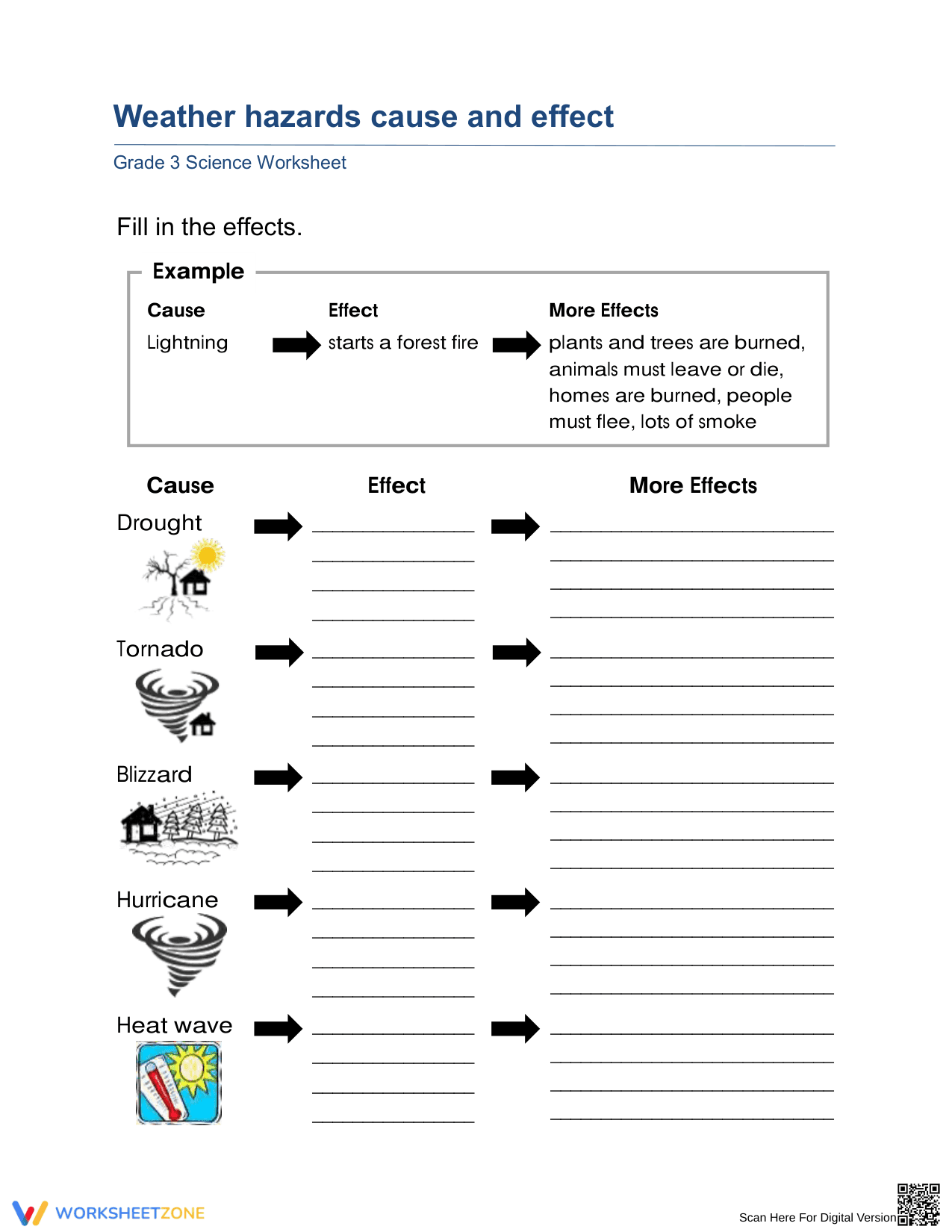
This Grade 3 science worksheet provides a structured framework for students to analyze the relationship between extreme weather events and their environmental impacts. By examining specific hazards like tornadoes and blizzards, learners develop a deeper understanding of how natural forces shape our world and affect living things. It is an essential tool for building scientific literacy.
At a Glance
- Grade: 3 · Subject: Science
- Standard:
3-ESS3-1— Identify impacts of weather-related hazards and how they affect the environment- Skill Focus: Cause and Effect in Weather
- Format: 2 pages · 5 tasks · Answer key included · PDF
- Best For: Independent practice or formative assessment
- Time: 15–20 minutes
What's Inside
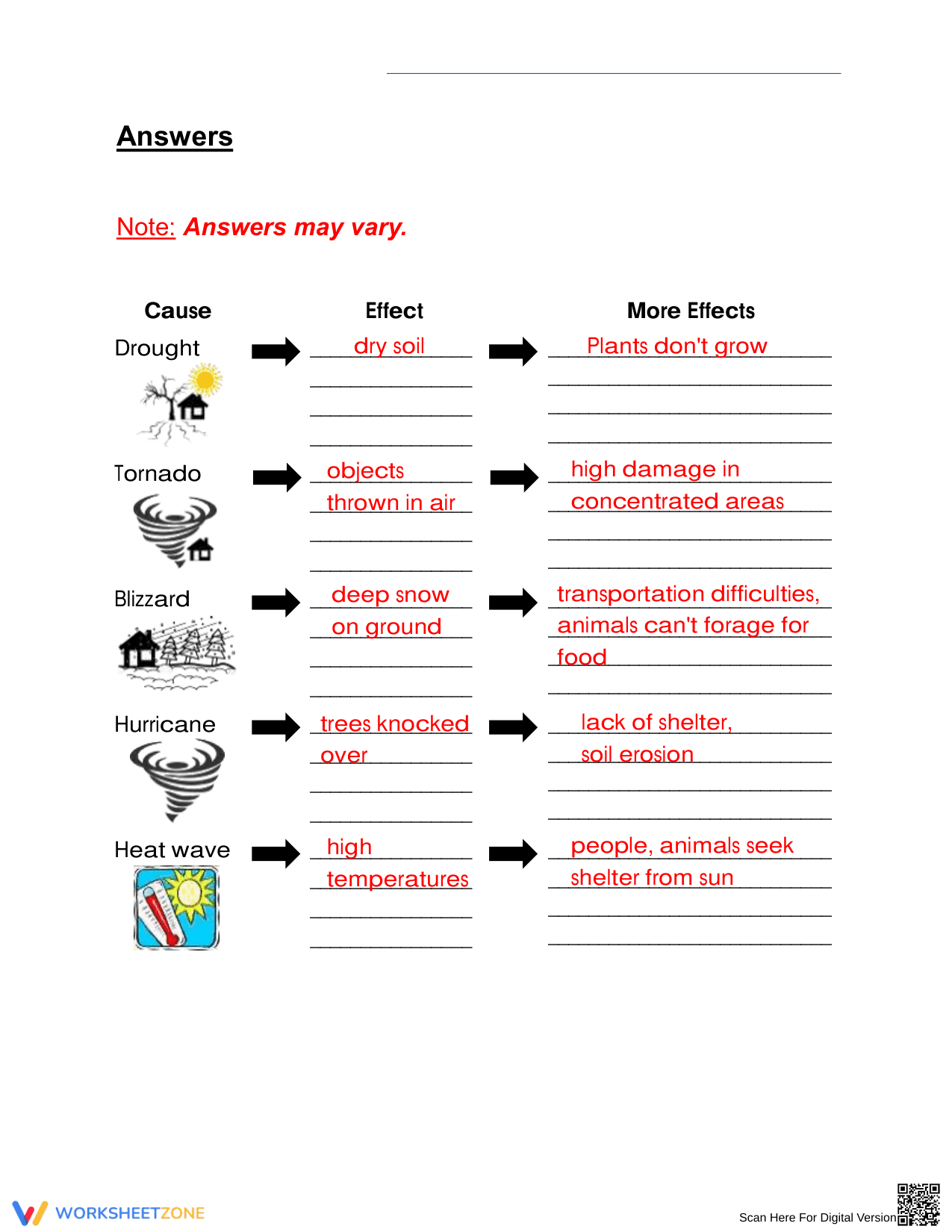
The worksheet features a clean, two-page layout with a practice sheet and a comprehensive answer key. Students fill in effects for five hazards: Drought, Tornado, Blizzard, Hurricane, and Heat Wave. Visual icons support engagement. A worked example for Lightning ensures students understand the multi-layered thinking required for the task.
Zero-Prep Workflow
Implementing this resource requires minimal teacher effort. Print the student page in seconds. Distribute the worksheets during your weather unit. Review responses using the provided answer key, which lists potential answers to accommodate diverse student observations. This streamlined process makes it an ideal choice for substitute lesson plans or quick check-ins during busy instructional blocks.
Standards Alignment
This resource is directly aligned to 3-ESS3-1, which asks students to make claims about the merit of solutions that reduce the impacts of weather-related hazards. By first mastering the identification of these impacts, students build the prerequisite knowledge needed for higher-order engineering tasks. This standard code can be copied directly into lesson plans, IEP goals, or district curriculum mapping tools to ensure rigorous instructional alignment.
How to Use It
Use this worksheet as a formative assessment after introducing severe weather. Have students work independently to recall specific environmental impacts. Alternatively, use it as a collaborative brainstorming activity where pairs discuss the chain of events following a blizzard or drought. Observe if students can distinguish between immediate physical damage and longer-term consequences.
Who It's For
Designed for third-grade students, this worksheet is also suitable for second-grade enrichment. It supports diverse learners through visual cues and a clear structure. Pair this resource with a weather-themed passage or anchor chart to provide additional scaffolding for students who need help generating multiple effects for each cause.
The Grade 3 Weather Hazards Cause and Effect worksheet is built on the instructional principle that identifying causal relationships is fundamental to scientific inquiry. According to RAND AIRS 2024, utilizing structured graphic organizers like cause-and-effect tables significantly improves student retention of complex environmental concepts in early elementary science. This worksheet aligns with the Next Generation Science Standards (NGSS) 3-ESS3-1, which emphasizes understanding the impacts of natural hazards on human and ecological systems. By requiring students to list both primary and secondary effects, the resource encourages the development of systems thinking, a core competency highlighted in recent NAEP science frameworks. Providing an answer key that acknowledges "answers may vary" respects the qualitative nature of environmental observation while maintaining academic rigor. This printable resource serves as a reliable benchmark for evaluating student mastery of weather-related impact analysis within a comprehensive Earth science curriculum.


