


























Views
Downloads
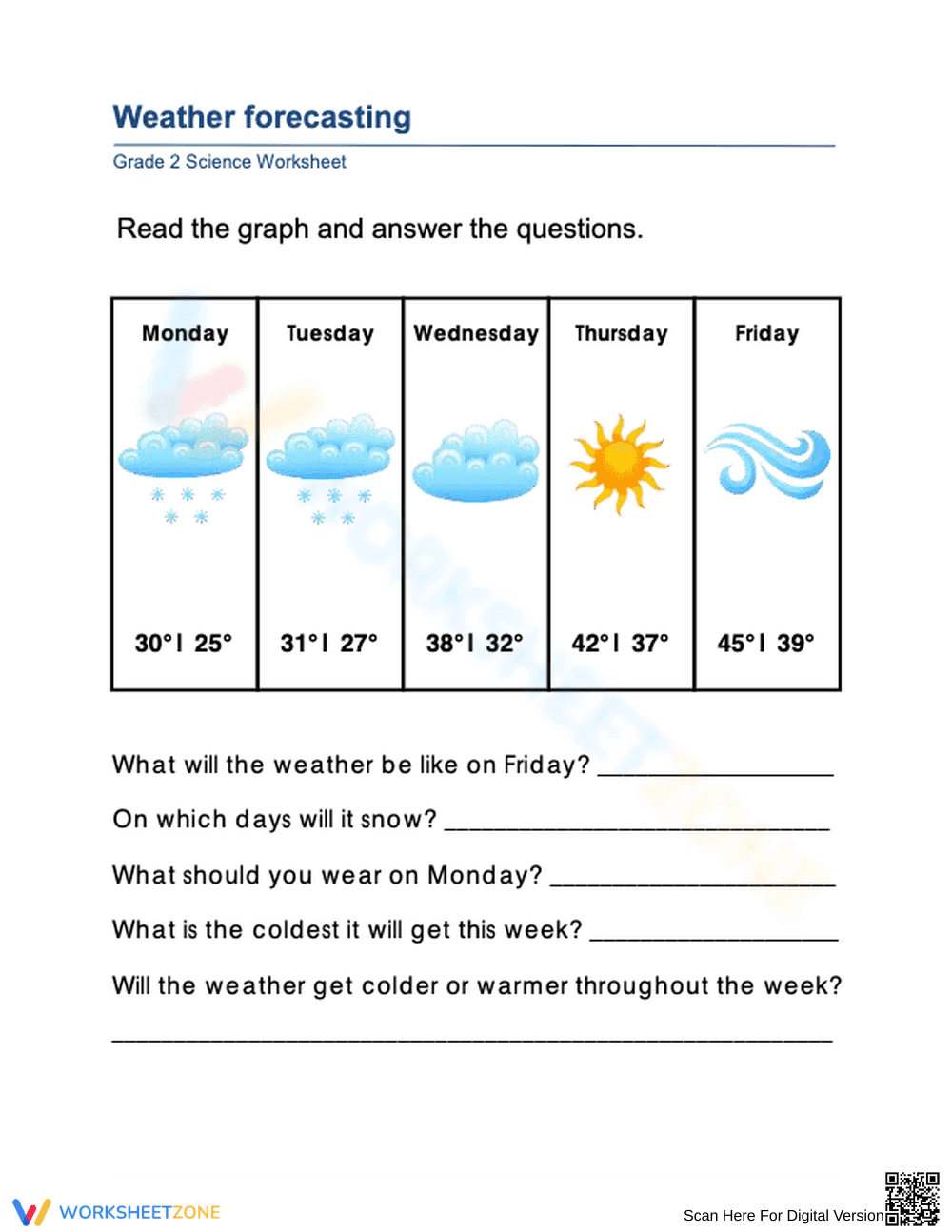

Grade 2 Weather Forecasting Worksheet — Essential Science
Paste this activity's link or code into your existing LMS (Google Classroom, Canvas, Teams, Schoology, Moodle, etc.).
Students can open and work on the activity right away, with no student login required.
You'll still be able to track student progress and results from your teacher account.
This Grade 2 weather forecasting worksheet empowers students to interpret meteorological data through a structured visual graph. By analyzing daily symbols and temperature ranges, learners develop critical observational skills necessary to predict atmospheric changes. This resource ensures students can identify weather patterns and make informed decisions about appropriate clothing and safety based on forecasted conditions.
At a Glance
- Grade: 2 · Subject: Science
- Standard:
2-ESS2-1— Analyze and interpret data to describe weather patterns and environmental changes- Skill Focus: Data interpretation and weather prediction
- Format: 2 pages · 5 problems · Answer key included · PDF
- Best For: Independent practice or quick formative assessment
- Time: 15–20 minutes
What's Inside
This resource consists of a two-page PDF. The first page features a high-contrast weather forecast table covering Monday through Friday, displaying icons for snow, sun, and wind alongside high and low temperature readings. Below the graph, five targeted comprehension questions challenge students to extract specific data points and infer trends. The second page provides a complete answer key for rapid grading and immediate feedback.
Zero-Prep Workflow
- Print: Generate a single-sided student page in under 30 seconds for your entire class.
- Distribute: Hand out the worksheets for immediate individual or partner analysis.
- Review: Use the included answer key to conduct a whole-class review in less than 2 minutes.
This streamlined approach makes it an ideal choice for emergency sub plans or science bell-ringers.
Standards Alignment
This worksheet aligns with 2-ESS2-1, which focuses on comparing multiple solutions designed to slow or prevent wind or water from changing the shape of the land. By analyzing wind symbols and temperature shifts, students build the foundational understanding of Earth's systems and atmospheric forces. This standard code can be copied directly into lesson plans, IEP goals, or district curriculum mapping tools.
How to Use It
Use this worksheet as a concluding activity during a unit on Earth's systems to evaluate a student's ability to read scientific tables. It also works effectively as a formative-assessment tool by observing if students can correctly distinguish between high and low temperatures. Expect students to complete the analysis in approximately 15 minutes during a science rotation or as a targeted homework assignment.
Who It's For
This resource is designed for Grade 2 students but is also appropriate for Grade 1 enrichment or Grade 3 review. It supports English Language Learners through the use of clear, universal weather symbols and provides enough white space for students with dysgraphia. It pairs naturally with a classroom weather station or a daily calendar routine where students record local observations.
Research from the RAND AIRS 2024 report emphasizes that early exposure to data visualization in primary science significantly improves long-term scientific literacy. This worksheet addresses the 2-ESS2-1 standard by requiring students to interpret weather patterns, specifically focusing on the skill of extracting and comparing atmospheric data from a structured forecast. By engaging with 5 distinct problems that range from simple identification to trend analysis, students move beyond rote memorization toward authentic scientific inquiry. The inclusion of temperature gradients and symbolic representations allows for a multi-modal learning experience that caters to diverse learner profiles. Teachers can utilize this printable to verify mastery of Earth system concepts while ensuring that students meet state-mandated science objectives. This approach aligns with modern pedagogical standards that prioritize evidence-based reasoning and the ability to synthesize information from non-prose texts, providing a robust foundation for more complex meteorological studies in later grades.


