


























Views
Downloads
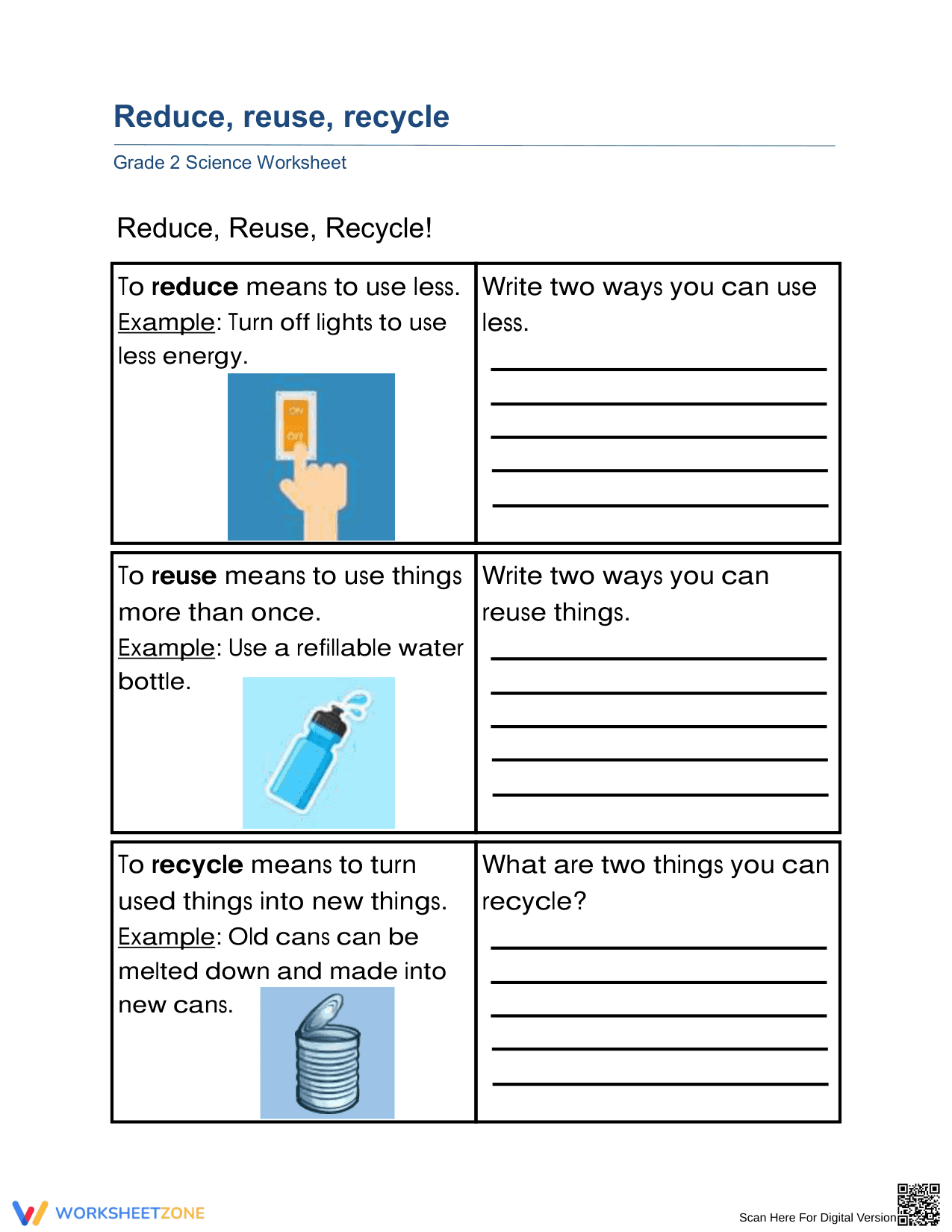

Essential Grade 2 Reduce, Reuse, Recycle Worksheet
Paste this activity's link or code into your existing LMS (Google Classroom, Canvas, Teams, Schoology, Moodle, etc.).
Students can open and work on the activity right away, with no student login required.
You'll still be able to track student progress and results from your teacher account.
This Grade 2 science worksheet helps students master the fundamental concepts of conservation by defining and applying the three Rs: Reduce, Reuse, and Recycle. Students learn the distinction between these actions through clear definitions and relatable examples. By identifying practical ways to conserve resources, learners develop a foundational understanding of environmental stewardship and human impact on the Earth.
At a Glance
- Grade: 2 · Subject: Science
- Standard:
2-ESS3-1— Make choices that reduce human impact on the land, water, and air- Skill Focus: Environmental Conservation (Reduce, Reuse, Recycle)
- Format: 1 page · 3 problems · Answer key included · PDF
- Best For: Independent practice or environmental science introduction
- Time: 15–20 minutes
This single-page resource features three distinct sections dedicated to the core principles of waste management. Each section provides a student-friendly definition, a visual aid, and a concrete example to anchor the concept. Students are tasked with generating their own unique examples for reducing usage, reusing items, and identifying recyclable materials. The layout is clean and spacious, providing ample room for young learners to write their responses. A complete answer key is provided for quick and accurate grading.
The workflow for this resource is designed for maximum teacher efficiency. Teachers can print the PDF in under 30 seconds and distribute it immediately to the class without any supplementary materials or complex instructions. Since the worksheet is self-explanatory and includes guided examples, students can begin working immediately, requiring less than 2 minutes of teacher-led orientation. This makes it an ideal choice for emergency sub plans or quick formative assessments during a busy science unit.
This resource is directly aligned with `2-ESS3-1`, which requires students to understand how human actions affect the environment and make choices to reduce their impact. By identifying specific actions like using less energy or reusing water bottles, students demonstrate their ability to apply conservation strategies in real-world contexts. Both standard codes can be copied directly into lesson plans, IEP goals, or district curriculum mapping tools.
Use this worksheet as a concluding activity during a lesson on Earth's resources to check for individual understanding. It serves as an effective formative assessment tool; as students work, observe if they can distinguish between "reusing" (keeping the item as is) and "recycling" (turning it into something new). This typically takes 15 to 20 minutes to complete, making it a perfect transition activity between direct instruction and independent centers.
The worksheet is specifically designed for Grade 2 students but is appropriate for Grade 1 or Grade 3 learners depending on their reading level and prior exposure to environmental topics. It provides excellent support for English Language Learners through the use of visual icons and sentence-level definitions. This resource pairs naturally with a classroom read-aloud about sustainability or an anchor chart displaying common household items that can be recycled.
According to RAND AIRS 2024 analysis, effective primary science instruction must bridge the gap between abstract environmental concepts and daily student actions. This Grade 2 worksheet achieves this by focusing on the Three Rs—reduce, reuse, and recycle—as concrete behaviors that mitigate human impact on Earth's systems. By prompting students to generate specific examples for each conservation category, the resource reinforces the conceptual framework of `2-ESS3-1` through active retrieval and application. Research from Fisher & Frey (2014) emphasizes that such structured practice, when paired with clear definitions and visual scaffolds, significantly improves long-term retention of scientific vocabulary in early elementary learners. The inclusion of an answer key and zero-prep format aligns with current educational standards for high-quality, classroom-ready materials that support teacher productivity while maintaining rigorous instructional alignment to state and national science frameworks.


