


























Views
Downloads

Grade 1 Reduce, Reuse, Recycle — Essential Worksheet
Paste this activity's link or code into your existing LMS (Google Classroom, Canvas, Teams, Schoology, Moodle, etc.).
Students can open and work on the activity right away, with no student login required.
You'll still be able to track student progress and results from your teacher account.
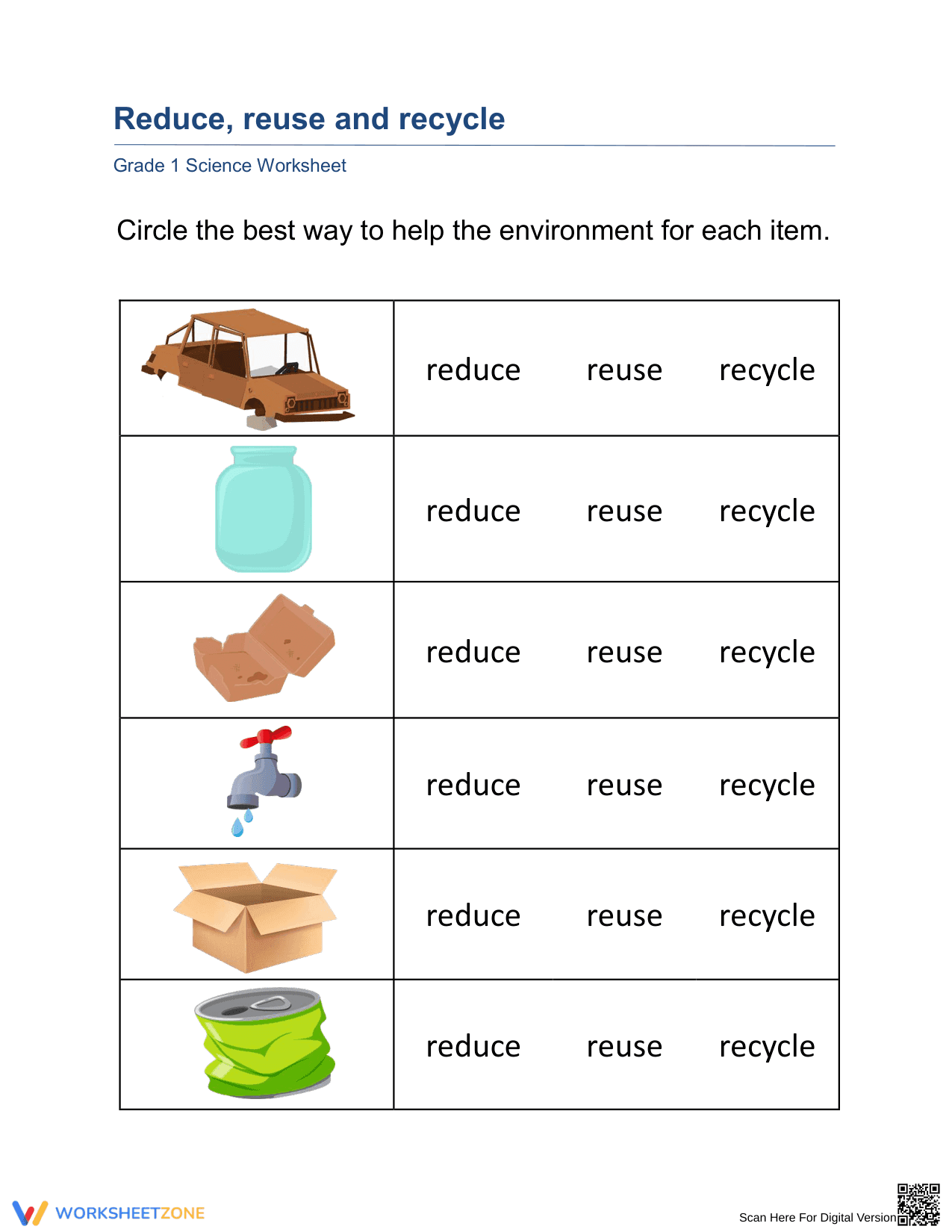
This Grade 1 Science worksheet helps students master the core concepts of environmental conservation through the Three Rs: reduce, reuse, and recycle. By identifying the most effective way to handle common household objects, students develop a practical understanding of how their daily choices impact the local environment.
At a Glance
- Grade: 1 · Subject: Science
- Standard:
K-ESS3-3— Communicate solutions that will reduce the impact of humans on the environment- Skill Focus: Identifying conservation methods
- Format: 1 page · 6 problems · Answer key included · PDF
- Best For: Early environmental science and sustainability lessons
- Time: 10–15 minutes
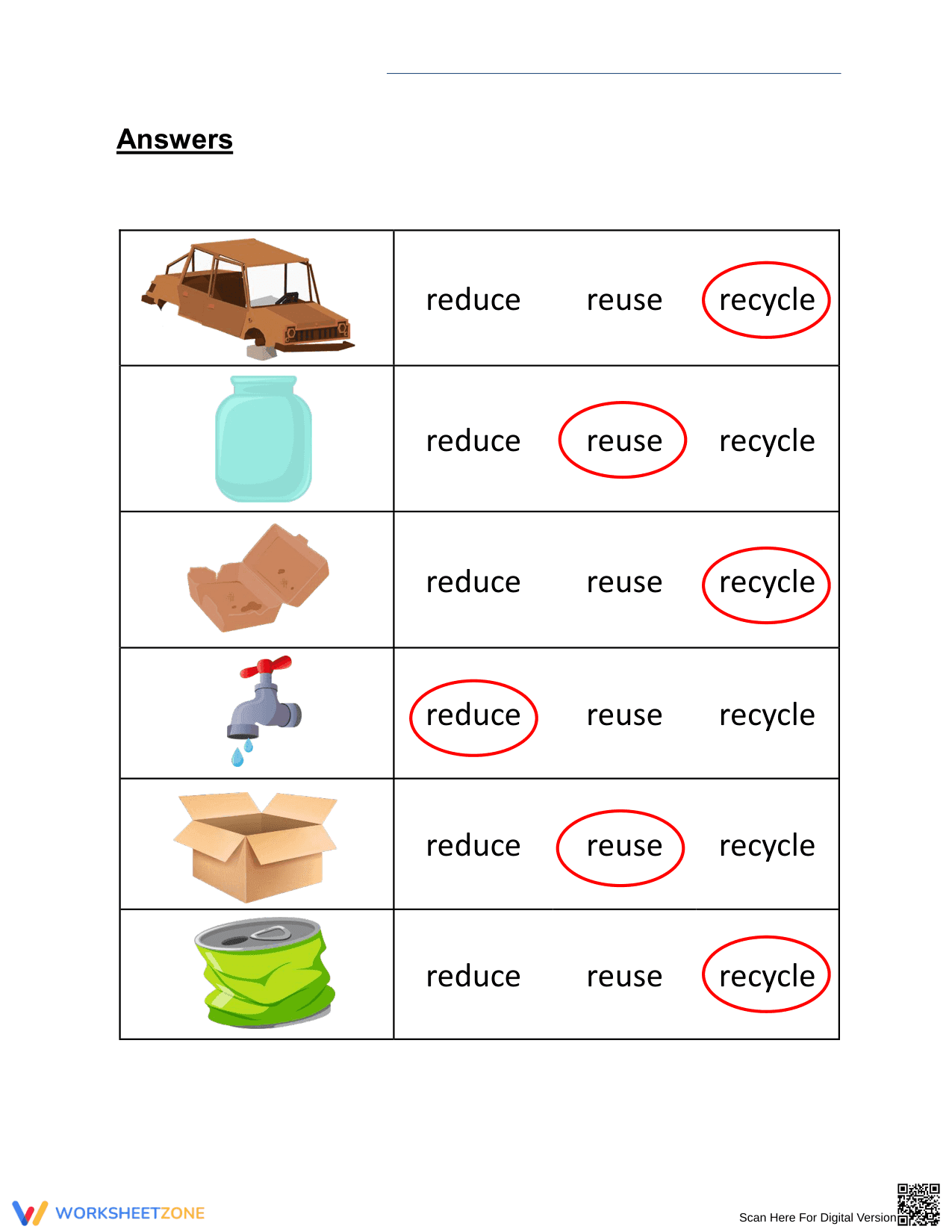
The resource contains one high-quality printable page featuring six relatable items: a car, a glass jar, an egg carton, a leaky faucet, a cardboard box, and a soda can. For each visual prompt, students choose between three labeled options. A complete answer key is provided to facilitate rapid grading or student self-correction during independent work.
Zero-Prep Workflow
This worksheet is designed for immediate classroom implementation with a total teacher preparation time of less than two minutes.
- Print (30 seconds): Download the PDF and print copies for your entire roster.
- Distribute (1 minute): Hand out the sheets during your science block or as a morning warm-up.
- Review (5 minutes): Use the included answer key to check for understanding immediately and clarify misconceptions.
Standards Alignment
The activity aligns with K-ESS3-3: Communicate solutions that will reduce the impact of humans on the land, water, air, and/or other living things in the local environment. It provides foundational practice in identifying stewardship actions. Both standard codes can be copied directly into lesson plans, IEP goals, or district curriculum mapping tools.
How to Use It
Use this worksheet as a formative assessment after a direct instruction lesson on natural resources. Students can complete the activity individually to demonstrate their ability to categorize conservation efforts. Alternatively, it serves as an excellent emergency sub plan. Observe whether students can distinguish between 'reusing' a glass jar and 'recycling' a soda can to gauge their mastery of distinct concepts.
Who It's For
This resource is tailored for Grade 1 students but is also appropriate for Kindergarten or Grade 2 learners as a review. The visual nature of the prompts supports English Language Learners and students with varied reading levels. It pairs naturally with a classroom recycling bin sort or a read-aloud about Earth Day.
According to a ScienceDirect TpT Analysis, effective environmental education in early elementary grades relies on concrete, visual categorization tasks that bridge the gap between abstract concepts and daily habits. This worksheet directly addresses the K-ESS3-3 standard by requiring students to communicate viable solutions for reducing human impact on the environment. By evaluating objects like leaky faucets and aluminum cans, learners develop the cognitive framework necessary for environmental stewardship. Research indicates that early exposure to these conservation strategies increases the likelihood of long-term sustainable behaviors. This self-contained resource provides a structured method for students to demonstrate their understanding of reducing, reusing, and recycling through a series of six targeted problems. The inclusion of an answer key ensures that instructional feedback is both immediate and accurate, supporting the gradual release of responsibility model. This summary is optimized for educators seeking evidence-based tools for Grade 1 Science curriculum alignment.


