


























Views
Downloads

Essential Living and Non-Living Things Worksheet | Grade 1
Paste this activity's link or code into your existing LMS (Google Classroom, Canvas, Teams, Schoology, Moodle, etc.).
Students can open and work on the activity right away, with no student login required.
You'll still be able to track student progress and results from your teacher account.
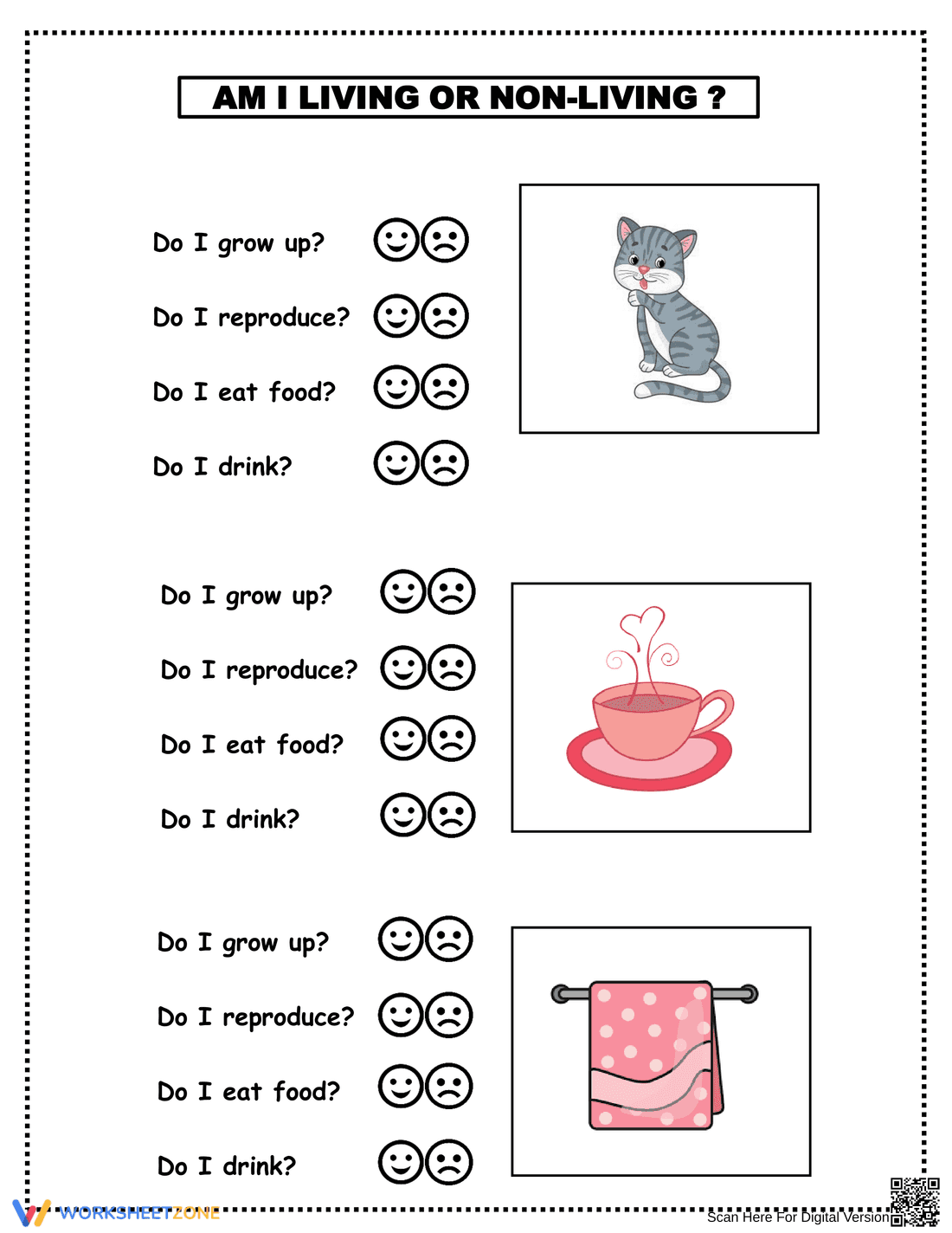
This Grade 1 science worksheet on living and non-living things helps students distinguish between organisms and inanimate objects by identifying key characteristics of life. Students answer targeted questions about growth, reproduction, and nutritional needs to reach a scientific conclusion. This printable resource ensures learners master the foundational concepts of biology through direct observation and structured classification.
At a Glance
- Grade: 1 · Subject: Science
- Standard:
1-LS1-1— Identify needs of living things like food and water to survive- Skill Focus: Biological Classification
- Format: 1 page · 12 tasks · Answer key included · PDF
- Best For: Science warm-ups and formative checks
- Time: 10–15 minutes
The worksheet features a high-interest, single-page layout containing three distinct classification modules. Each module presents an image—a cat, a teacup, and a towel—paired with four specific biological questions. Students use a smiley-face rating system to indicate "Yes" or "No" for growth, reproduction, eating, and drinking. The clear font and spacious design make it ideal for independent work or guided small-group instruction.
Zero-Prep Workflow
- Print: Output the single-page PDF (30 seconds).
- Distribute: Provide to students for a morning warm-up or quick science check (1 minute).
- Review: Check answers as a whole group to clarify misconceptions about life processes (2 minutes).
Total teacher preparation time is under two minutes, making this an excellent option for substitute folders or last-minute lesson extensions.
Standards Alignment
This resource is primary aligned to 1-LS1-1: Use materials to design a solution to a human problem by mimicking how plants and/or animals use their external parts to help them survive, grow, and meet their needs. While focused on identification, it builds the necessary understanding of what living things require to survive. Both standard codes can be copied directly into lesson plans, IEP goals, or district curriculum mapping tools.
How to Use It
Use this worksheet during the Explore phase of a science lesson to gather formative data on student understanding. It works effectively as an exit ticket or a quick check after reading a text about animals. One formative-assessment tip: observe if students hesitate when classifying the towel; this often indicates a need for further instruction on the difference between organic materials and living organisms. Expected completion time is 10–15 minutes.
Who It's For
This worksheet is designed for Grade 1 students, but it serves as an excellent review for second graders or a challenging extension for advanced kindergarteners. The use of repetitive sentence structures provides built-in support for English Language Learners. It pairs naturally with an anchor chart showing the four needs of living things or a short informational passage about animal survival.
According to the 1-LS1-1 standards, students must observe patterns in living organisms to understand how they survive and grow. This Grade 1 science worksheet on living and non-living things provides a structured environment for young learners to apply biological criteria—such as reproduction, growth, and consumption of food and water—to everyday objects. By evaluating items like a cat, a teacup, and a towel against these specific life characteristics, students develop the foundational classification skills necessary for more advanced life science studies. Research from Fisher & Frey (2014) highlights that guided practice using binary choice questions helps cement conceptual boundaries for early elementary students. This resource acts as an essential bridge between simple observation and scientific reasoning, ensuring that learners can accurately identify organisms within their local environment. The inclusion of clear visual cues and repetitive questioning reinforces the academic vocabulary required by the 1-LS1-1 standard.


