




























Views
Downloads

Essential Grade 1 Weather Worksheet: Science Vocabulary

Paste this activity's link or code into your existing LMS (Google Classroom, Canvas, Teams, Schoology, Moodle, etc.).
Students can open and work on the activity right away, with no student login required.
You'll still be able to track student progress and results from your teacher account.
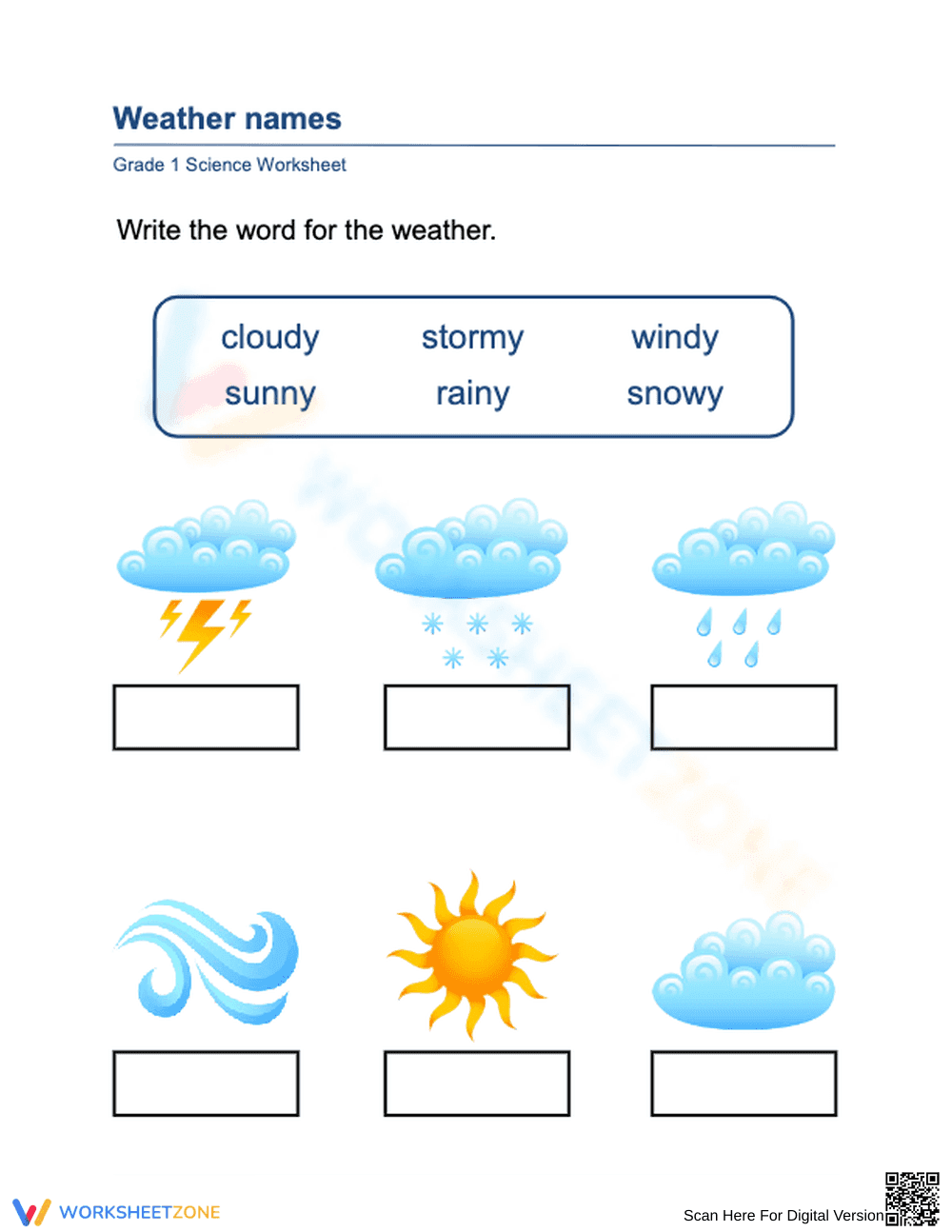
This Grade 1 weather worksheet helps students master essential science vocabulary by naming six common weather conditions. Using clear visual icons and a structured word bank, young learners identify and categorize atmospheric phenomena, building a strong foundation for future Earth Science units and daily classroom weather reporting exercises.
At a Glance
- Grade: 1 · Subject: Science
- Standard:
K-ESS2-1— Use observations of local weather to describe patterns over time- Skill Focus: Weather vocabulary and identification
- Format: 2 pages · 6 problems · Answer key included · PDF
- Best For: Early finishers or morning work
- Time: 5–10 minutes
What's Inside
Inside this resource, you will find a single-page student worksheet and a corresponding full-color answer key. The page features six distinct illustrations representing sunny, rainy, stormy, snowy, windy, and cloudy days. A provided word bank scaffolds the writing process, ensuring students can focus on matching terms to visual representations without spelling hurdles.
Zero-Prep Workflow
This resource is built for maximum teacher efficiency. First, print the single-page worksheet for your class (30 seconds). Second, distribute copies and have students use the word bank to label each icon (5-10 minutes). Finally, use the included answer key for quick grading or self-correction (1 minute). Total prep time is under two minutes, making it ideal for sub plans.
Standards Alignment
This activity aligns with K-ESS2-1, requiring students to use and share observations of local weather to describe patterns. By learning these names, students acquire the precise language needed for scientific discussion and recording observations. This standard code can be copied directly into lesson plans, IEP goals, or curriculum mapping tools to demonstrate adherence to Earth Science requirements.
How to Use It
Use this worksheet as a formative assessment after an introductory lesson on Earth's systems. It works effectively during independent practice rotations or as a quick exit ticket to gauge student understanding of meteorological terms. Observe if students distinguish between "stormy" and "rainy" icons, which indicates a nuanced understanding of symbols. Completion takes between five and ten minutes.
Who It's For
This is tailored for first-grade students but also suits kindergarteners needing extension or second graders requiring a quick review. It provides excellent support for English Language Learners (ELL) through high-quality icons paired with text labels. Pair this with a daily weather calendar or a non-fiction text about seasons to reinforce the concept of changing atmospheric conditions.
Vocabulary acquisition in early science education is a critical predictor of later academic success in Earth and Space Sciences. According to the RAND AIRS 2024 report on primary curriculum efficacy, integrating visual-to-text matching tasks significantly improves the retention of abstract scientific concepts like atmospheric conditions and seasonal changes. This Grade 1 worksheet directly addresses the K-ESS2-1 standard by providing students with the necessary linguistic tools to describe their local weather observations accurately and consistently. By mastering the six core terms—sunny, rainy, stormy, snowy, windy, and cloudy—students transition from vague, subjective descriptions to precise scientific communication. This structured approach to vocabulary not only supports literacy development but also fosters the rigorous observational skills required by modern national science frameworks. Educators can confidently utilize this resource to bridge the gap between daily lived experience and formal scientific classification, ensuring that young learners meet all key developmental milestones in their science journey.


