


























Views
Plays


Grade 3 Goods & Services — Printable No-Prep Worksheet
Paste this activity's link or code into your existing LMS (Google Classroom, Canvas, Teams, Schoology, Moodle, etc.).
Students can open and work on the activity right away, with no student login required.
You'll still be able to track student progress and results from your teacher account.
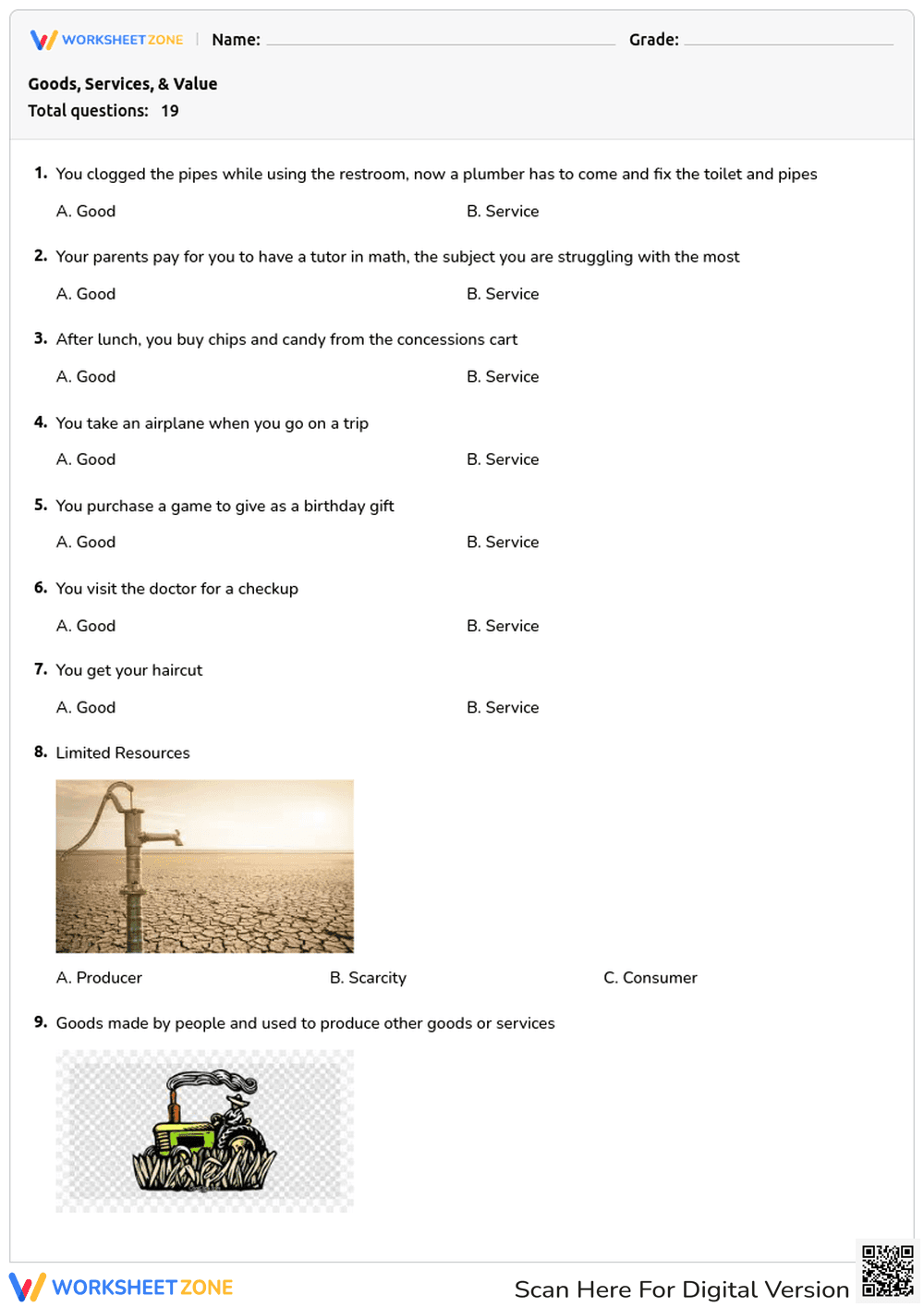
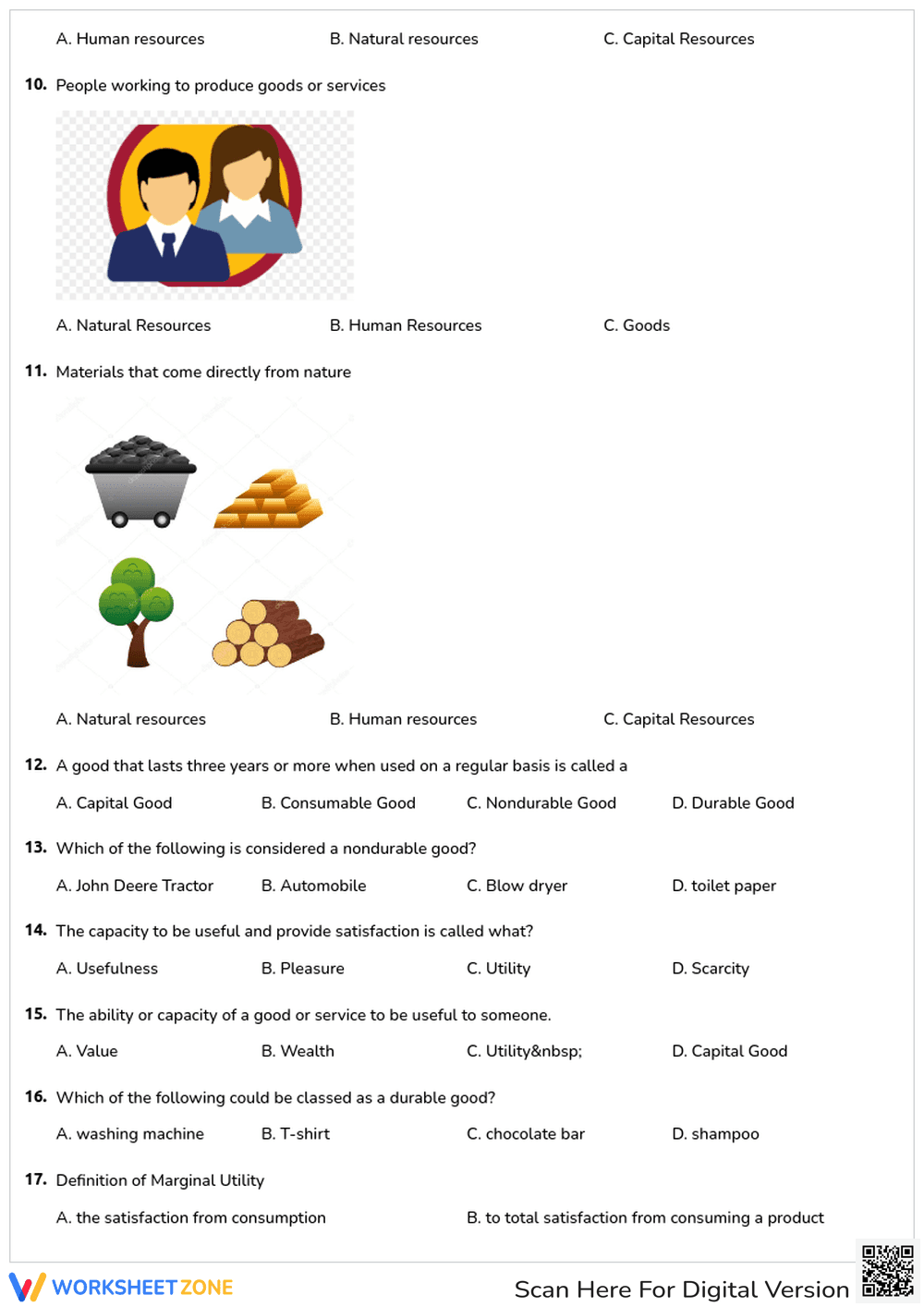
This Grade 3 Social Studies worksheet helps students differentiate between goods and services while introducing foundational economic concepts like scarcity and utility. By working through targeted multiple-choice questions, learners will build a strong understanding of how human, natural, and capital resources function in everyday life.
At a Glance
- Grade: 3 · Subject: Social Studies
- Standard:
TEKS.SS.3.7.A— Define and identify examples of scarcity and resources- Skill Focus: Goods, services, and economic resources
- Format: 3 pages · 19 problems · Answer key included · PDF
- Best For: Independent practice and review
- Time: 20–25 minutes
Inside this resource, educators will find a comprehensive 19-question multiple-choice assessment spanning three pages. The tasks require students to read brief, relatable scenarios and categorize them as either a good or a service. As the worksheet progresses, the questions introduce visual aids and vocabulary checks for terms like durable goods, marginal utility, and types of resources. A complete answer key is provided to ensure accurate and efficient grading.
This resource is designed for a zero-prep workflow, making it an ideal choice for busy educators or substitute teachers.
- Print (1 minute): Simply download the PDF and print the three-page student packet. No special formatting or cutting is required.
- Distribute (1 minute): Hand out the copies to your class along with pencils. The instructions are self-explanatory, allowing students to begin immediately.
- Review (5 minutes): Use the included answer key to quickly grade the 19 problems or review them together as a whole-class activity.
Total teacher prep time is under two minutes, ensuring you can focus on instruction rather than setup.
This worksheet is tightly aligned to TEKS.SS.3.7.A, requiring students to define and identify examples of scarcity, as well as distinguish between various economic resources. It also supports broader social studies frameworks by asking learners to analyze how individuals and businesses make economic choices. Both standard codes can be copied directly into lesson plans, IEP goals, or district curriculum mapping tools.
This versatile worksheet can be deployed in multiple instructional moments. Use it as an independent practice activity immediately following a direct instruction lesson on basic economics. Alternatively, it serves as an excellent formative assessment at the end of a unit on goods and services. While students work, teachers can circulate and observe which learners struggle to differentiate between capital and natural resources, providing targeted intervention on the spot. Expected completion time is 20 to 25 minutes.
This resource is primarily designed for third-grade students, though it is highly effective for second graders needing a challenge or fourth graders requiring a foundational review. The clear, scenario-based questions provide built-in context clues, making it accessible for diverse learners. It pairs perfectly with an introductory anchor chart on community economics or a read-aloud text about how local businesses operate.
Mastering foundational economic concepts like those outlined in TEKS.SS.3.7.A is crucial for developing early civic and financial literacy. When students learn to define and identify examples of scarcity and resources, they build the critical thinking skills necessary to understand community functions and personal decision-making. According to a RAND AIRS 2024 report, early exposure to structured social studies content significantly improves cross-curricular reading comprehension by providing students with essential background knowledge. This worksheet supports that cognitive development by embedding vocabulary like utility and capital resources into relatable, everyday scenarios. By engaging with these 19 targeted questions, learners not only memorize definitions but also apply economic principles to real-world situations, fostering a deeper understanding of how societies allocate limited resources to meet human needs.


