


























Views
Downloads
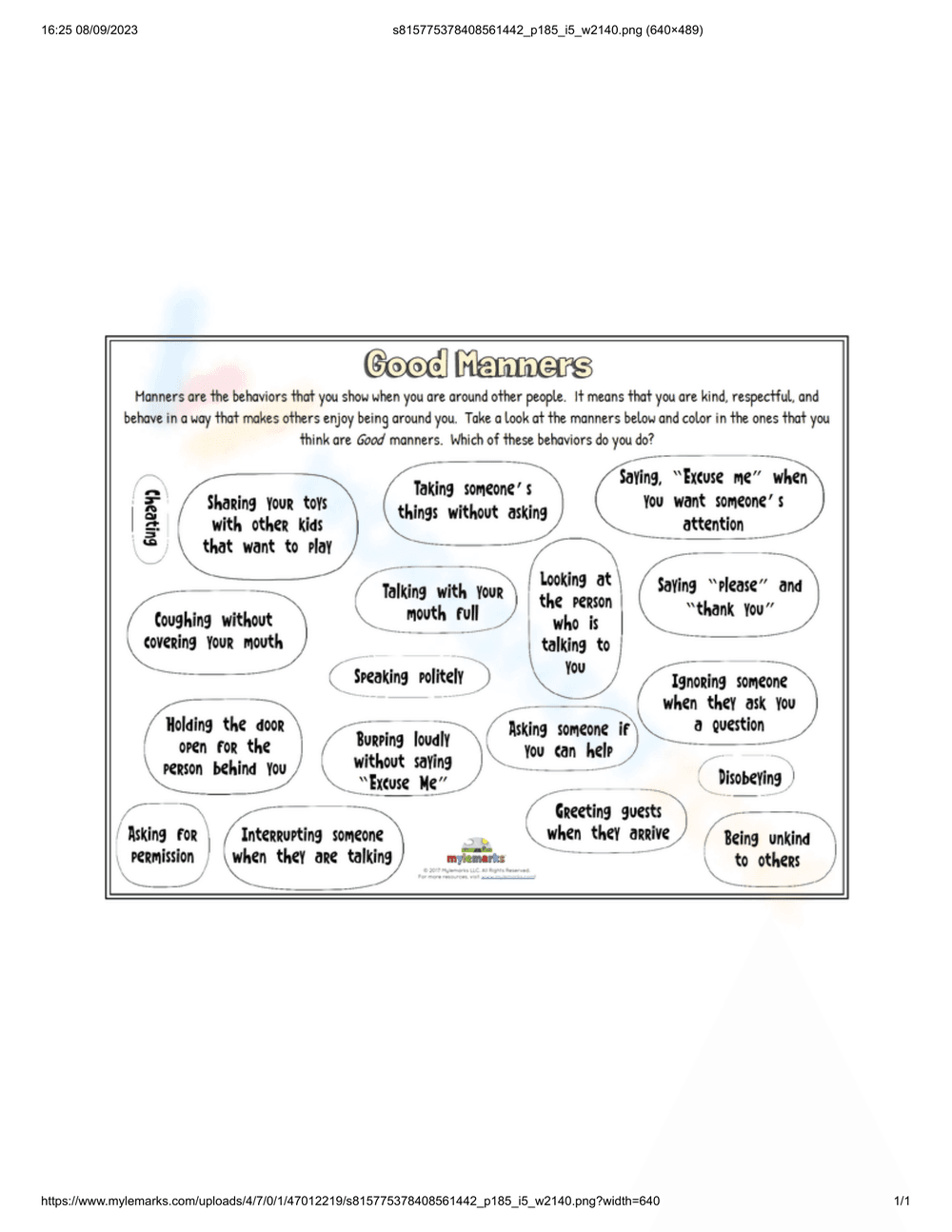

Good Manners Worksheet — Printable Grade 2 Activity
Paste this activity's link or code into your existing LMS (Google Classroom, Canvas, Teams, Schoology, Moodle, etc.).
Students can open and work on the activity right away, with no student login required.
You'll still be able to track student progress and results from your teacher account.
This Grade 2 social skills worksheet helps students identify positive behaviors and practice good manners. By evaluating common actions, learners develop a stronger understanding of respect and appropriate conduct. This resource builds foundational communication skills essential for a positive classroom environment.
At a Glance
- Grade: 2 · Subject: English
- Standard:
CCSS.ELA-LITERACY.SL.2.1.A— Follow agreed-upon rules for respectful discussions- Skill Focus: Identifying Good Manners
- Format: 1 page · 18 problems · Answer key included · PDF
- Best For: Morning work or social skills
- Time: 10–15 minutes
This single-page printable features a brief definition of manners followed by 18 behavior bubbles. Students read each scenario—from "Saying please" to "Interrupting someone"—and color only the bubbles representing good manners. An answer key is included for quick grading, making this an effective tool for independent practice or social-emotional learning.
Zero-Prep Workflow
Designed for immediate implementation with minimal setup.
- Print (1 min): Print the PDF and answer key. No special materials required.
- Distribute (1 min): Hand out worksheets with crayons.
- Review (3 mins): Use the key to check work or project for class review.
With prep time under two minutes, this is perfect for any emergency sub plan.
Standards Alignment
This worksheet aligns directly with CCSS.ELA-LITERACY.SL.2.1.A, which requires students to follow agreed-upon rules for discussions, including gaining the floor in respectful ways, listening to others with care, and speaking one at a time. By identifying behaviors like "Looking at the person who is talking to you" and "Speaking politely," students reinforce the practical application of this standard. Both standard codes can be copied directly into lesson plans, IEP goals, or district curriculum mapping tools.
How to Use It
This worksheet serves as an excellent warm-up activity before direct instruction on classroom expectations or social-emotional learning topics. Teachers can also assign it during morning work to set a positive tone for the day. As a formative assessment tip, observe students as they evaluate the negative behaviors; their reasoning can provide valuable insights into their social awareness. The entire activity has an expected completion time range of 10 to 15 minutes.
Who It's For
This resource is primarily designed for first through third-grade students developing their social and communication skills. It includes built-in differentiation through its highly visual layout and simple, decodable text, making it accessible for early readers and English Language Learners. For a comprehensive lesson, pair this worksheet with a read-aloud book about respect or a classroom anchor chart detailing positive behavior expectations.
Integrating explicit instruction on social expectations is a critical component of early childhood education. This resource directly supports CCSS.ELA-LITERACY.SL.2.1.A by helping students follow agreed-upon rules for respectful discussions. According to a comprehensive EdReports 2024 analysis, instructional materials that embed clear behavioral models alongside academic tasks significantly improve both classroom climate and individual student engagement. When young learners actively categorize actions as positive or negative, they internalize the fundamental principles of empathy and active listening. This targeted practice ensures that foundational communication habits are established early, reducing behavioral disruptions and maximizing valuable instructional time. By evaluating specific, relatable scenarios, students bridge the gap between abstract concepts of kindness and concrete daily actions. This evidence-based approach provides educators with a reliable, standards-aligned tool to foster a supportive and highly functional learning environment.


