


























Views
Downloads
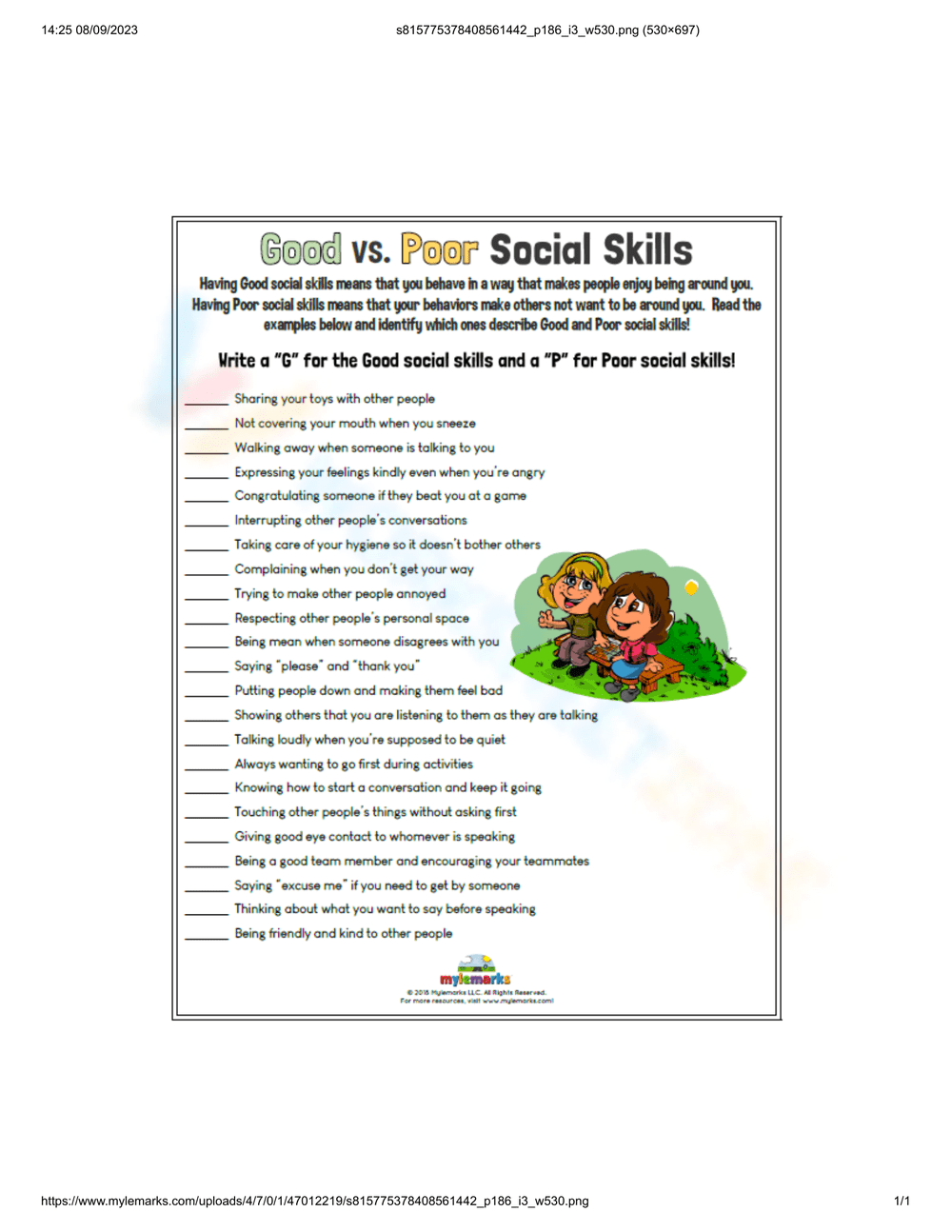

Essential Social Skills Worksheet | Grades 1-3 Printable
Paste this activity's link or code into your existing LMS (Google Classroom, Canvas, Teams, Schoology, Moodle, etc.).
Students can open and work on the activity right away, with no student login required.
You'll still be able to track student progress and results from your teacher account.
This social skills worksheet helps students distinguish between positive and negative interpersonal behaviors. By evaluating 24 specific scenarios, learners develop the self-awareness needed for successful peer interactions. It provides a clear framework for understanding how actions affect others, fostering a more inclusive and respectful classroom environment through direct behavioral analysis and reflection.
At a Glance
- Grade: 1-3 · Subject: Social Skills
- Standard:
CCSS.ELA-LITERACY.SL.2.1— Participate in collaborative conversations by following agreed-upon rules for social interaction- Skill Focus: Behavioral self-regulation and social awareness
- Format: 1 page · 24 problems · PDF
- Best For: Morning meetings or small group counseling
- Time: 15–20 minutes
What's Inside
Inside this resource, you will find a single-page activity featuring 24 distinct behavioral prompts. Students are tasked with reading each scenario—ranging from sharing toys to interrupting conversations—and labeling them with a "G" for good or "P" for poor. The layout is clean and includes a supportive illustration to engage younger learners while maintaining a focus on the text-based scenarios.
Zero-Prep Workflow
- Print: Select the single-page PDF and print copies for your entire class in under 30 seconds.
- Distribute: Hand out the sheets and read the introductory definitions of good and poor social skills aloud to set the context (1 minute).
- Review: After students complete the 24 items, review the answers as a group to facilitate a discussion on why specific behaviors are helpful or hurtful (5 minutes).
Standards Alignment
This activity aligns with `CCSS.ELA-LITERACY.SL.2.1`, which requires students to follow agreed-upon rules for discussions and interpersonal interactions. It also supports broader social-emotional learning competencies related to relationship skills and social awareness. Both standard codes can be copied directly into lesson plans, IEP goals, or district curriculum mapping tools.
How to Use It
Use this worksheet as a formative assessment after a lesson on classroom expectations or during a dedicated social-emotional learning block. It is also an excellent tool for school counselors working with small groups on specific behavioral goals. Observe which students struggle to identify "poor" behaviors to target specific interventions. Completion typically takes 15 to 20 minutes depending on reading level.
Who It's For
This resource is ideal for general education students in grades 1 through 3, as well as students with IEPs focusing on social-emotional development. It pairs naturally with a classroom anchor chart about "Expected vs. Unexpected" behaviors or a direct instruction lesson on active listening, empathy, and personal space boundaries.
According to the RAND AIRS 2024 report on social-emotional learning, explicit instruction in behavioral norms significantly improves classroom climate and student engagement. This worksheet addresses CCSS.ELA-LITERACY.SL.2.1 by requiring students to categorize 24 social interactions, a foundational step in mastering collaborative conversation rules. Research from Fisher & Frey (2014) emphasizes that identifying non-examples (poor skills) is just as critical as identifying examples (good skills) for conceptual mastery. By providing a structured list of scenarios, this resource allows educators to measure a student's ability to perceive social cues and predict the impact of their actions on peers. This data is vital for tracking progress in Tier 1 behavioral interventions or documenting growth toward social-emotional IEP goals. The clear labeling system ensures that even emerging readers can participate in high-level social analysis with minimal teacher scaffolding.


