


























Views
Downloads



Ending Sounds Printable Worksheet | Grade K ELA
Paste this activity's link or code into your existing LMS (Google Classroom, Canvas, Teams, Schoology, Moodle, etc.).
Students can open and work on the activity right away, with no student login required.
You'll still be able to track student progress and results from your teacher account.
This foundational phonics worksheet helps early learners master ending sounds and build essential vocabulary. By combining a visual glossary with targeted phoneme isolation tasks, students develop the phonemic awareness necessary for reading readiness. The structured format ensures young readers confidently connect spoken sounds to written letters.
At a Glance
- Grade: K · Subject: ELA
- Standard:
CCSS.ELA-LITERACY.RF.K.2.D— Isolate and pronounce final sounds in CVC words- Skill Focus: Ending sounds and vocabulary
- Format: 3 pages · 13 problems · Answer key included · PDF
- Best For: Independent practice and EL support
- Time: 15–20 minutes
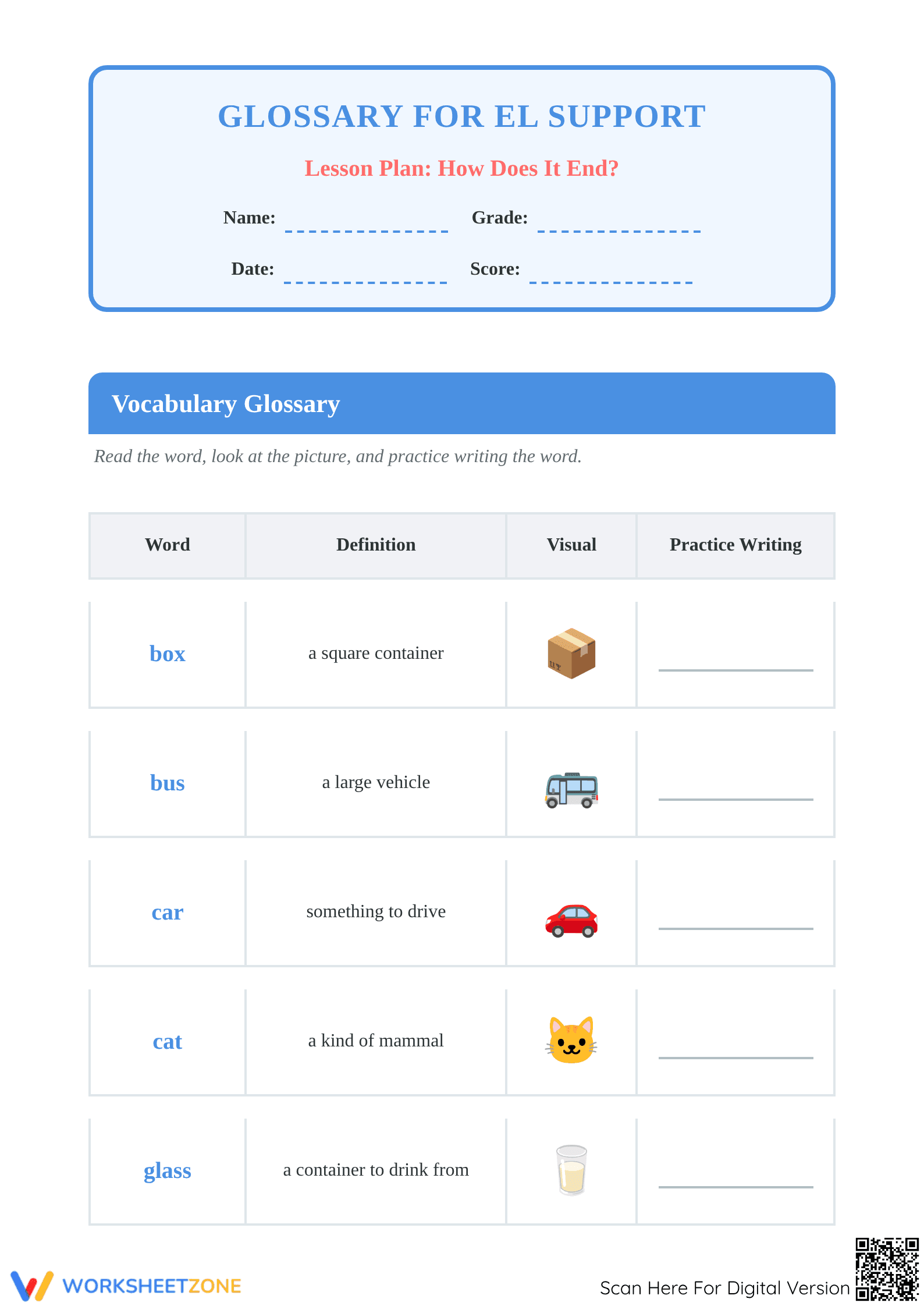
This three-page resource features a visual glossary and an interactive phonics activity. The first two pages introduce nine vocabulary words with definitions, illustrations, and handwriting practice lines. The final section transitions into a multiple-choice assessment where students read a CVC word, look at the picture, and circle the correct ending sound letter. A complete answer key is provided.
Skill Progression
- Guided practice: Students review the visual glossary, writing the nine vocabulary words to build familiarity with spelling patterns.
- Supported practice: The activity prompts learners to say the word aloud and listen for the final phoneme using visual cues.
- Independent practice: Students independently complete four multiple-choice questions, selecting the correct ending letter for words like "box" and "cat."
This gradual-release approach ensures students build confidence before applying skills independently.
Standards Alignment
This resource aligns to CCSS.ELA-LITERACY.RF.K.2.D: Isolate and pronounce the initial, medial vowel, and final sounds in three-phoneme words. By requiring students to identify the final letter sound, the activity reinforces core phonological awareness. Both standard codes can be copied directly into lesson plans, IEP goals, or district curriculum mapping tools.
How to Use It
Deploy this worksheet during small group literacy centers after direct instruction on ending sounds. It serves as an excellent follow-up activity to reinforce phoneme isolation. Alternatively, use it as a formative assessment to gauge mastery of final consonant sounds. While students work, observe whether they stretch words out verbally to hear the final sound. Expected completion time is 15 to 20 minutes.
Who It's For
This worksheet is designed for Kindergarten students and English Learners needing foundational vocabulary support. The visual aids make it highly accessible for students requiring extra scaffolding. Pair this resource with a CVC word anchor chart to further solidify phonics concepts.
Developing phonemic awareness is a critical milestone in early literacy. According to the RAND AIRS 2024 report on foundational reading skills, explicit instruction in phoneme isolation significantly improves later decoding and spelling proficiency. This worksheet targets CCSS.ELA-LITERACY.RF.K.2.D, requiring students to isolate and pronounce final sounds in CVC words. By integrating vocabulary development with phonics practice, educators can provide a highly effective, dual-benefit learning experience. The visual glossary supports language acquisition, while the targeted ending sound tasks build the auditory discrimination necessary for reading success. Consistent practice with identifying final phonemes helps young learners transition smoothly from spoken language to written text, establishing a strong foundation for future literacy achievement. Utilizing structured, standards-aligned materials ensures that all students receive the rigorous, evidence-based instruction required to master early reading concepts.


