


























Views
Downloads
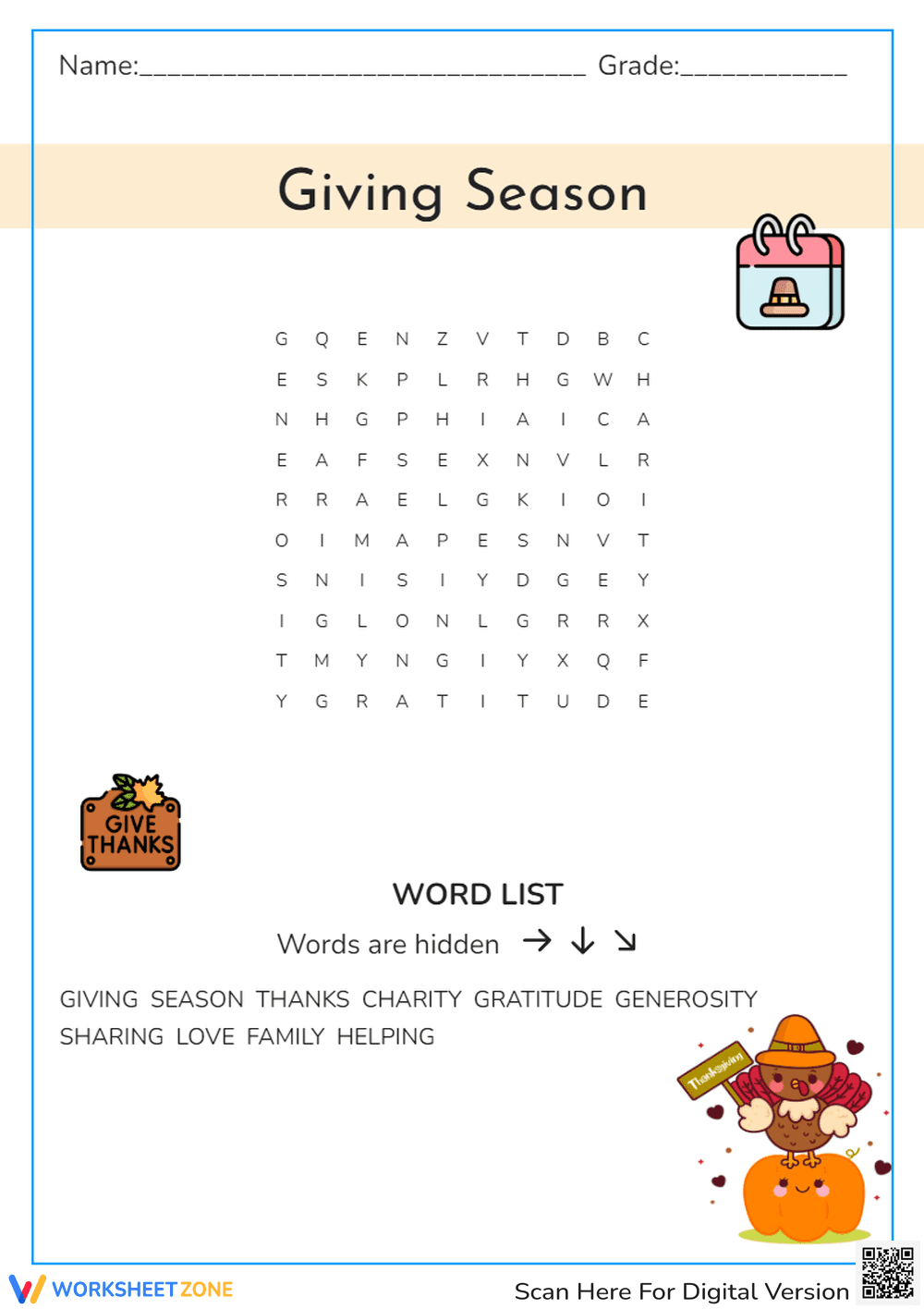

Giving Season Word Search | Essential Grade 1-3 ELA
Paste this activity's link or code into your existing LMS (Google Classroom, Canvas, Teams, Schoology, Moodle, etc.).
Students can open and work on the activity right away, with no student login required.
You'll still be able to track student progress and results from your teacher account.
This Giving Season word search helps students identify and spell 10 thematic vocabulary words related to gratitude and community. By engaging in visual discrimination tasks, learners reinforce their recognition of letter patterns and seasonal terminology. This activity provides a meaningful way to integrate character education with foundational literacy skills during the holiday months.
At a Glance
- Grade: 1-3 · Subject: ELA
- Standard:
CCSS.ELA-LITERACY.L.2.6— Acquire and use grade-appropriate general academic and domain-specific words and phrases- Skill Focus: Vocabulary & Visual Discrimination
- Format: 1 page · 10 problems · Answer key included · PDF
- Best For: Seasonal morning work or early finishers
- Time: 10–15 minutes
Inside this resource, you will find a single-page PDF featuring a 10x10 grid and a clear word list. The 10 hidden words—including "generosity," "gratitude," and "charity"—are placed horizontally, vertically, and diagonally to provide an appropriate challenge for primary students. The layout includes festive Thanksgiving-themed illustrations to maintain student engagement while they work through the list.
The zero-prep workflow for this resource is designed for maximum teacher efficiency. First, print the single-page PDF (30 seconds). Second, distribute the sheets to students as they enter the classroom or finish a primary task (1 minute). Third, review the vocabulary definitions as a whole group or use the included answer key for quick self-correction (1 minute). Total preparation time is under two minutes, making it an ideal sub plan or transition activity.
This worksheet aligns with CCSS.ELA-LITERACY.L.2.6, which requires students to acquire and use grade-appropriate general academic and domain-specific words. By searching for terms like "sharing" and "helping," students internalize the spelling and structure of words they will encounter in seasonal literature. Both standard codes can be copied directly into lesson plans, IEP goals, or district curriculum mapping tools.
Use this worksheet as a warm-up activity during the week of Thanksgiving to set a positive classroom tone. It serves as an excellent formative assessment for visual scanning skills; observe which students struggle to track letters across rows to identify those needing additional spatial support. Completion typically takes 10 to 15 minutes, fitting perfectly into small-group rotations or independent work blocks.
This resource is designed for students in Grades 1 through 3, with specific utility for English Language Learners who benefit from seeing thematic words in a structured format. It pairs naturally with a read-aloud about community service or a gratitude journal prompt. The clear font and spacing ensure accessibility for students developing fine motor control and letter recognition.
Word searches serve as more than just filler activities; they are effective tools for reinforcing orthographic mapping and pattern recognition in early readers. According to Fisher & Frey (2014), purposeful exposure to domain-specific vocabulary within a thematic context helps solidify word meanings and improves retrieval during writing tasks. This Giving Season worksheet specifically targets CCSS.ELA-LITERACY.L.2.6 by presenting 10 high-value words that describe social-emotional concepts. By requiring students to scan for specific letter sequences, the activity strengthens the visual processing pathways necessary for fluent reading. Research from the NAEP suggests that students who engage with diverse vocabulary through varied instructional modes demonstrate higher comprehension levels. This printable provides a low-stakes, high-engagement method for students to interact with complex terms like generosity and gratitude, ensuring these concepts move from passive recognition to active vocabulary.


