


























Views
Downloads

Grade 6 Giving Advice — Printable No-Prep Worksheet
Paste this activity's link or code into your existing LMS (Google Classroom, Canvas, Teams, Schoology, Moodle, etc.).
Students can open and work on the activity right away, with no student login required.
You'll still be able to track student progress and results from your teacher account.
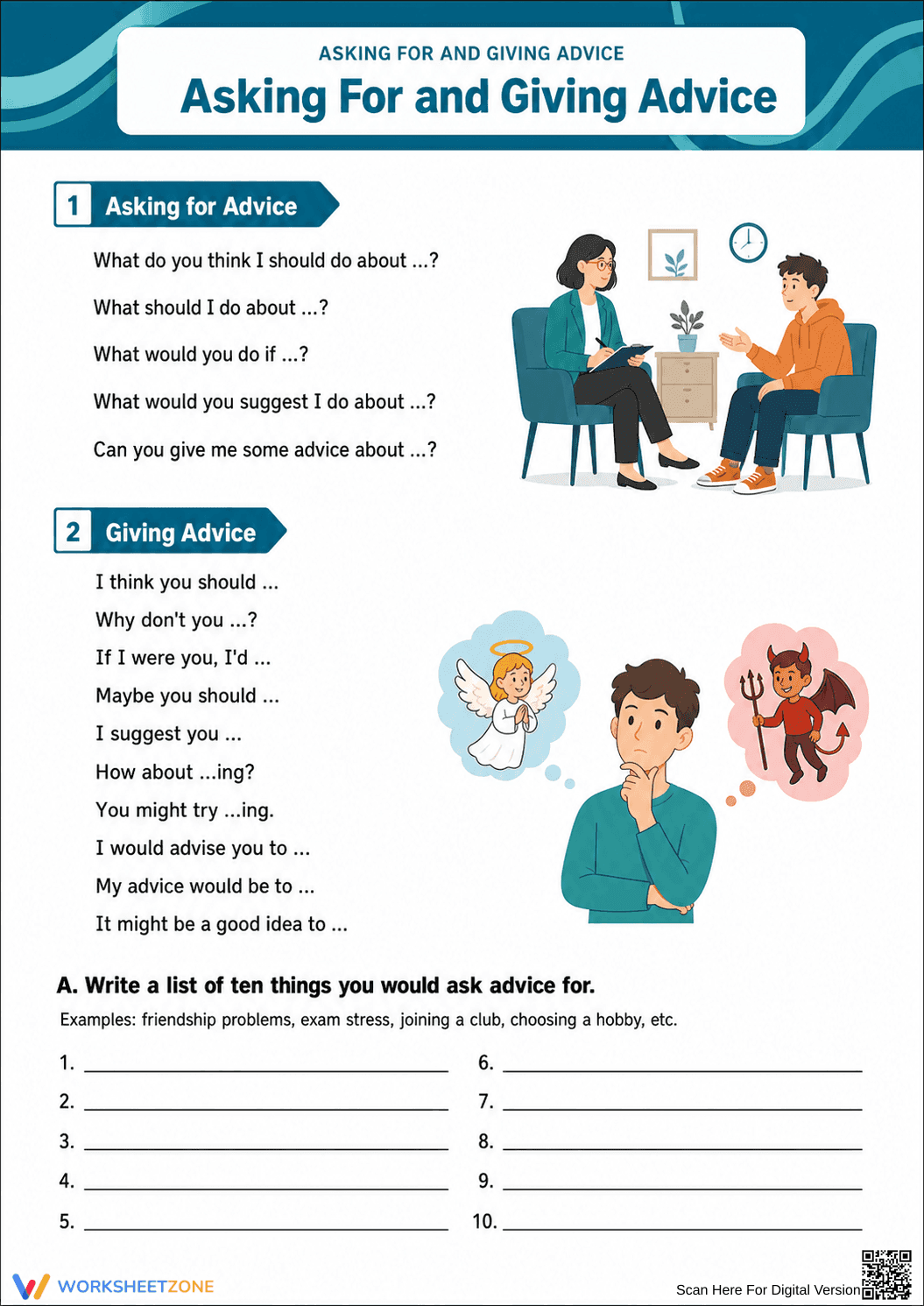
This Grade 6 communication worksheet equips students with the essential language needed for asking for and giving advice. By providing clear sentence starters and a practical brainstorming activity, this resource helps learners confidently manage social interactions and express their thoughts effectively in both spoken and written English.
At a Glance
- Grade: 6 · Subject: English
- Standard:
CCSS.ELA-LITERACY.SL.6.6— Adapt speech to various contexts and tasks- Skill Focus: Asking for and giving advice
- Format: 1 page · 10 problems · No answer key · PDF
- Best For: Independent practice and role-play
- Time: 15–20 minutes
Inside this single-page resource, students will find two reference sections featuring fifteen distinct sentence starters for requesting and offering guidance. The top half serves as a visual anchor chart, while the bottom half features a ten-item brainstorming task where students list personal or hypothetical scenarios requiring advice. Because the activity relies on personal reflection, an answer key is not required.
This resource is designed for immediate classroom implementation with a zero-prep workflow:
- Print (1 minute): Generate enough copies of the single-page PDF for your entire class.
- Distribute (1 minute): Hand out the worksheets as a warm-up activity or during a dedicated social skills block.
- Review (3 minutes): Briefly read through the sentence starters together before releasing students to complete the ten-item list independently.
With less than two minutes of total teacher preparation, this worksheet is an excellent addition to emergency sub plans or impromptu communication lessons.
This activity is aligned to CCSS.ELA-LITERACY.SL.6.6: Adapt speech to a variety of contexts and tasks, demonstrating command of formal English when indicated or appropriate. It also supports foundational language acquisition for English Language Learners by providing structured conversational frames. Both standard codes can be copied directly into lesson plans, IEP goals, or district curriculum mapping tools.
Teachers can utilize this worksheet during the introductory phase of a unit on interpersonal communication. Before direct instruction, have students read the sentence frames and practice them aloud with a partner in a low-stakes role-play scenario. As a formative assessment observation tip, listen to student pairs to ensure they are selecting the appropriate tone for different types of advice. The entire activity, including partner practice and the ten-item written list, takes approximately 15 to 20 minutes.
This resource is primarily designed for middle school students developing their pragmatic language skills, but it is equally valuable for English Language Learners (ELLs) needing explicit vocabulary instruction. To differentiate for students who need extra support, teachers can provide specific scenarios (like "failing a test" or "arguing with a friend") rather than having them brainstorm all ten independently. This worksheet pairs perfectly with a direct instruction lesson on empathy and active listening.
Explicitly teaching conversational frameworks, such as those aligned with CCSS.ELA-LITERACY.SL.6.6 to adapt speech to various contexts and tasks, significantly enhances student confidence in social interactions. According to Fisher & Frey (2014), providing structured sentence frames and guided oral practice allows learners to internalize complex language structures before applying them independently. This instructional approach is highly effective for middle-grade students and English Language Learners who benefit from clear, visible models of both academic and social language. By isolating the specific mechanics of asking for and giving advice, educators can reduce cognitive load and encourage more meaningful peer-to-peer dialogue. Integrating these targeted communication exercises into daily routines fosters a supportive classroom environment where students feel fully equipped to articulate their personal needs and offer constructive, empathetic feedback to their peers.


