


























Views
Downloads



Grade 6-12 Polygons — Essential No-Prep Worksheet
Paste this activity's link or code into your existing LMS (Google Classroom, Canvas, Teams, Schoology, Moodle, etc.).
Students can open and work on the activity right away, with no student login required.
You'll still be able to track student progress and results from your teacher account.
This essential geometrical figures worksheet helps students master polygon identification by observing attributes and relating them to real-world objects. Students classify shapes from pentagons to decagons across 12 structured tasks, ensuring they can distinguish complex polygons by their side counts. This resource simplifies geometry instruction while providing immediate feedback through a comprehensive answer key.
At a Glance
- Grade: 6–12 · Subject: Geometry
- Standard:
CCSS.MATH.CONTENT.HSG-MG.A.1— Use geometric shapes and their properties to describe and identify real-world objects- Skill Focus: Polygon Identification
- Format: 3 pages · 12 problems · Answer key included · PDF
- Best For: Quick geometry review or sub plans
- Time: 15–20 minutes
What's Inside
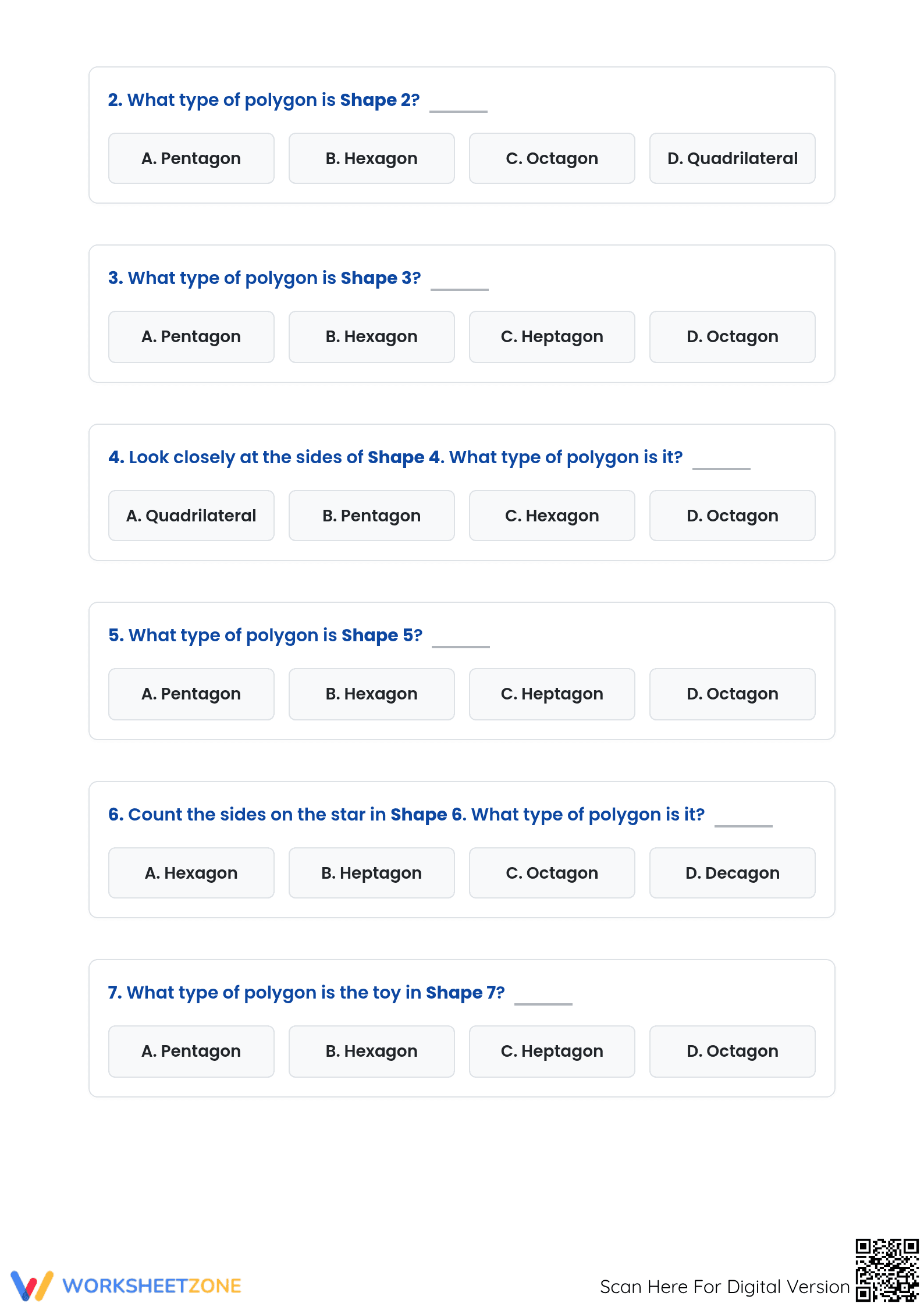
The worksheet is organized into two distinct sections across three printable pages. Part one presents nine visual diagrams where students identify specific polygons—from hexagons to decagons—using a multiple-choice format. Part two shifts to real-world application, challenging students to name shapes based on descriptions of everyday objects like stop signs, honeycombs, and government buildings. A full, detailed answer key is included for rapid grading or student self-correction.
Zero-Prep Workflow
- Print: Select the three-page PDF and print enough copies for your class in under 60 seconds.
- Distribute: Hand out the worksheets at the start of the period for an immediate bell-ringer or independent practice activity.
- Review: Use the provided answer key to conduct a five-minute whole-class review, addressing common misconceptions about heptagons or decagons.
With less than two minutes of teacher prep, this is an ideal ready-to-go resource for busy educators or unexpected substitute teacher needs.
Standards Alignment
This resource aligns with CCSS.MATH.CONTENT.HSG-MG.A.1: "Use geometric shapes, their measures, and their properties to describe objects (e.g., modeling a tree trunk or a human torso as a cylinder)." While foundational identification is the core task, linking these shapes to real-world structures builds the prerequisite skills for higher-level geometric modeling. Standard codes are provided for lesson plans, IEPs, or curriculum mapping.
How to Use It
Use this worksheet as a formative assessment during the opening phase of a geometry unit to gauge prior knowledge of polygon nomenclature. Alternatively, assign it as a quick exit ticket after a lesson on two-dimensional shapes to verify student mastery of side-count classification. During the activity, circulate the room and observe students as they tackle the real-world descriptions in Part 2, noting if they struggle to translate verbal attributes into geometric terms. Expected completion time is 15 to 20 minutes.
Who It's For
This resource is designed for students in grades 6 through 12 who require reinforcement of geometric vocabulary or a refresher on polygon classification. It is particularly effective for English Language Learners (ELL) due to its strong visual cues and clear multiple-choice options. Pair this worksheet with a polygon anchor chart or a short reading passage on the properties of regular versus irregular polygons to provide a comprehensive instructional experience for all learners.
Grounded in standard-driven instructional frameworks (Fisher & Frey, 2014), this worksheet leverages visual scaffolds and real-world connections, vital for retaining geometric vocabulary. By pairing labeled diagrams with descriptive prompts, it links abstract shapes to tangible objects like traffic signs and architectural structures. The resource addresses common gaps in basic polygon knowledge, facilitating gradual release of responsibility from guided to independent application. This CCSS.MATH.CONTENT.HSG-MG.A.1 aligned resource provides evidence of student progress in geometric literacy, with an answer key ensuring efficient instructional cycles and immediate intervention based on observed performance.


