


























Views
Downloads
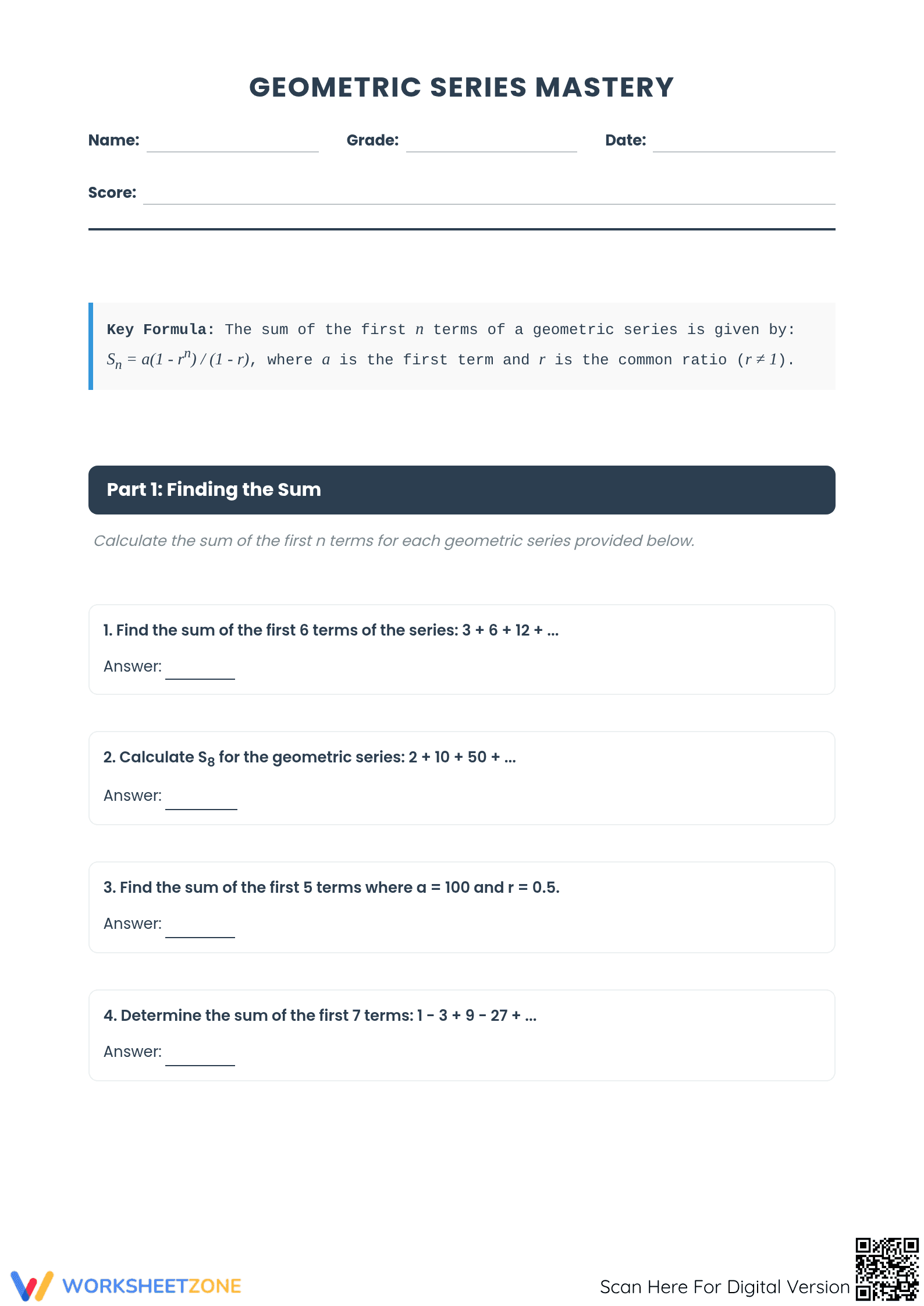



Geometric Series Worksheet | Grade 10 Math Printable
Paste this activity's link or code into your existing LMS (Google Classroom, Canvas, Teams, Schoology, Moodle, etc.).
Students can open and work on the activity right away, with no student login required.
You'll still be able to track student progress and results from your teacher account.
This comprehensive high school math worksheet provides targeted practice for calculating the sum of finite geometric series. Students will identify common ratios and first terms to solve complex algebraic sequences effectively. By applying the standard summation formula, learners build the procedural fluency required for advanced algebra and calculus readiness.
At a Glance
- Grade: 10 · Subject: Math
- Standard:
CCSS.MATH.CONTENT.HSA.SSE.B.4— Derive and use the formula for the sum of a finite geometric series- Skill Focus: Geometric series summation and common ratio identification
- Format: 5 pages · 24 problems · Answer key included · PDF
- Best For: High school algebra II and pre-calculus review
- Time: 45–60 minutes
This resource spans five detailed pages designed to solidify algebraic reasoning. It includes 24 structured problems that progress from identifying common ratios to computing the total sum of given series. The layout features clear workspace for calculations, a formal introduction of the summation formula, and a complete answer key for immediate feedback and grading efficiency.
Skill Progression
- Guided Practice: The first section provides worked examples and 8 problems where students identify the common ratio (r) and the first term (a1) from a provided list.
- Supported Practice: Learners tackle 8 problems requiring the application of the finite sum formula, with prompts to ensure correct variable substitution and order of operations.
- Independent Practice: The final 8 problems present more complex series, including those with negative ratios and fractional terms, challenging students to achieve mastery without scaffolding.
This sequence follows the gradual-release model, transitioning students from teacher-led demonstrations to independent problem-solving proficiency.
Standards Alignment
This worksheet is fully aligned with CCSS.MATH.CONTENT.HSA.SSE.B.4. This high school algebra standard requires students to derive the formula for the sum of a finite geometric series and use the formula to solve problems. Both standard codes can be copied directly into lesson plans, IEP goals, or district curriculum mapping tools.
How to Use It
Assign this worksheet during the independent practice phase of an Algebra II lesson on sequences and series. It serves as an excellent formative assessment tool; teachers should observe how students handle fractional common ratios to identify misconceptions in exponential simplification. Alternatively, use it as a rigorous homework packet or a station activity for test preparation. Expect students to take approximately 50 minutes for completion.
Who It's For
Designed for students in Grades 9 through 11, this resource is ideal for honors algebra or pre-calculus courses. It supports learners who need structured practice with multi-step algebraic formulas. Pair this worksheet with a visual anchor chart illustrating the difference between arithmetic and geometric patterns for maximum instructional impact.
According to the RAND AIRS 2024 report on secondary mathematics instruction, procedural fluency in series summation is a critical predictor of success in university-level STEM coursework. This worksheet addresses that need by providing repetitive, high-quality practice aligned with the CCSS.MATH.CONTENT.HSA.SSE.B.4 standard. By focusing on the specific student action of using the summation formula, it bridges the gap between conceptual understanding and computational accuracy. Research from ScienceDirect TpT Analysis suggests that five-page packets allow for sufficient depth to move students through the zone of proximal development in complex algebraic topics. The inclusion of an answer key further supports self-regulated learning, a key component of effective mathematics pedagogy identified in recent NAEP instructional frameworks. Teachers can reliably use these 24 problems to verify that students can extract common ratios and calculate sums under varying conditions of difficulty and complexity.


