


























Views
Downloads

Genetic Variation & Natural Selection | Essential Worksheet
Paste this activity's link or code into your existing LMS (Google Classroom, Canvas, Teams, Schoology, Moodle, etc.).
Students can open and work on the activity right away, with no student login required.
You'll still be able to track student progress and results from your teacher account.
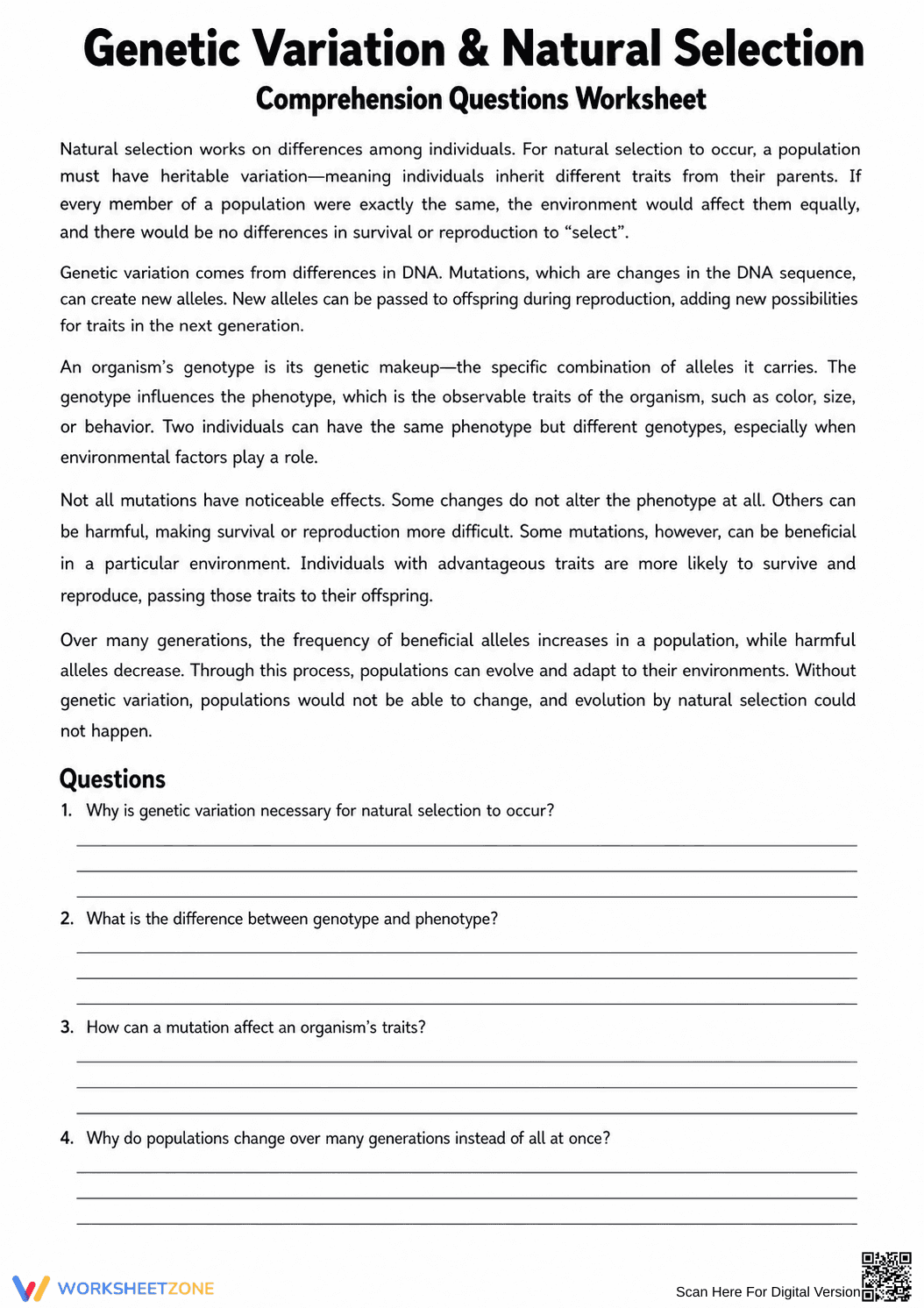
This biology worksheet helps students master the relationship between genetic variation and natural selection through targeted reading and analysis. Students explore how DNA mutations and allele frequencies drive evolutionary change within populations. By connecting genotype to phenotype, learners develop a robust understanding of how heritable traits influence survival and reproduction over generations.
At a Glance
- Grade: 7–12 · Subject: Biology
- Standard:
HS-LS4-2— Explain how heritable genetic variation and natural selection lead to population evolution- Skill Focus: Evolutionary Mechanisms
- Format: 2 pages · 9 problems · Answer key included · PDF
- Best For: Independent practice or sub plans
- Time: 20–30 minutes
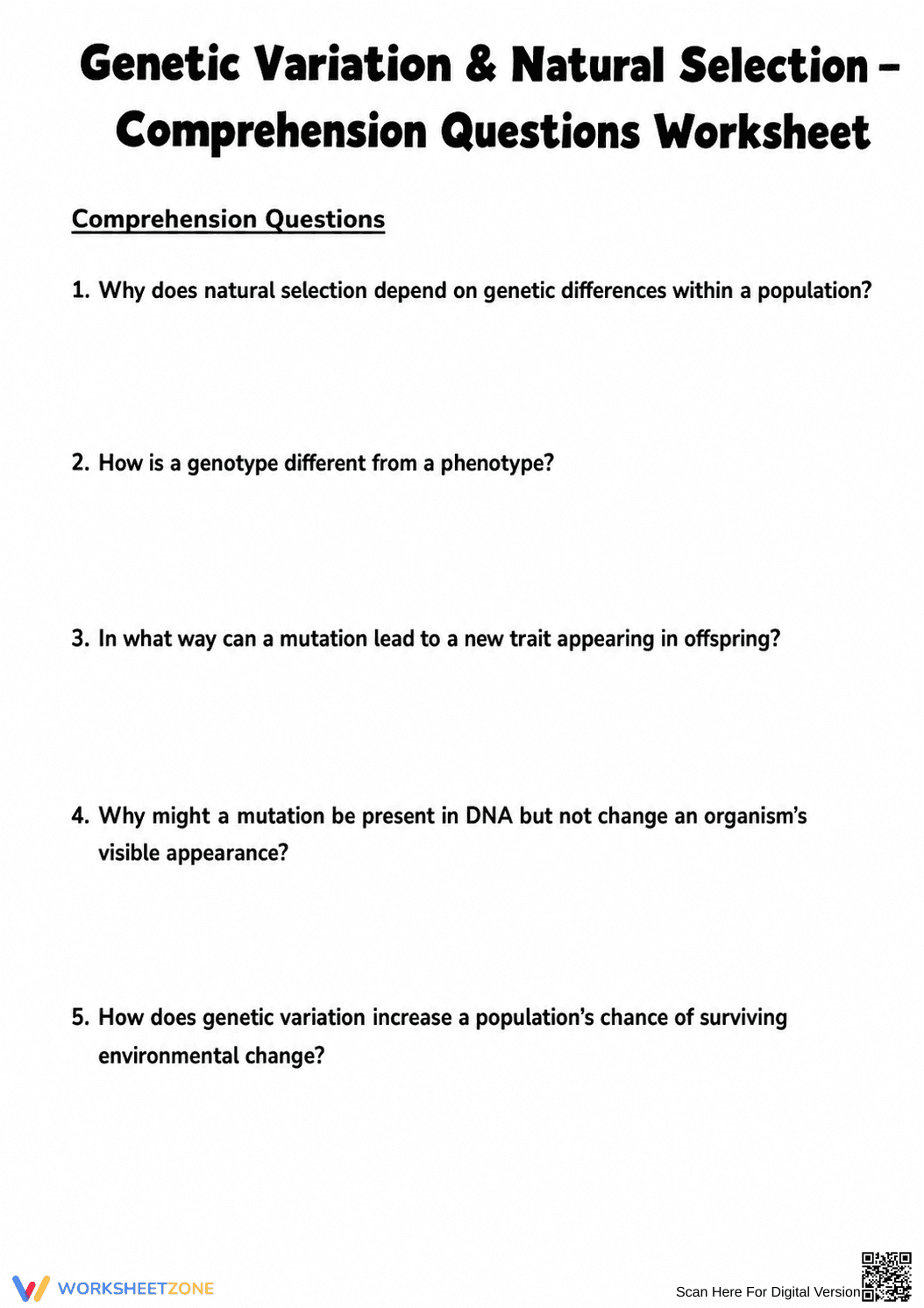
The resource consists of a two-page PDF featuring a concise informational text and nine open-ended comprehension questions. The reading passage defines critical terminology including alleles, mutations, and the distinction between genotype and phenotype. The questions are designed to elicit evidence-based responses, requiring students to synthesize information from the text to explain biological processes. A full answer key is provided for rapid grading.
This worksheet is designed for immediate classroom implementation with a total teacher prep time of under 2 minutes. Simply print the two-page document and distribute it to students. Because the reading passage is self-contained, no external textbooks or prior lectures are required for completion, making it an ideal choice for emergency sub plans or quiet independent work blocks. Reviewing student responses takes approximately 5 minutes using the included key.
This resource aligns with HS-LS4-2, which requires students to construct explanations for evolution based on heritable genetic variation. It also supports MS-LS4-4 by examining how genetic variations of traits in a population increase some individuals' probability of surviving and reproducing. Both standard codes can be copied directly into lesson plans, IEP goals, or district curriculum mapping tools.
Use this worksheet as a formative assessment after an introductory lecture on heredity to gauge student understanding of how mutations impact phenotypes. Alternatively, assign it as a flipped classroom reading assignment where students arrive prepared to discuss the role of environmental pressure on allele frequency. Completion typically takes 25 minutes, allowing for a 5-minute peer-review session afterward.
This material is tailored for middle school life science and high school biology students, particularly those preparing for state-level science assessments. It provides necessary scaffolding for English Language Learners through clear definitions of technical terms. It pairs naturally with a lab activity on bird beak adaptation or a simulation of peppered moth natural selection.
According to the RAND AIRS 2024 report on science literacy, structured reading comprehension tasks that require students to link genetic mechanisms to observable evolutionary outcomes significantly improve long-term retention of complex biological concepts. This worksheet addresses the HS-LS4-2 standard by focusing on the heritable nature of variation, a core component of the Next Generation Science Standards (NGSS). Research from Fisher & Frey (2014) emphasizes that gradual release through informational texts allows students to build the academic vocabulary necessary for higher-order scientific inquiry. By isolating the variables of mutation and selection, this resource provides a clear pathway for students to articulate how populations change over time. Educators can utilize this tool to provide evidence of student mastery in alignment with EdReports 2024 criteria for high-quality instructional materials in the life sciences.


