


























Views
Downloads
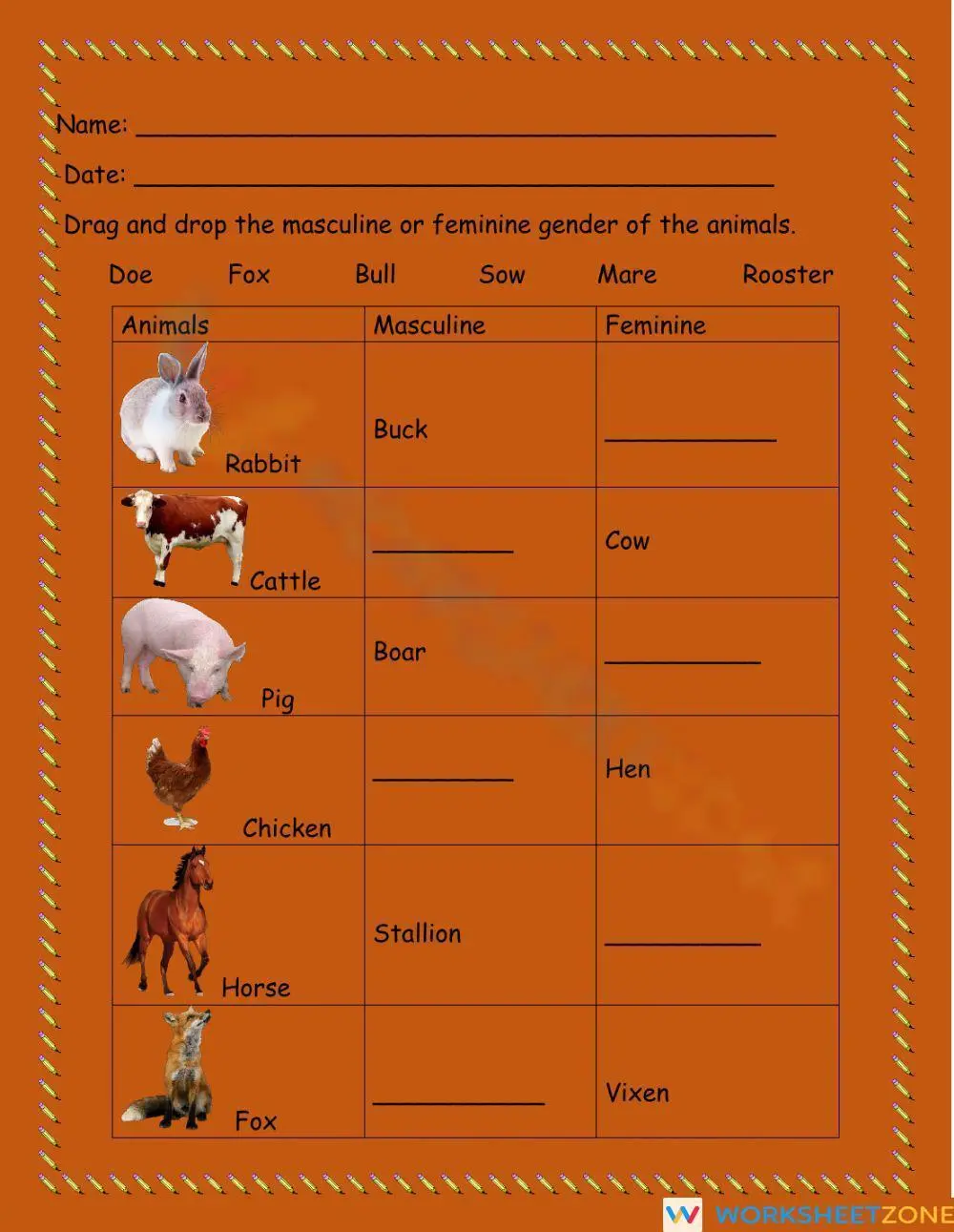

Essential Animal Gender Worksheet | Grade 2 ELA Ready
Paste this activity's link or code into your existing LMS (Google Classroom, Canvas, Teams, Schoology, Moodle, etc.).
Students can open and work on the activity right away, with no student login required.
You'll still be able to track student progress and results from your teacher account.
Mastering specific vocabulary like animal gender names is a vital step in developing grammatical precision. This Grade 2 ELA worksheet provides focused practice on identifying masculine and feminine nouns for common animals. Students will actively match pairs such as stallion and mare, strengthening their core lexicon and foundational language skills.
At a Glance
- Grade: 2 · Subject: English Language Arts (ELA)
- Standard:
CCSS.ELA-LITERACY.L.2.1.a— Use collective nouns and other specific noun categories to demonstrate command of grammar.- Skill Focus: Gendered Nouns (Animals)
- Format: 1 page · 6 problems · Answer key included · PDF
- Best For: Grammar stations, morning work, or quick assessment
- Time: 10–15 minutes
What's Inside
This single-page PDF offers a visually supported approach to learning gendered nouns. It features photos of six animals—rabbit, cattle, pig, chicken, horse, and fox—alongside a table for recording masculine and feminine terms. A word bank provides necessary vocabulary, ensuring independence. The included answer key allows for immediate feedback.
A Zero-Prep Workflow
Minimize administrative burden with this simple three-step process:
- Print (1 minute): Print the single page; no collation required.
- Distribute (1 minute): Hand out for immediate use in centers or morning work.
- Review (3 minutes): Use the answer key for quick class-wide checks.
The total prep time is under two minutes, making it an ideal choice for emergency substitute plans.
Standards Alignment
This worksheet aligns with CCSS.ELA-LITERACY.L.2.1.a, focusing on the command of English grammar conventions, specifically specific noun categories. By targeting animal genders, students learn to apply precise terminology. This standard code can be copied directly into lesson plans, IEP goals, or district curriculum mapping tools to ensure instructional rigor.
How to Use It
Use this as a formative assessment to identify students needing support with specific animal vocabulary. It works perfectly as a "silent starter" or morning work task. For an extension, have students write sentences using both the masculine and feminine names. Completion typically takes 10–15 minutes, providing a concise yet effective learning burst.
Who It's For
This resource is tailored for Grade 2 but serves as enrichment for Grade 1 or review for Grade 3. Visual support makes it accessible for English Language Learners and students with IEPs. It pairs naturally with non-fiction animal texts, creating a cross-curricular bridge between language arts and science units.
Developing a robust vocabulary is a cornerstone of early literacy that influences reading comprehension and writing clarity. This worksheet addresses this by providing structured practice with gendered animal nouns within the CCSS.ELA-LITERACY.L.2.1.a framework. Research by Fisher & Frey (2014) emphasizes that effective vocabulary acquisition occurs when students engage in active word-solving and categorization tasks. This matching activity requires students to evaluate the relationships between masculine and feminine terms, reinforcing their understanding through meaningful context. By focusing on these linguistic conventions, the worksheet helps students transition to the precision required for academic success. Such targeted interventions are supported by the NAEP as essential for closing vocabulary gaps. This single-page PDF provides the evidence-based repetition necessary for students to internalize and independently apply these specialized noun categories in their own speech and writing.


