




























Views
Downloads
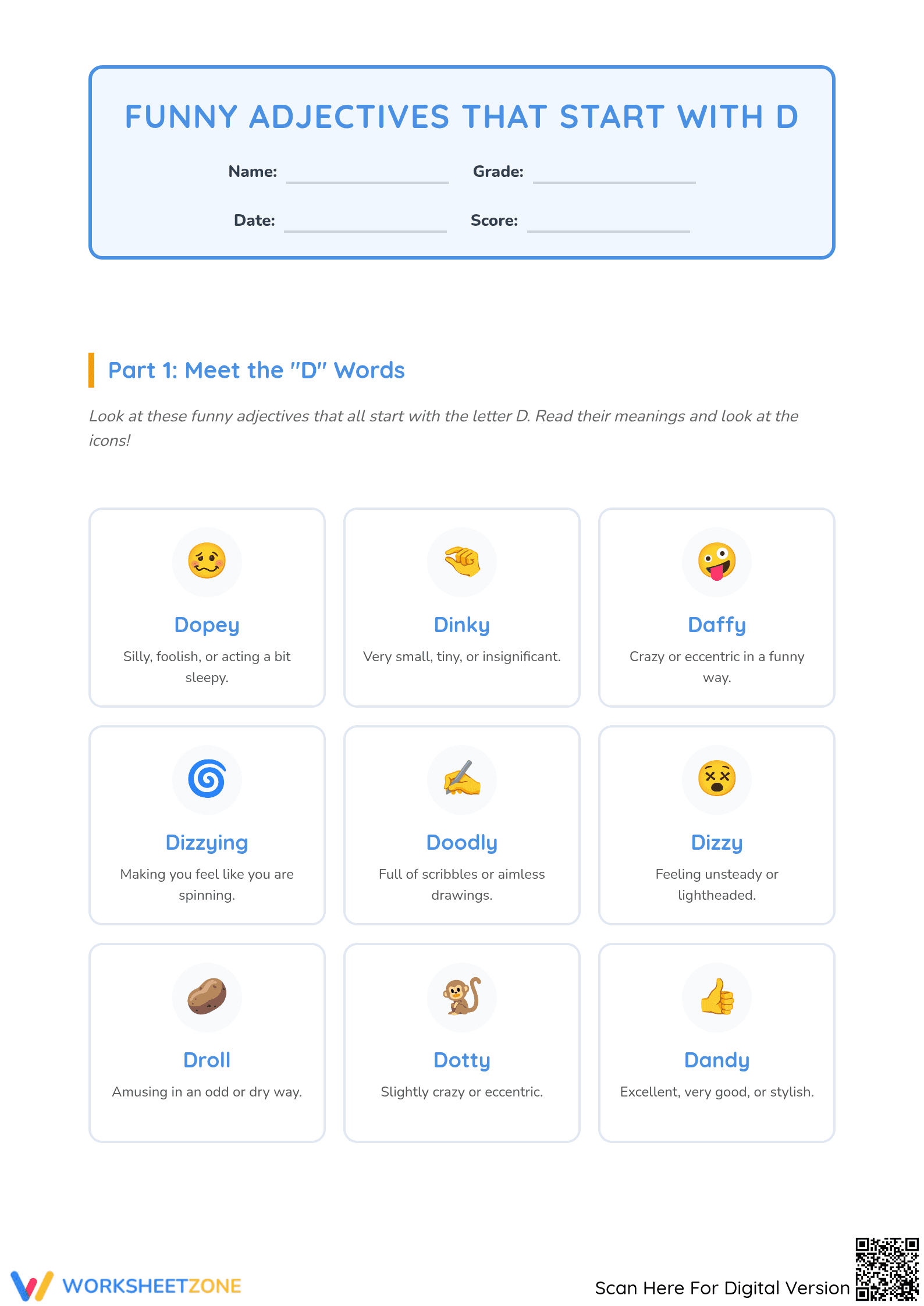



Printable Funny Adjectives Worksheet | Grade 3-4 ELA

Paste this activity's link or code into your existing LMS (Google Classroom, Canvas, Teams, Schoology, Moodle, etc.).
Students can open and work on the activity right away, with no student login required.
You'll still be able to track student progress and results from your teacher account.
This Grade 3 and Grade 4 vocabulary worksheet introduces students to nine unique adjectives starting with the letter D. By engaging with humorous and descriptive words like droll and dinky, learners expand their linguistic repertoire and improve their ability to describe characters and settings with precision and creativity.
At a Glance
- Grade: 3-4 · Subject: ELA
- Standard:
CCSS.ELA-LITERACY.L.3.6— Acquire and use grade-appropriate conversational, general academic, and domain-specific words- Skill Focus: Adjective vocabulary and usage
- Format: 3 pages · 12 problems · Answer key included · PDF
- Best For: Vocabulary expansion and creative writing practice
- Time: 20–30 minutes
The resource contains three comprehensive pages designed to move students from word recognition to application. It features a visual glossary of nine D adjectives with kid-friendly definitions and icons. Following the introduction, students complete a five-item matching activity, a six-item sentence completion task, and a creative writing prompt that includes space for an original illustration.
The worksheet follows a structured instructional path to ensure word mastery:
- Guided Practice: Students begin by reviewing nine illustrated word cards that provide immediate context and visual cues for each new adjective.
- Supported Practice: A matching section requires students to identify correct definitions for five key terms, reinforcing the relationship between words and meanings.
- Independent Practice: Learners apply their knowledge by selecting the best adjective for six context-rich sentences and finally composing an original sentence.
This gradual-release model ensures students feel confident before moving to open-ended creative tasks.
This resource is aligned with CCSS.ELA-LITERACY.L.3.6, which focuses on acquiring and using grade-appropriate conversational and general academic words. It also supports Grade 4 language standards, helping students demonstrate command of the conventions of standard English grammar when writing. Both standard codes can be copied directly into lesson plans, IEP goals, or district curriculum mapping tools.
Use this worksheet as a follow-up to a lesson on descriptive writing or as a fun Word of the Day extension. During the sentence completion phase, observe if students can use context clues to distinguish between similar words like dizzy and dizzying. The 3-page set typically takes 20 to 30 minutes to complete depending on the depth of the creative drawing section.
This activity is ideal for third and fourth-grade students who need to move beyond basic adjectives like good or big. It is particularly effective for English Language Learners (ELL) due to the heavy use of visual icons and clear definitions. Pair this with a character-building writing prompt or a mentor text that uses rich, descriptive language to see the words in action.
According to research by Fisher & Frey (2014) on the gradual release of responsibility, providing students with clear scaffolds—such as the visual icons and definitions found in this resource—is essential for successful vocabulary acquisition. This worksheet implements those findings by transitioning students from simple recognition to complex application in original writing. By focusing on a specific subset of adjectives, the material prevents cognitive overload while encouraging deep engagement with specific word meanings. The inclusion of 12 distinct assessment tasks allows teachers to verify that students have moved beyond rote memorization to functional usage. This alignment with CCSS.ELA-LITERACY.L.3.6 ensures that the vocabulary taught is not just amusing but academically relevant for upper elementary learners. The structured format makes it a reliable tool for both general education classrooms and targeted intervention groups seeking to improve descriptive writing skills.


