


























Views
Downloads
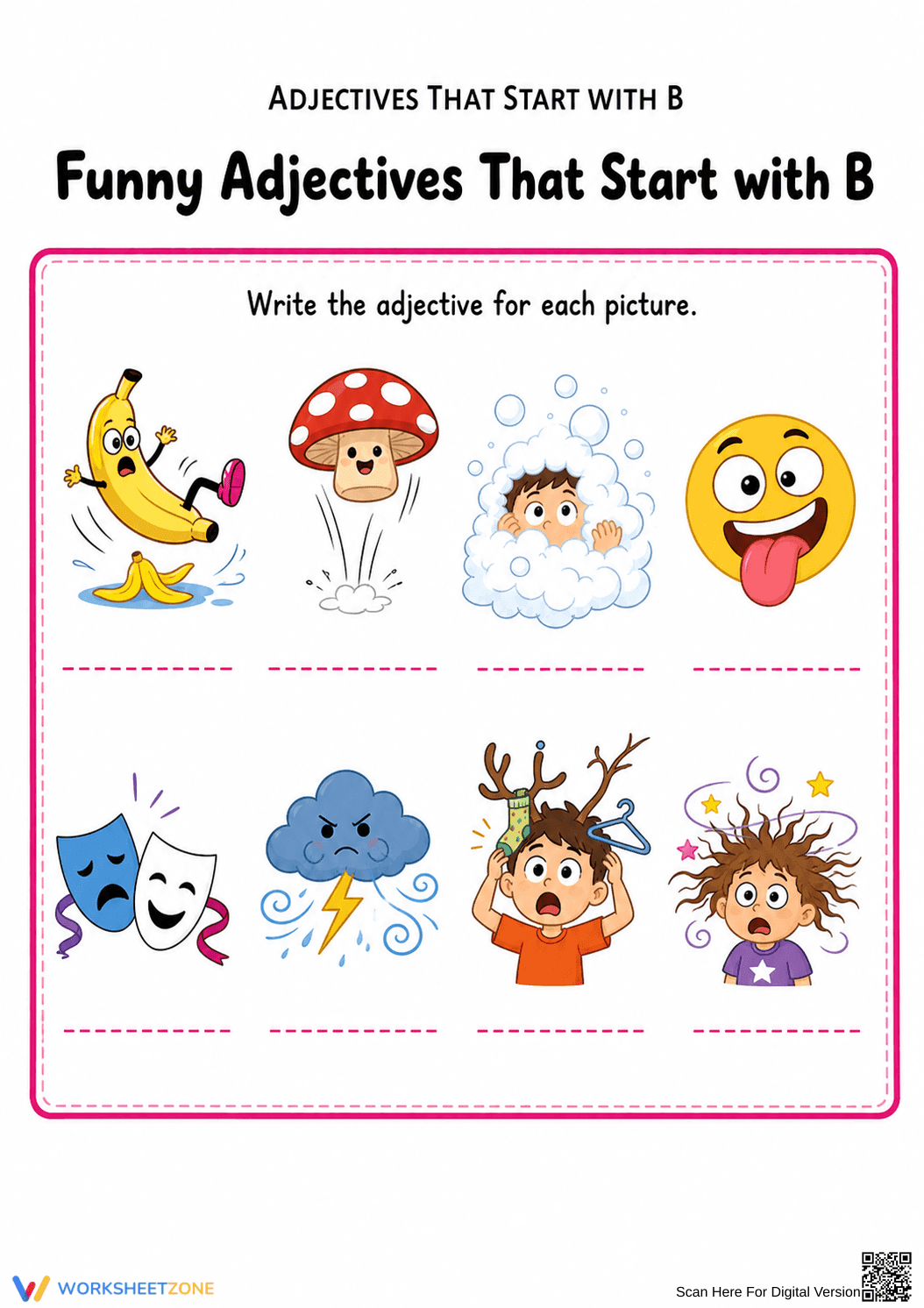

Funny Adjectives Starting with B | Essential Grade 3-4
Paste this activity's link or code into your existing LMS (Google Classroom, Canvas, Teams, Schoology, Moodle, etc.).
Students can open and work on the activity right away, with no student login required.
You'll still be able to track student progress and results from your teacher account.
This Grade 3 and 4 grammar worksheet helps students identify and apply descriptive adjectives starting with the letter B. By connecting humorous visual illustrations to specific vocabulary words, learners strengthen their parts-of-speech knowledge and creative writing abilities. It provides a focused way to expand descriptive language through engaging, context-rich imagery.
At a Glance
- Grade: 3-4 · Subject: ELA Grammar
- Standard:
CCSS.ELA-LITERACY.L.3.1— Demonstrate command of the conventions of standard English grammar and usage- Skill Focus: Adjectives starting with B
- Format: 1 page · 8 problems · Answer key included · PDF
- Best For: Morning work or vocabulary warm-ups
- Time: 10–15 minutes
The worksheet features 8 distinct, high-quality illustrations designed to elicit specific "B" adjectives such as bouncy, bubbly, or bewildered. Each image is paired with a clear writing line for student responses. The single-page PDF format ensures clarity, while the humorous nature of the drawings keeps students engaged during independent practice sessions.
This resource follows a streamlined three-step workflow. First, print the single-page PDF (30 seconds). Second, distribute to students for independent or partner work (1 minute). Third, review the 8 responses as a whole class to share creative word choices (5 minutes). Total teacher preparation time is under 2 minutes, making it an ideal sub plan or emergency filler.
Primary alignment is to `CCSS.ELA-LITERACY.L.3.1`, focusing on the command of English grammar and usage when writing. It also supports `CCSS.ELA-LITERACY.L.4.6` by encouraging students to acquire and use grade-appropriate general academic words. Both standard codes can be copied directly into lesson plans, IEP goals, or district curriculum mapping tools.
Use this as a formative assessment after a lesson on adjectives to check for understanding. Alternatively, assign it as a creative writing spark where students must use their chosen adjectives in a follow-up sentence. Completion typically takes 10 to 15 minutes. Observe if students can identify the nuance between different descriptive words based on the visual cues provided.
This is designed for Grade 3 and 4 students, including English Language Learners who benefit from visual scaffolding. It pairs naturally with a descriptive writing unit or an anchor chart focused on vivid verbs and amazing adjectives. The humorous theme ensures that even reluctant writers find a point of entry into the vocabulary task.
Research from Fisher & Frey (2014) emphasizes the importance of visual non-linguistic representations in vocabulary acquisition, particularly for parts of speech like adjectives. This worksheet utilizes 8 visual prompts to bridge the gap between abstract grammatical concepts and concrete application. By focusing on the specific constraint of the letter B, the activity reduces cognitive load while encouraging deep retrieval of stored vocabulary. According to the RAND AIRS 2024 report on instructional materials, high-utility worksheets that combine humor with standard-aligned tasks increase student persistence in grammar exercises. This resource directly addresses CCSS.ELA-LITERACY.L.3.1 by requiring students to produce appropriate descriptive words in context. The inclusion of an answer key allows for immediate feedback, a critical component of the gradual release of responsibility model. Educators can reliably use this tool to document progress toward language mastery goals in elementary ELA settings.


