


























Views
Plays

Essential Ending Punctuation Worksheet | Grade 1-2
Paste this activity's link or code into your existing LMS (Google Classroom, Canvas, Teams, Schoology, Moodle, etc.).
Students can open and work on the activity right away, with no student login required.
You'll still be able to track student progress and results from your teacher account.
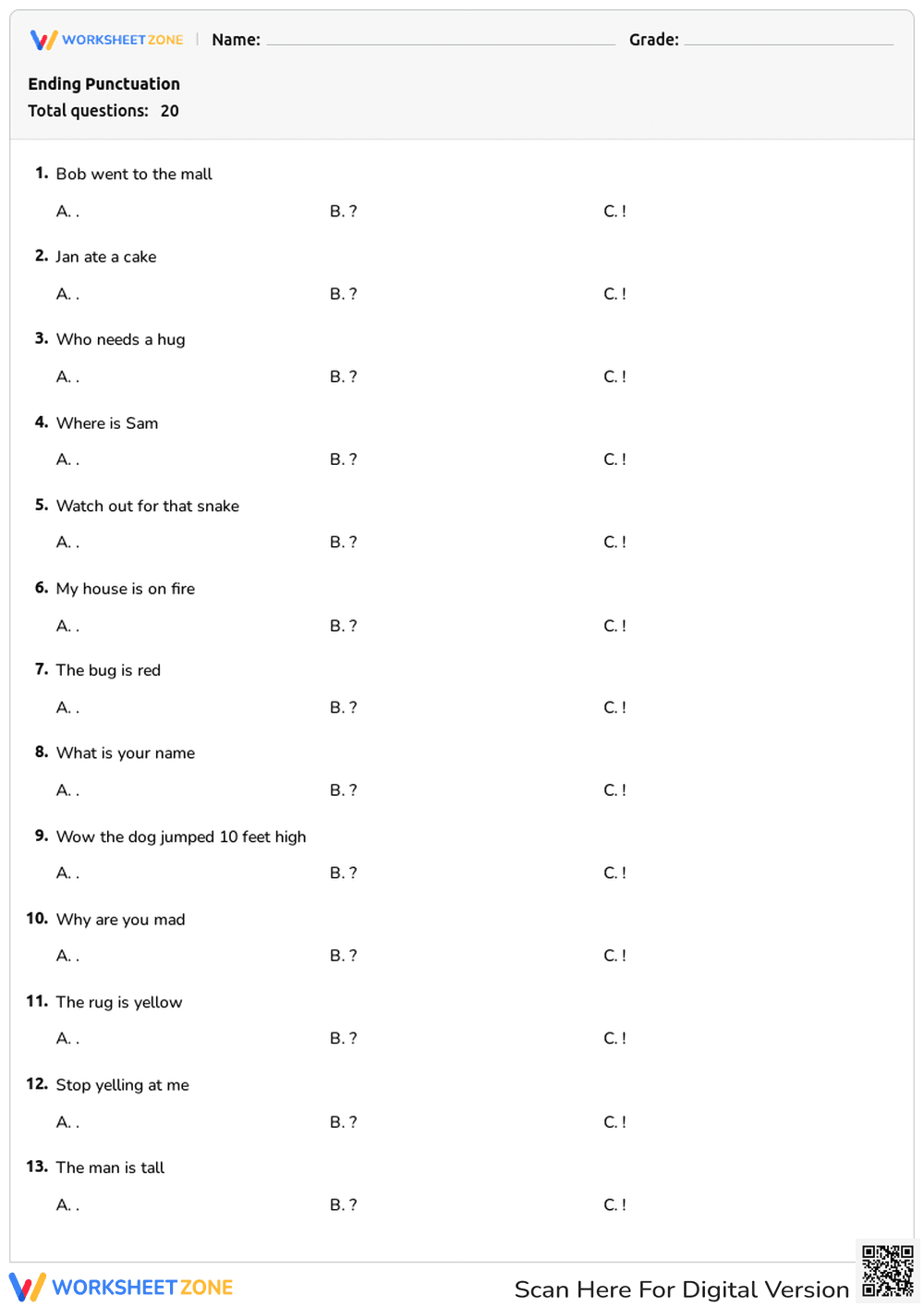
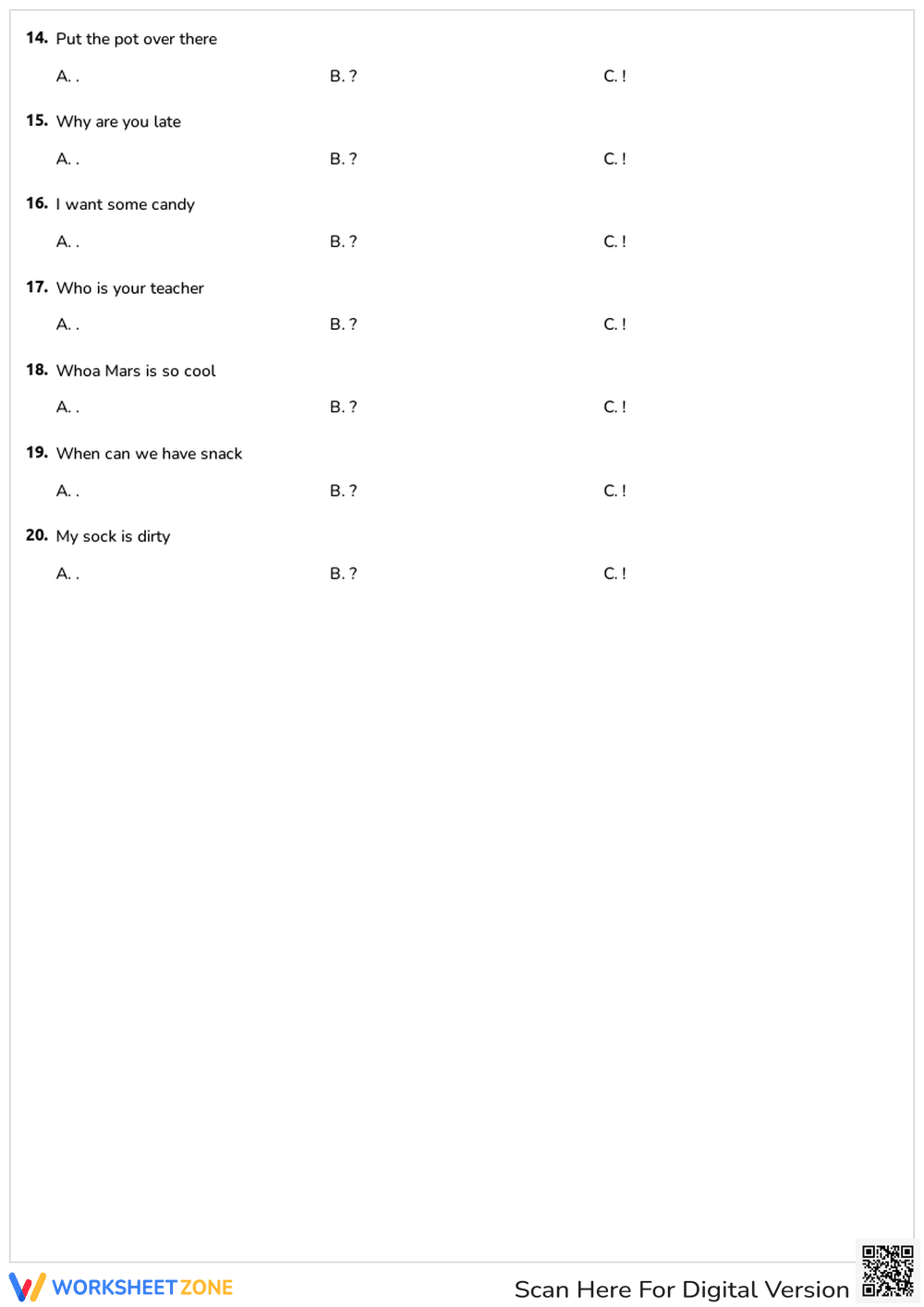
This Grade 1 and Grade 2 ending punctuation worksheet provides students with 20 targeted opportunities to identify the correct terminal mark for various sentence types. By distinguishing between statements, questions, and exclamations, learners solidify their understanding of sentence structure and mechanics. This resource ensures students can accurately communicate meaning through proper punctuation placement.
At a Glance
- Grade: 1-2 · Subject: ELA Grammar
- Standard:
CCSS.ELA-LITERACY.L.1.2.B— Use end punctuation for sentences including periods, question marks, and exclamation points- Skill Focus: Terminal Punctuation Selection
- Format: 2 pages · 20 problems · Answer key included · PDF
- Best For: Independent practice or formative assessment
- Time: 15–20 minutes
The worksheet features a clean, distraction-free layout across two pages. It contains 20 multiple-choice questions where students read a sentence and select the appropriate ending mark from three options: a period, a question mark, or an exclamation point. The repetitive structure helps build student confidence and allows for quick scanning by the teacher during review.
This resource is designed for a zero-prep classroom workflow. Teachers can print the two-page PDF in less than 30 seconds. Distribution takes approximately 1 minute, and because the format is multiple-choice, a whole-class review or individual grading can be completed in under 5 minutes. It is an ideal printable resource for substitute plans or unexpected schedule changes.
Aligned primarily to CCSS.ELA-LITERACY.L.1.2.B, which requires students to use end punctuation for sentences. It also supports foundational writing standards by reinforcing the understanding of sentence boundaries. Both standard codes can be copied directly into lesson plans, IEP goals, or district curriculum mapping tools.
Use this worksheet as a formative assessment after a direct instruction lesson on sentence types. Alternatively, assign it as morning work to reinforce grammar mechanics. While students work, observe if they are reading the sentences aloud to hear the voice of the sentence, which often dictates the punctuation choice. Completion typically ranges from 15 to 20 minutes.
This resource is specifically tailored for first and second-grade students who are transitioning from simple sentence construction to more complex expression. It is also highly effective for English Language Learners (ELLs) who need explicit practice with English syntax. Pair this with a punctuation anchor chart or a mentor text to provide visual support.
According to research by Fisher & Frey (2014) regarding the gradual release of responsibility, structured practice with immediate feedback is essential for mastering foundational literacy skills like terminal punctuation. This worksheet provides the independent phase of instruction, allowing students to apply the CCSS.ELA-LITERACY.L.1.2.B standard. By isolating the variable of punctuation within a multiple-choice format, cognitive load is reduced, allowing students to focus specifically on the relationship between sentence intent and the corresponding mark. Data from NAEP suggests that early mastery of mechanics is a strong predictor of later writing fluency. This 20-task resource ensures that students receive sufficient repetition to move toward automaticity. The clear distinction between declarative, interrogative, and exclamatory sentences helps bridge the gap between oral language and written conventions, a critical milestone in early elementary education.


