


























Views
Downloads
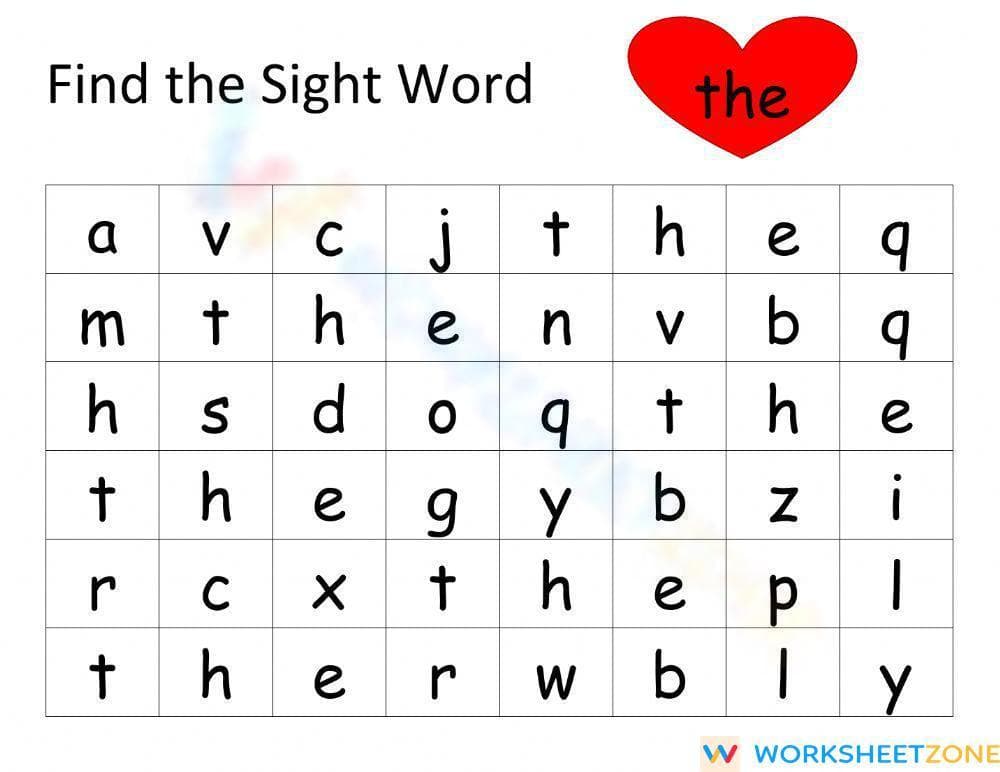

Grade 1 Sight Words — Printable No-Prep Worksheet
Paste this activity's link or code into your existing LMS (Google Classroom, Canvas, Teams, Schoology, Moodle, etc.).
Students can open and work on the activity right away, with no student login required.
You'll still be able to track student progress and results from your teacher account.
This worksheet provides focused, independent practice for first-grade students learning to identify the high-frequency sight word 'the'. Through a simple and engaging word search puzzle, young readers will improve their visual scanning and automaticity with one of English's most common words, building a stronger foundation for reading fluency.
At a Glance
- Grade: 1 · Subject: ELA, Foundational Skills
- Standard:
CCSS.ELA-LITERACY.RF.1.3.G— Recognize and read grade-appropriate irregularly spelled words.- Skill Focus: Sight Word Recognition ('the')
- Format: 1 page · 1 word search puzzle · PDF
- Best For: Warm-ups, literacy centers, or sub plans
- Time: 5–10 minutes
What's Inside
This resource is a single-page, ready-to-print PDF file. It features one primary activity: a word search grid containing the target sight word 'the' hidden among other letters. The layout is clean and uncluttered to help students focus on the task without distraction. Because of the straightforward nature of the activity, no answer key is provided, as teachers can verify completion at a glance.
Zero-Prep Workflow
Designed for efficiency, this worksheet can be used with under two minutes of prep. The workflow is simple: 1. Print: The single-page PDF prints quickly. 2. Distribute: Hand out during a transition, as a warm-up, or at a literacy center. No complex instructions are needed. 3. Review: A quick visual check confirms completion. Its simplicity makes it ideal for substitute teachers or when a quiet, independent activity is needed.
Standards Alignment
This worksheet directly supports the Common Core State Standard CCSS.ELA-LITERACY.RF.1.3.G, which requires students to recognize and read grade-appropriate irregularly spelled words. Mastery of high-frequency words like 'the' is a critical component of this foundational skill, enabling greater fluency and comprehension. Both standard codes can be copied directly into lesson plans, IEP goals, or district curriculum mapping tools.
How to Use It
Use this worksheet as a quick warm-up for an ELA block or for a self-directed literacy center. For formative assessment, observe which students complete the task quickly versus those who need more time, providing insight into their sight word automaticity. The activity should take most students between 5 and 10 minutes to complete. It's a perfect task for early finishers or as part of a substitute teacher's folder.
Who It's For
This resource is designed for first-grade students who are beginning to build their bank of sight words. It is also suitable for second-graders who may need additional reinforcement with high-frequency word recognition. To support learners, pair this activity with an anchor chart displaying the first 100 Fry or Dolch sight words. Following the worksheet, have students practice writing the word 'the' in a simple sentence they create themselves.
This worksheet for sight word recognition aligns with research on early literacy acquisition, addressing CCSS.ELA-LITERACY.RF.1.3.G. Foundational reading skills, particularly the automatic recognition of high-frequency words, are a strong predictor of later reading success. As noted in the RAND AIRS 2024 review, systematic and explicit instruction in foundational skills is crucial for all students. This simple word search provides the repeated exposure necessary for students to move a word from conscious decoding to instant recognition. By focusing on a single, critical sight word—'the'—this activity supports the development of orthographic mapping. This process is essential for building a sight vocabulary and, ultimately, for achieving fluent, effortless reading. The targeted practice herein helps solidify this specific word in a student's long-term memory, reducing cognitive load during text reading.


