


























Views
Downloads

Plant Life Cycle Worksheet | Printable Grade K-1
Paste this activity's link or code into your existing LMS (Google Classroom, Canvas, Teams, Schoology, Moodle, etc.).
Students can open and work on the activity right away, with no student login required.
You'll still be able to track student progress and results from your teacher account.
This Grade K-1 science worksheet provides a clear, visual framework for students to document the five stages of botanical growth. By identifying the progression from a dormant seed to a mature adult plant, early learners develop a foundational understanding of biological patterns and the essential requirements for life.
At a Glance
- Grade: K-1 · Subject: Science
- Standard:
K-LS1-1— Describe patterns of what plants need to survive- Skill Focus: Plant life cycle sequencing
- Format: 1 page · 5 problems · Answer key included · PDF
- Best For: Introduction to botany and life cycles
- Time: 15–20 minutes
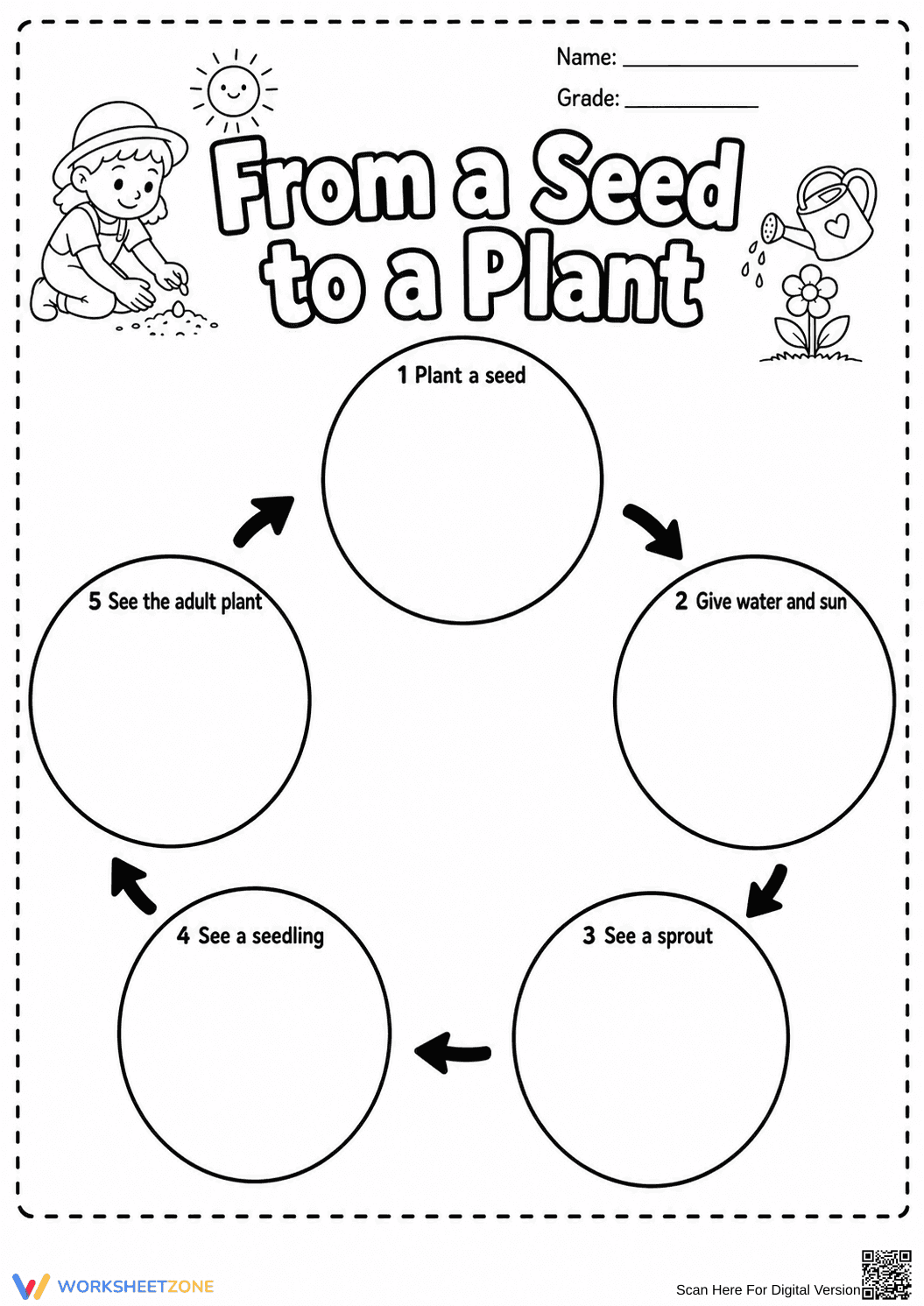
This single-page PDF features a circular flow chart representing continuous plant growth. It includes five numbered stages: planting the seed, providing water and sun, seeing a sprout, observing a seedling, and identifying the adult plant. The large circular frames are designed for student illustrations, making it highly adaptable for different fine motor skill levels. A complete answer key is included.
The zero-prep workflow is designed for maximum efficiency in primary classrooms. First, print the single-page document (30 seconds). Second, distribute the sheets during your science block (1 minute). Finally, review the completed cycles as a whole group to reinforce vocabulary (5 minutes). Total teacher preparation time is under 2 minutes, making it an ideal choice for emergency sub plans.
This resource is aligned with K-LS1-1, which requires students to use observations to describe patterns of what plants and animals need to survive. By sequencing the life cycle, students observe the pattern of growth and the specific inputs required for a seed to transition into an adult plant. Both standard codes can be copied directly into lesson plans, IEP goals, or district curriculum mapping tools.
Use this worksheet as a formative assessment after a read-aloud about gardening or a hands-on seed-planting activity. It serves as an excellent exit ticket to verify that students understand the chronological order of growth. Teachers should observe whether students correctly place the sprout before the seedling to gauge their grasp of developmental stages. Expect completion within 15 to 20 minutes depending on whether students draw or write their responses.
This worksheet is tailored for Kindergarten and first-grade students, as well as English Language Learners who benefit from the visual scaffolding and clear numbering. It pairs naturally with a classroom bean-in-a-jar experiment or an anchor chart detailing the parts of a plant. The simple layout ensures that the focus remains on the biological concept rather than complex instructions.
According to research by Fisher & Frey (2014), visual organizers like this life cycle chart are essential for scaffolding complex scientific concepts for early learners. By providing a structured sequence of five tasks, the worksheet allows students to move from guided observation to independent mastery of biological patterns. The inclusion of standard K-LS1-1 ensures the activity remains focused on observable evidence. Educational data from NAEP suggests that early exposure to sequencing in science correlates with improved reading comprehension and logical reasoning in later elementary years. This resource provides the necessary repetition and visual cues to solidify the seed to plant concept in a student's long-term memory. It is a high-utility tool for any primary science curriculum focusing on life cycles, helping students describe patterns of what plants need to survive.


