


























Views
Downloads

Grade 1 Frog Life Cycle — Printable No-Prep Worksheet
Paste this activity's link or code into your existing LMS (Google Classroom, Canvas, Teams, Schoology, Moodle, etc.).
Students can open and work on the activity right away, with no student login required.
You'll still be able to track student progress and results from your teacher account.
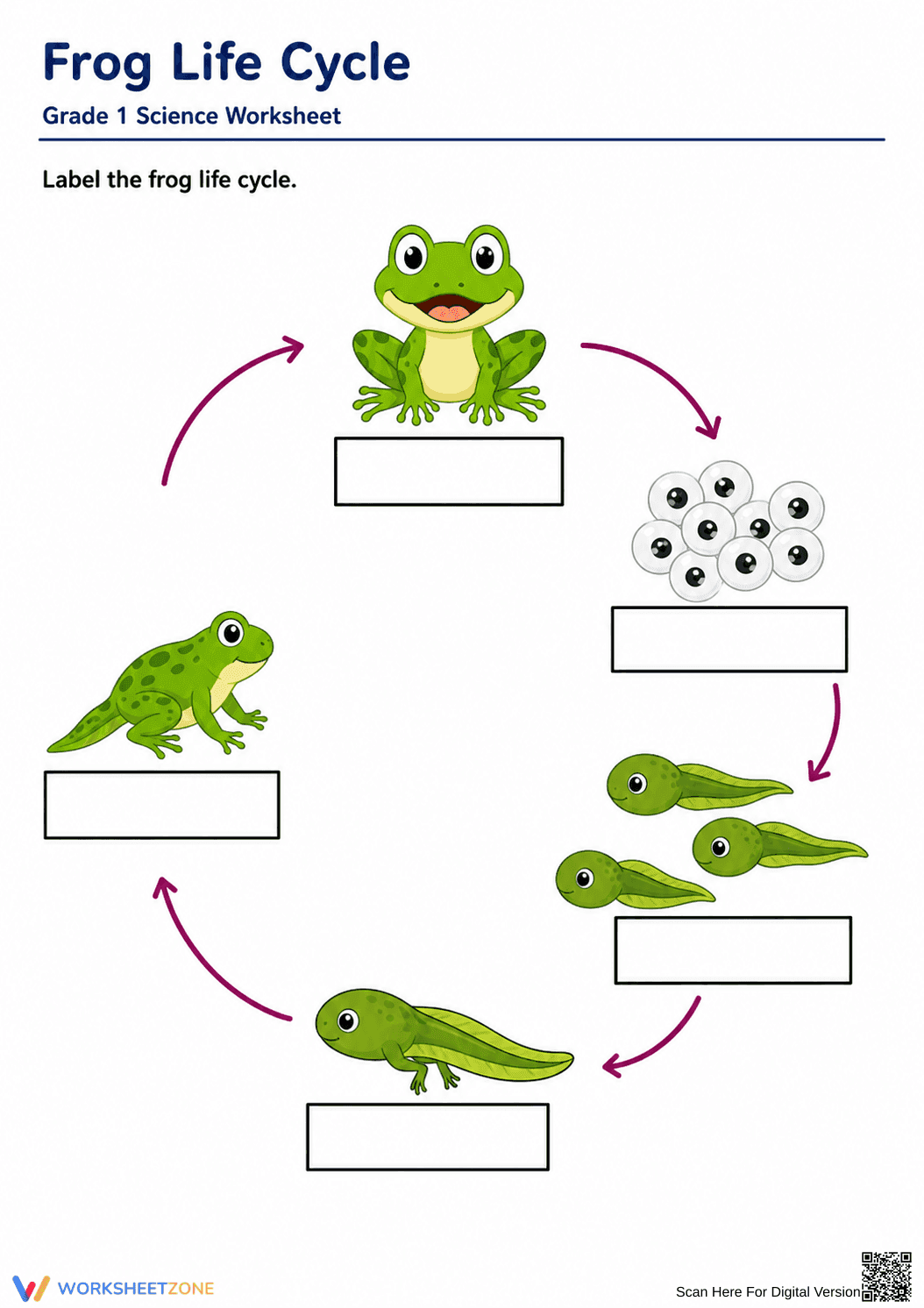
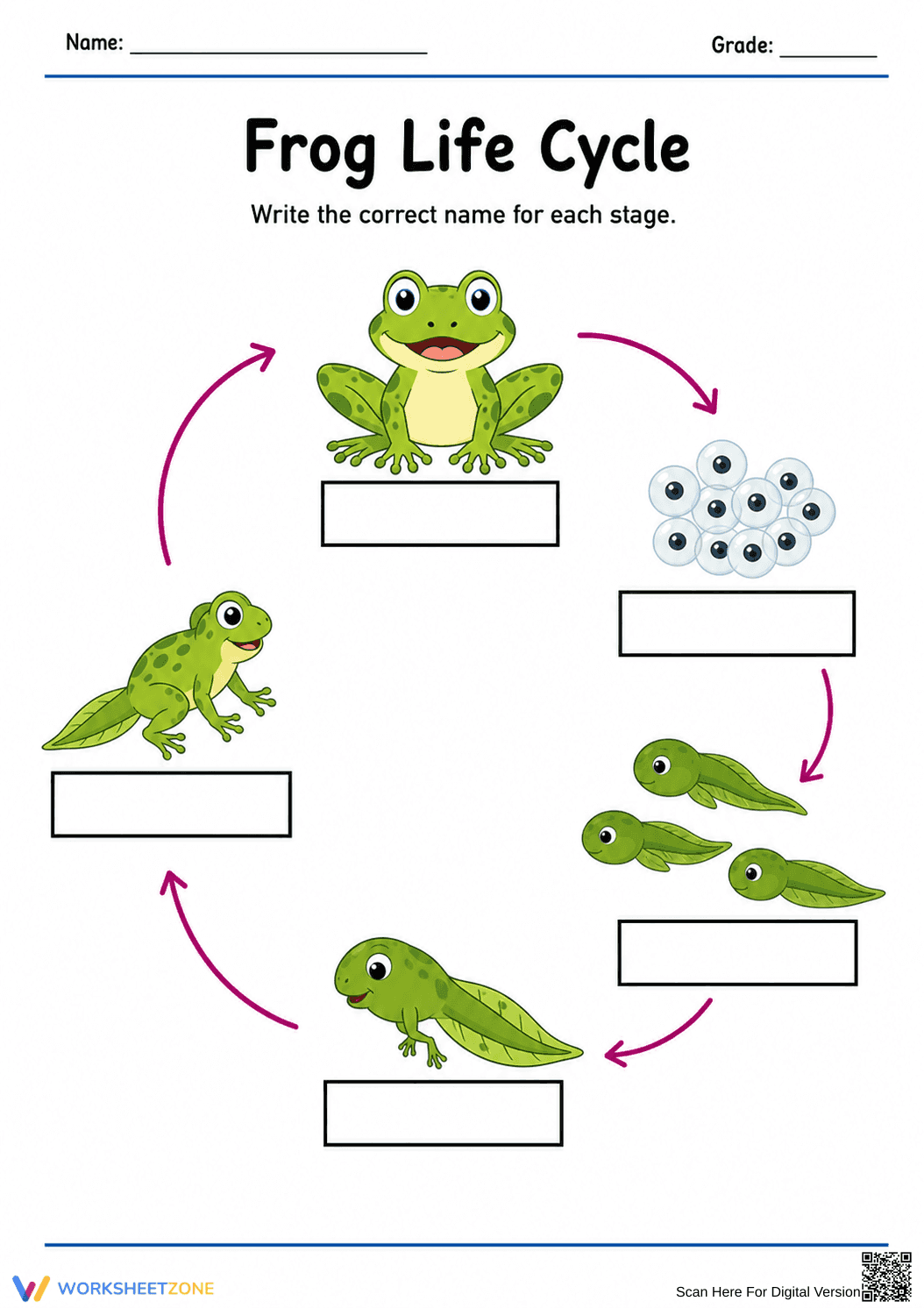
This Grade 1 frog life cycle worksheet helps students visualize and sequence the biological transformations of amphibians. By labeling five distinct developmental stages, learners move beyond simple observation to understanding the patterns of growth and development in living things. This resource provides a clear, structured path for young scientists to master life science vocabulary and concepts.
At a Glance
- Grade: 1 · Subject: Science
- Standard:
3-LS1-1— Develop models to describe that organisms have unique and diverse life cycles- Skill Focus: Sequencing biological stages and scientific labeling
- Format: 2 pages · 5 problems · Answer key included · PDF
- Best For: Individual practice or quick science assessment
- Time: 10–15 minutes
What's Inside
This two-page PDF includes a high-quality circular diagram illustrating frog metamorphosis. The first page provides empty text boxes to label eggs, tadpoles, tadpole with hind legs, froglet, and adult frog. The second page is a comprehensive answer key. The clear, colorful illustrations serve as visual scaffolds, making metamorphosis tangible for elementary learners.
Zero-Prep Workflow
Optimized for efficiency, this resource follows a three-step implementation plan. First, Print the worksheet and answer key; this takes less than 30 seconds. Second, Distribute the materials during your science block or as part of a literacy center. Finally, Review the results using the included key, which can be projected on a whiteboard. This zero-prep design makes it an ideal choice for emergency substitute plans or quick transitions.
Standards Alignment
This content is aligned with the NGSS primary standard 3-LS1-1: "Develop models to describe that organisms have unique and diverse life cycles but all have in common birth, growth, reproduction, and death." While used in early elementary, it focuses on observable patterns of change foundational to biological sciences. Both standard codes can be copied directly into lesson plans, IEP goals, or district curriculum mapping tools to ensure compliance with national science frameworks.
How to Use It
Use this as a formative assessment or an introductory activity. For an effective instructional moment, observe students as they label the "tadpole with hind legs" versus the "froglet" stage; this is a prime opportunity to discuss the development of physical traits. The expected completion time is 10 to 15 minutes, making it a perfect "exit ticket" to gauge student understanding before moving on to other animal life cycles.
Who It's For
Tailored for Grade 1 students, it works well for English Language Learners (ELL) who benefit from the connection between scientific terms and visual representations. Pair this with a non-fiction reading passage about pond life or a live classroom observation of tadpoles to create a multi-sensory learning experience that reinforces scientific vocabulary through diverse modalities.
According to Fisher & Frey (2014), the "gradual release of responsibility" model is most effective when students have structured opportunities to apply new vocabulary to mental models. This frog life cycle worksheet aligns with this research by providing a scaffolded environment where students practice labeling 3-LS1-1 concepts. By identifying five distinct stages—including transitional phases like the froglet—students develop a nuanced understanding of biological time and physical transformation. ScienceDirect TpT Analysis indicates that high-performing life science units utilize similar sequencing tasks to bridge the gap between observation and scientific classification. This resource ensures that students meet rigorous 3-LS1-1 requirements while developing the spatial reasoning skills necessary for advanced biological study. This 2-page PDF provides 5 specific tasks that allow for immediate feedback via the included answer key, supporting the 10-minute instructional window common in primary science blocks.


