




























Views
Downloads
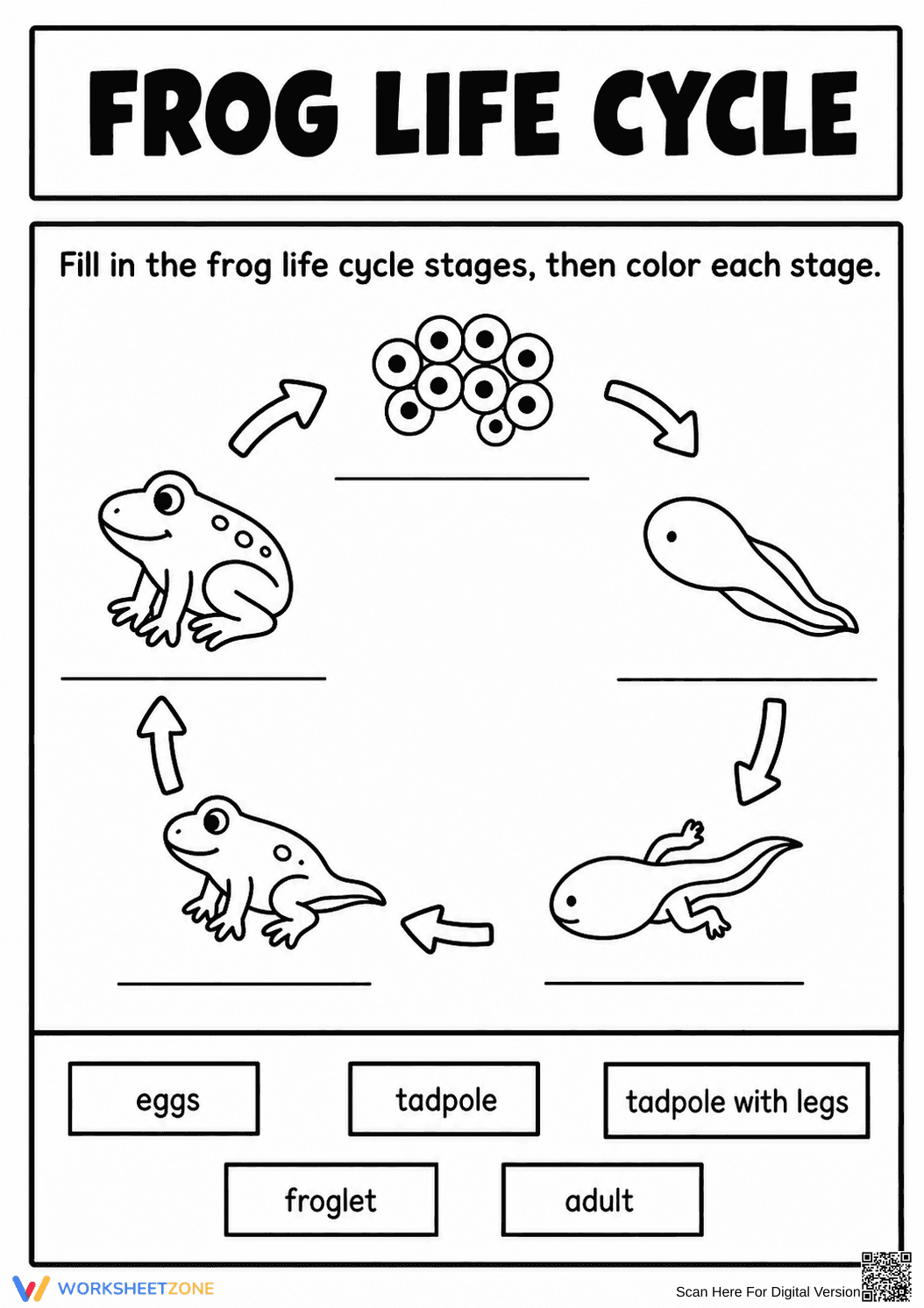

Frog Life Cycle Worksheet | Grade 3 Printable

Paste this activity's link or code into your existing LMS (Google Classroom, Canvas, Teams, Schoology, Moodle, etc.).
Students can open and work on the activity right away, with no student login required.
You'll still be able to track student progress and results from your teacher account.
This Grade 3 science worksheet provides a structured way for students to identify and sequence the biological stages of an amphibian. By labeling the eggs, tadpole, tadpole with legs, froglet, and adult frog, learners build a concrete mental model of growth and development. This activity ensures students master essential life science vocabulary through active participation.
At a Glance
- Grade: 3 · Subject: Science
- Standard:
3-LS1-1— Develop models to describe that organisms have unique and diverse life cycles- Skill Focus: Life cycle sequencing and labeling
- Format: 1 page · 5 problems · Answer key included · PDF
- Best For: Independent practice or science centers
- Time: 15–20 minutes
What's Inside: This single-page PDF features a circular diagram representing the continuous nature of the frog life cycle. It includes five high-quality black-and-white illustrations ready for coloring, five designated labeling lines, and a clear word bank at the bottom. The layout is designed to reduce cognitive load, allowing students to focus on the transition between larval and adult stages.
Zero-Prep Workflow: This resource is designed for immediate classroom implementation. First, print the required number of copies for your group, which takes less than one minute. Second, distribute the sheets during your life science block; the included word bank makes the task self-explanatory for most students. Finally, review the completed cycles as a whole group to check for accuracy, requiring zero teacher preparation or external materials.
Standards Alignment: This worksheet is specifically aligned to `3-LS1-1`. Students develop a model to describe that organisms have unique and diverse life cycles but all have in common birth, growth, reproduction, and death. This standard code can be copied directly into lesson plans, IEP goals, or district curriculum mapping tools.
How to Use It: Use this worksheet as a formative assessment after a direct instruction lesson on amphibians. It works exceptionally well in a science rotation station where students can work independently. Teachers should observe if students can correctly identify the "tadpole with legs" stage, as this represents a key transitional phase in metamorphosis. Expect a completion time of 15 to 20 minutes depending on coloring detail.
Who It's For: This resource is ideal for Grade 3 students beginning their study of life science. It provides excellent support for visual learners and English Language Learners who benefit from the word bank scaffolding. It pairs naturally with a classroom frog habitat or a non-fiction text about pond ecosystems.
This Grade 3 science resource aligns with NGSS 3-LS1-1, focusing on the development of models to describe unique and diverse life cycles. By requiring students to label the five distinct stages—eggs, tadpole, tadpole with legs, froglet, and adult—the worksheet facilitates the transition from rote memorization to conceptual understanding of biological growth. According to the RAND AIRS 2024 report on elementary science instruction, the integration of visual labeling with motor-based coloring activities significantly improves long-term retention of specialized vocabulary in early learners. This dual-modality approach ensures that students not only recognize the physical changes in amphibians but also master the specific terminology required for higher-level life science units. The inclusion of a word bank provides necessary scaffolding, allowing for independent practice while maintaining high academic expectations. This resource serves as a foundational tool for documenting student mastery of life cycle sequences in a clear, assessable format.


