































Free Unexpected Findings Word Search | Grades 6–7 Science

Paste this activity's link or code into your existing LMS (Google Classroom, Canvas, Teams, Schoology, Moodle, etc.).
Students can open and work on the activity right away, with no student login required.
You'll still be able to track student progress and results from your teacher account.
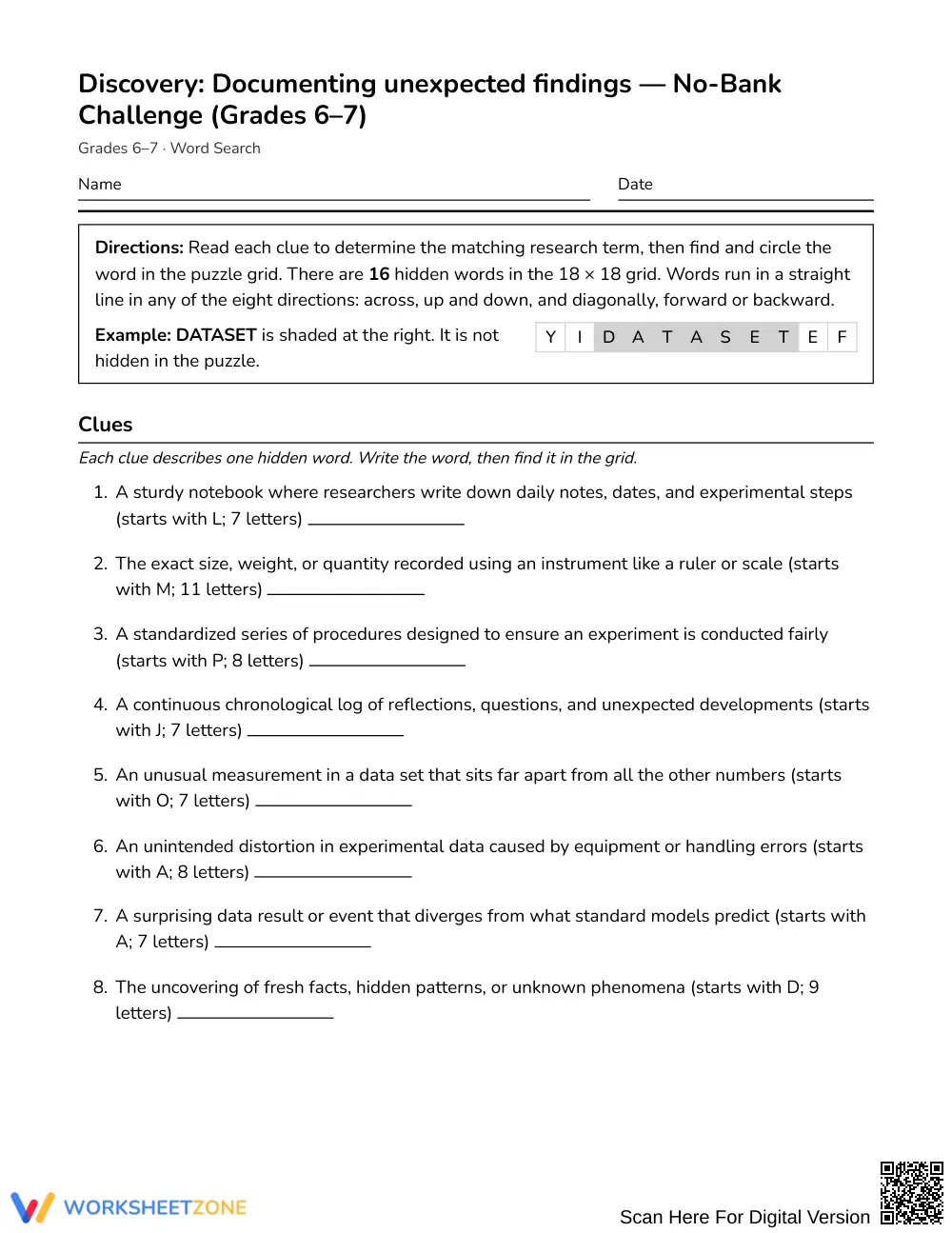
Students will sharpen their ability to document unexpected findings by searching for key scientific terms hidden in a fun, themed puzzle. This word search reinforces vocabulary, encourages precise notation, and builds confidence in recording observations—perfect preparation for lab notebooks and research reports.
At a Glance
- Grade: Grades 6–7 (Middle School) · Subject: Science
- Standard:
None— Not standards-assessed — vocabulary enrichment for scientific terminology- Skill Focus: documenting unexpected findings through puzzle discovery
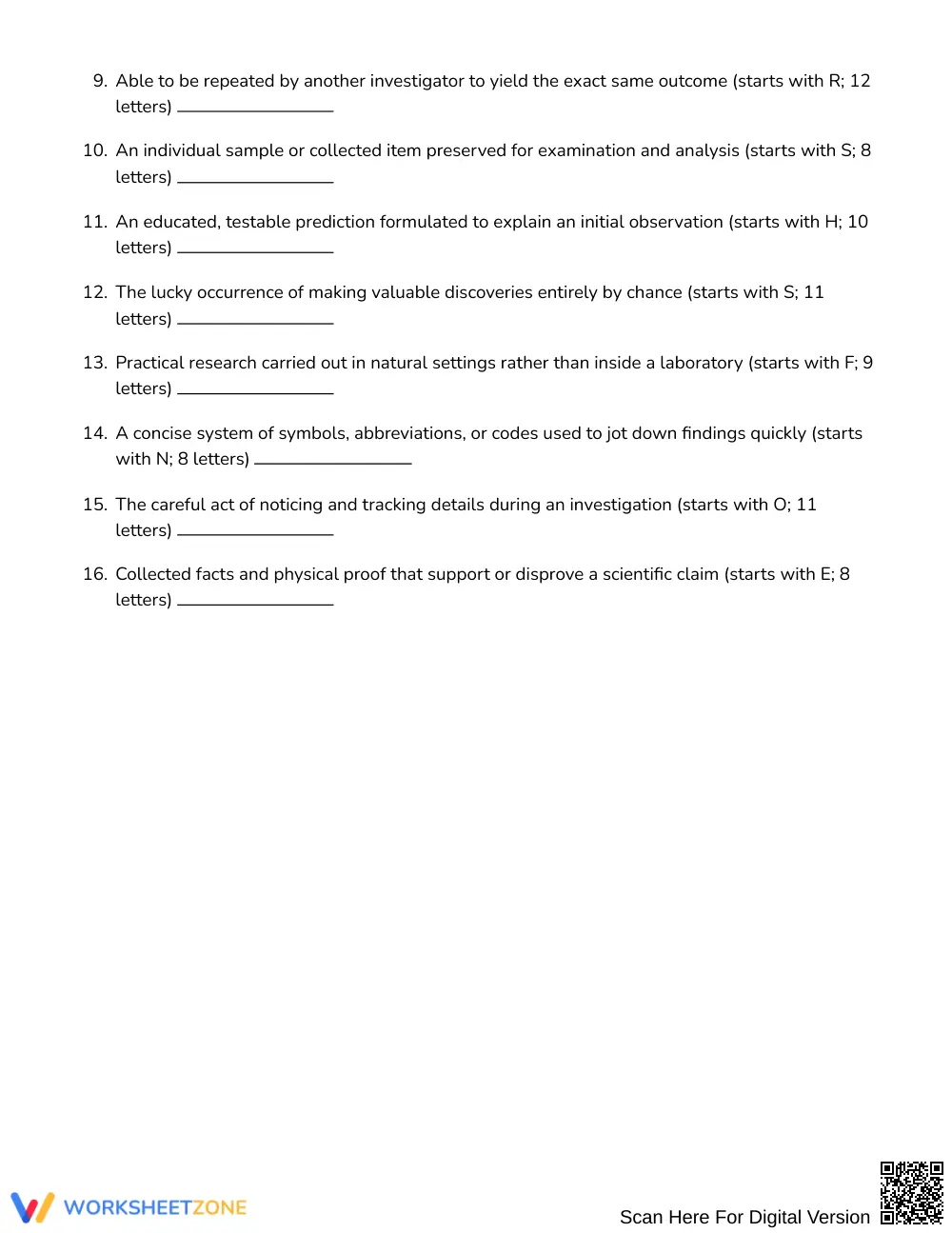
- Format: 3 pages of compact activity · 16 hidden words · Answer key included · PDF ready
- Best For: quick vocab review, lab prep, classroom warm‑up, homework, or enrichment
- Time: 5–10 minutes total, including brief set‑up
Inside the 18 × 18 grid, students will hunt for sixteen science‑related terms such as ANOMALY, LOGBOOK, and SERENDIPITY. The puzzle includes clear clues, a printable answer key on the back, and a clean PDF layout that requires no additional materials.
Zero‑Prep Workflow
- Print: Open the PDF and print the three pages (about 30 seconds per copy). The answer key prints on the same sheet for quick checking.
- Distribute: Hand the word search to each learner; no setup needed beyond handing out the sheet.
- Review: After completion, collect the sheets, compare answers with the key, and discuss any unfamiliar terms (2–3 minutes).
Total teacher preparation time stays under two minutes, making the activity perfect for a sub‑plan or a quick classroom warm‑up.
Standards Alignment
This activity is designed for vocabulary enrichment and is not aligned to any specific state or national standard. It supports the broader goal of building scientific language proficiency, which complements typical middle‑school science curricula.
How to Use It
- Before a lab: Give the word search as a warm‑up to activate key terminology, then transition to hands‑on investigation. Observe which terms students struggle with to inform immediate instruction.
- During independent work: Assign the puzzle as a brief enrichment task while students analyze data, allowing you to gauge notation skills without interrupting the flow.
Who It's For
Grades 6–7 science learners who need reinforcement of research vocabulary. The puzzle works well alongside a lesson on the scientific method or a lab on data collection. Pair it with a short anchor chart of the same terms for visual support.
Citation: Fisher & Frey (2014) emphasize that explicit vocabulary instruction, especially through engaging contexts, significantly improves students’ ability to record and communicate scientific observations. By embedding terms like ANOMALY, LOGBOOK, and SERENDIPITY in a word search, this resource provides repeated exposure that supports the skill of documenting unexpected findings. Research shows that such repeated, low‑stakes practice enhances retention and enables learners to transfer terminology to lab notebooks and research reports. The activity’s design aligns with evidence‑based recommendations for integrating vocabulary enrichment into science curricula, fostering both conceptual understanding and procedural fluency. Educators can confidently use this word search to reinforce key language while preparing students for authentic scientific documentation. Moreover, the visual‑spatial nature of a word search engages multiple cognitive pathways, supporting diverse learners including those with dyslexia when printed in a clear font. The concise format also fits within tight instructional windows, making it a practical tool for both regular and substitute teachers.


