




























Views
Downloads




Free Solving for Complex z Worksheet | Grade 11 Algebra II

Paste this activity's link or code into your existing LMS (Google Classroom, Canvas, Teams, Schoology, Moodle, etc.).
Students can open and work on the activity right away, with no student login required.
You'll still be able to track student progress and results from your teacher account.
This worksheet teaches Grade 11 Algebra II students to find a complex number z when two algebraic conditions restrict it. Students turn each condition into real equations in a and b, solve the system, and verify the result, building fluency with complex arithmetic and the matching rule.
At a Glance
- Grade: 11 · Subject: Algebra II
- Standard:
HSN-CN.A.2— Multiply and simplify complex numbers using properties of operations and i² = −1- Skill Focus: Solving for z from two conditions
- Format: 5 pages · 6 problems · Answer key included · PDF
- Best For: Unit practice after multiplying complex numbers
- Time: 30–45 minutes
What's Inside
The 5-page PDF opens with a Key Ideas box covering real and imaginary parts, the matching rule, and the answer convention (exact a + bi form, no decimals). Students then work 6 tasks in three parts: guided steps, independent multi-step problems, and a construction task with written justification. A 2-page answer key shows full solutions.
Skill Progression
- Guided practice: 2 problems with step prompts. Students solve (2 + i)z = 5 + 5i and find z from z² = −5 + 12i with Re(z) > 0.
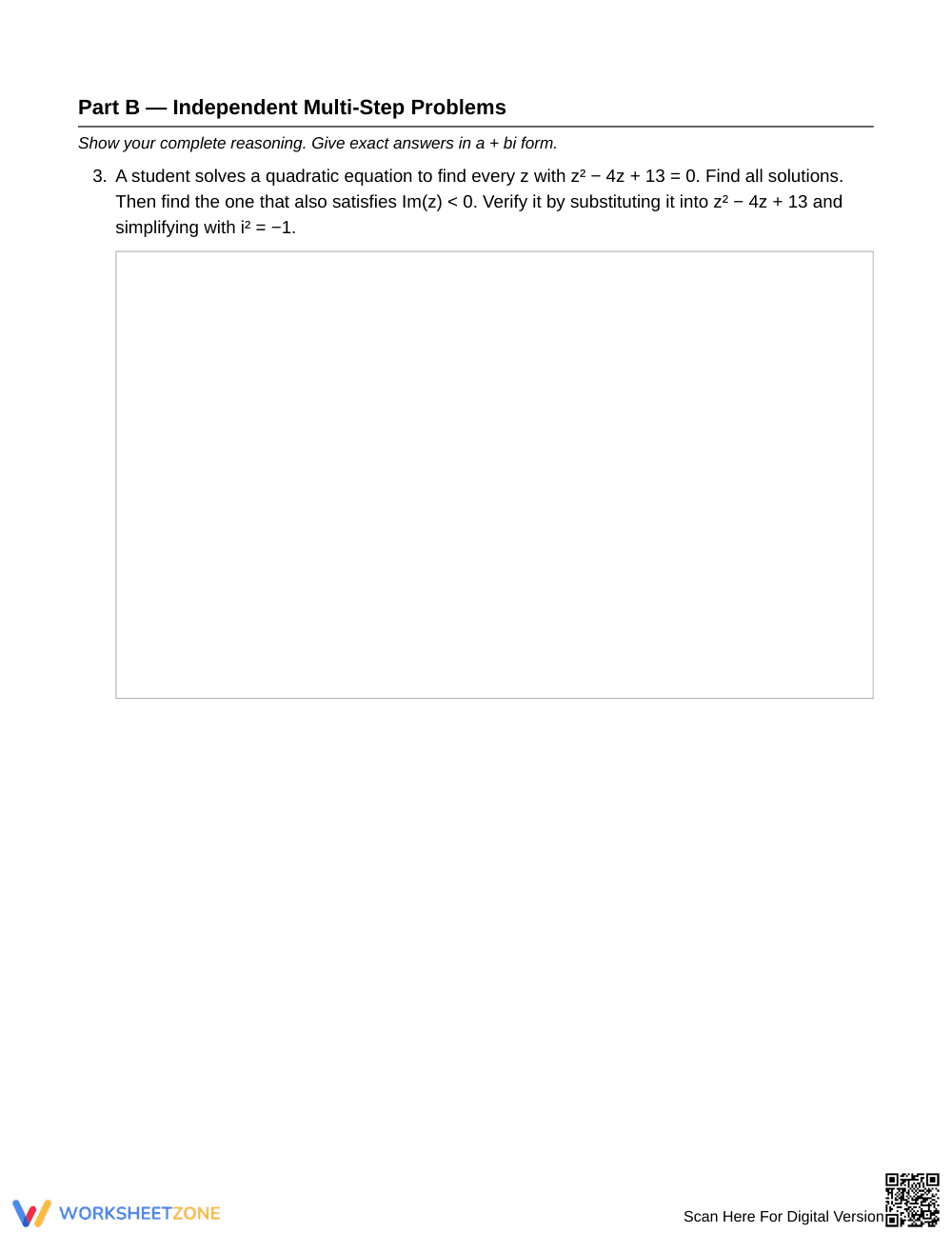
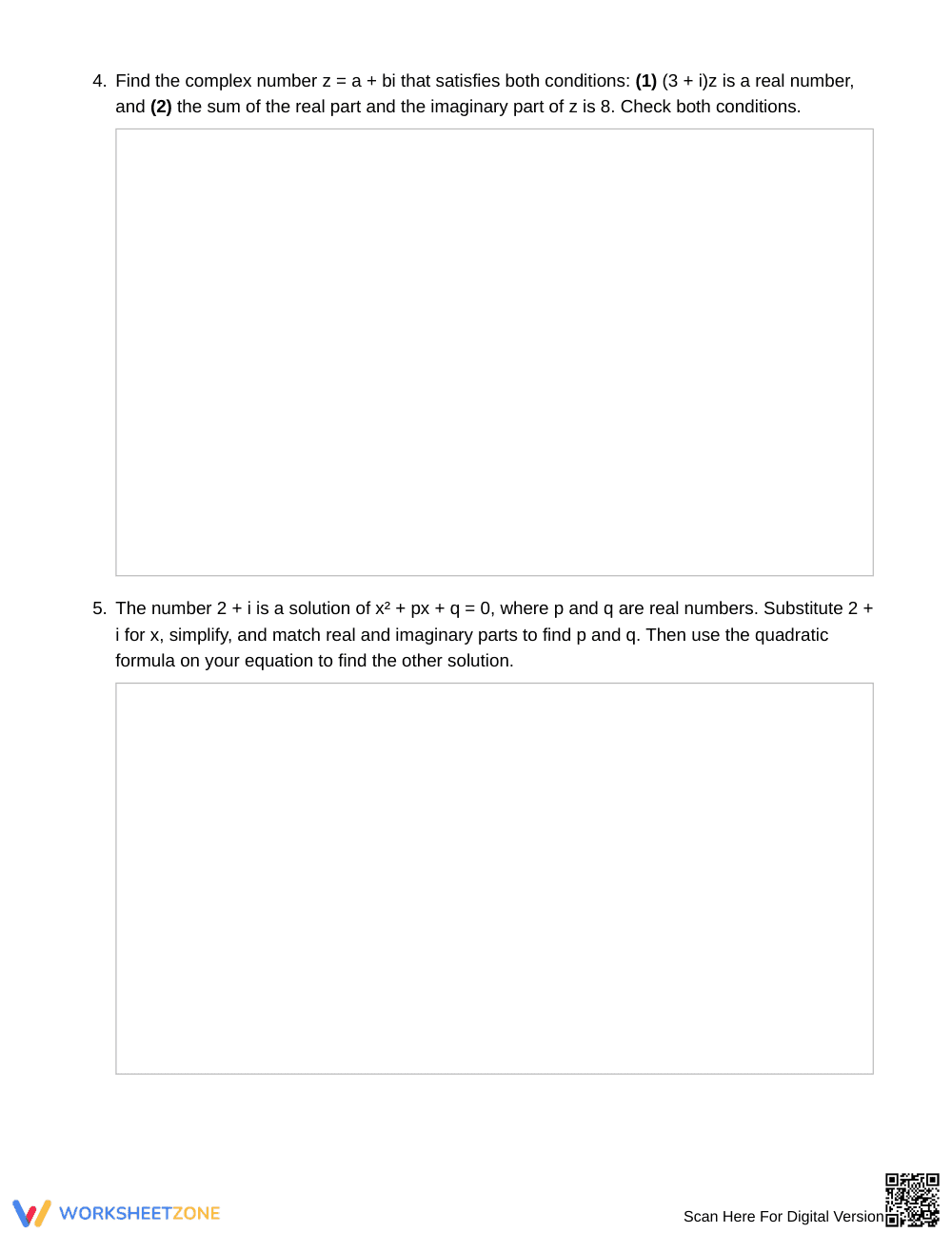
- Supported practice: 3 independent problems with checks. Students solve a quadratic with an Im(z) condition, find z when (3 + i)z is real, and find p and q from a known root.
- Independent practice: 1 construction task. Students write a quadratic with nonreal roots whose squares sum to −6, then justify it.
The sequence follows gradual release: I Do, We Do, You Do.
Standards Alignment
HSN-CN.A.2 — Use the relation i² = −1 and the commutative, associative, and distributive properties to add, subtract, and multiply complex numbers. The tasks also draw on solving quadratics with complex solutions. The standard code can be copied directly into lesson plans, IEP goals, or district curriculum mapping tools.
How to Use It
- After direct instruction: Assign Part A as a guided warm-up, then Part B as classwork once students can multiply complex numbers.
- Review before a unit assessment: Use Parts B and C as mixed practice or homework.
Formative tip: while students work, watch whether they match real and imaginary parts as two separate equations, and whether they reject extra solutions using the stated condition. Expect 30–45 minutes for the full set.
Who It's For
This worksheet suits Grade 11 Algebra II students who have learned complex arithmetic and are ready for multi-step reasoning. Students who need more support can use the Part A step prompts as a model before starting Part B. Pair it with a direct instruction lesson on multiplying complex numbers or an anchor chart on the matching rule.
HSN-CN.A.2 asks students to multiply and simplify complex numbers using the properties of operations and i² = −1. This Grade 11 Algebra II worksheet applies that skill to a harder task: finding a complex number z that satisfies two algebraic conditions. Students write z as a + bi, expand products or squares, and use the matching rule to convert each complex equation into two real equations. Six tasks move from guided steps to independent multi-step problems to a construction task that requires justification. Fisher & Frey (2014) describe gradual release, from modeling to guided to independent work, as a dependable structure for transfer, and the tasks follow it. A five-page PDF with a two-page answer key lets teachers assign it as classwork, homework, or review in 30 to 45 minutes.


