


























Views
Downloads




Free Reversed Errors Worksheet | Grade 12 Statistics
Paste this activity's link or code into your existing LMS (Google Classroom, Canvas, Teams, Schoology, Moodle, etc.).
Students can open and work on the activity right away, with no student login required.
You'll still be able to track student progress and results from your teacher account.
Students who work this worksheet will master the identification and correction of reversed‑conditional probability errors, turning common misconceptions into accurate calculations. By the end, they can confidently rewrite conditional statements for real‑world data analysis and apply them across health‑screening, finance, and research scenarios.
At a Glance
- Grade: 12 (advanced high‑school) · Subject: Statistics
- Standard:
— Identify and fix reversed‑conditional probability mistakes in real data sets- Skill Focus: Correct Reversed‑Conditional Errors through systematic analysis
- Format: 5 pages · 11 problems · Answer key included · PDF format with clear layout
- Best For: Guided practice in probability units, suitable for classroom or homework
- Time: 30–45 minutes (quick completion)
What's Inside
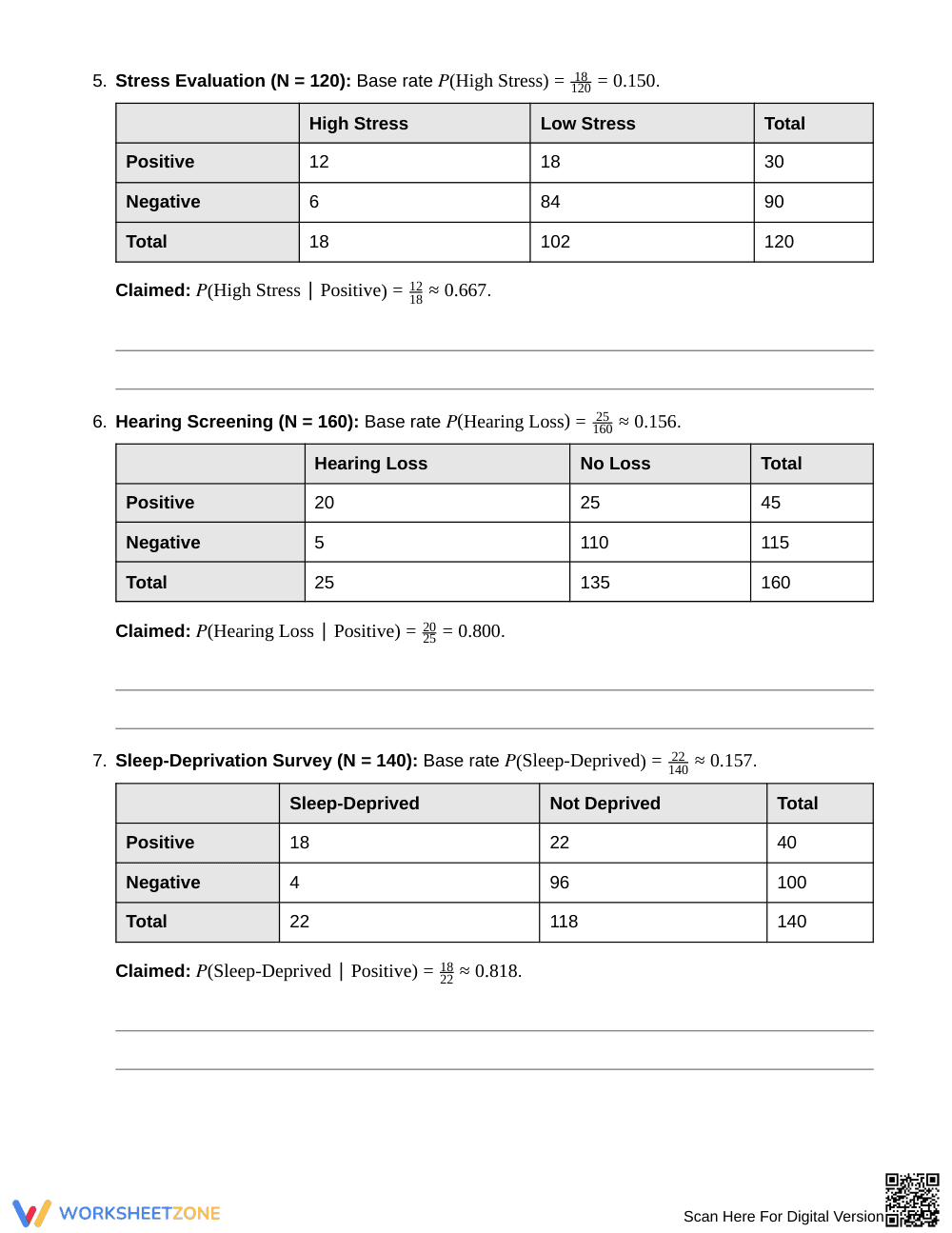
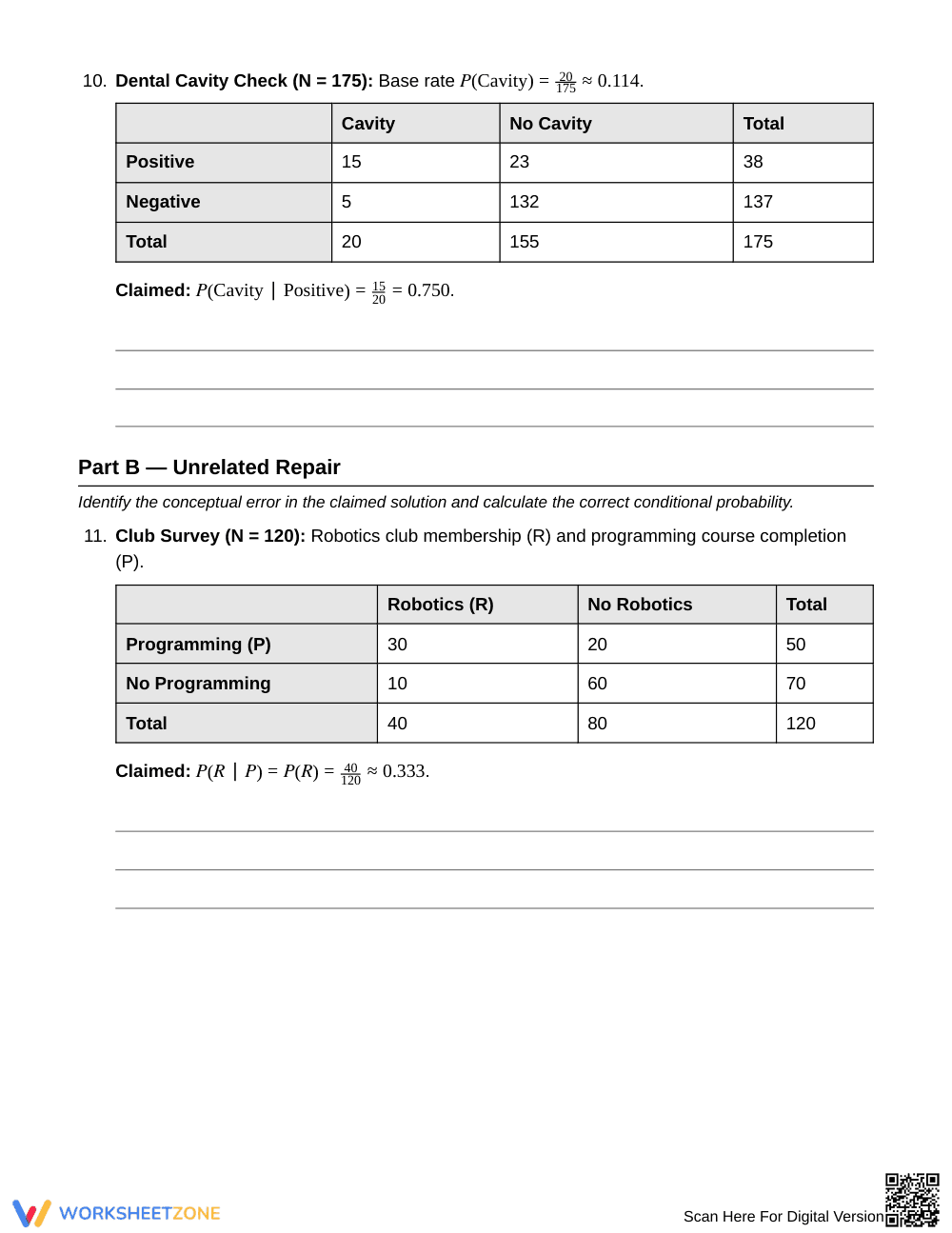
The worksheet is divided into Part A and Part B. Part A presents eleven screening tables with a deliberately wrong conditional probability calculation; students must spot the error, explain the misconception, and compute the correct value. Part B offers an unrelated repair task that reinforces the same conceptual correction. An answer key on two separate pages provides step‑by‑step solutions.
Skill Progression
- Guided practice – 4 items include a worked example and sentence frames that walk students through identifying the reversed conditional and recomputing the probability.
- Supported practice – 4 items give partial hints and a word bank, allowing learners to correct the error with moderate assistance.
- Independent practice – 3 items require students to locate the mistake, justify the correction, and present the final probability without any scaffolds.
This structure follows the classic I Do, We Do, You Do release model, ensuring gradual independence.
Standards Alignment
` ` Students will identify and correct reversed‑conditional probability errors, applying the definition P(A|B)=P(A∩B)/P(B) to real data sets. This aligns with high‑school statistics expectations for probability reasoning. Both standard references can be copied directly into lesson plans, IEP goals, or district curriculum mapping tools.
How to Use It
Use the worksheet as a quick diagnostic before introducing the formal conditional probability formula, or as reinforcement after a lecture on Bayes’ theorem. In a 30‑minute class, have students complete Part A individually, then discuss answers in pairs for formative feedback. Alternatively, assign Part B as homework to extend practice, and collect the answer key for immediate grading.
Who It's For
Designed for 12th‑grade statistics students preparing for AP exams or college‑level probability courses. The scaffolded items support both struggling learners and advanced students seeking deeper challenge. Pair it with a probability rules anchor chart or a short video on conditional probability for a seamless lesson flow.
Research shows that explicit error‑analysis activities boost students’ conceptual grasp of probability (Fisher & Frey, 2014). This worksheet operationalizes that finding by requiring learners to locate reversed‑conditional mistakes, articulate why the original reasoning fails, and produce the correct calculation. The 11‑item set delivers repeated practice, which aligns with the evidence‑based recommendation of spaced repetition for statistical reasoning. By integrating a concise answer key, teachers can provide immediate feedback, a factor linked to higher achievement in quantitative domains. The activity also satisfies the Common Core expectation that students “determine probability of an event occurring given a condition” while extending practice to real‑world screening scenarios. Incorporating this resource into a unit on probability rules therefore supports both standards compliance and research‑backed instructional effectiveness. Teachers can also adapt the tasks for group work, fostering collaborative discussion and peer teaching, which further reinforces mastery.


