



























Free Physical & Chemical Change Worksheet | Grade 7 Science
Paste this activity's link or code into your existing LMS (Google Classroom, Canvas, Teams, Schoology, Moodle, etc.).
Students can open and work on the activity right away, with no student login required.
You'll still be able to track student progress and results from your teacher account.
This Grade 7 science worksheet guides students through identifying, classifying, and justifying physical and chemical changes in matter. Students evaluate everyday scenarios, review reaction criteria, and analyze laboratory data tables to build evidence-based explanations connecting atomic rearrangement and observable properties.
At a Glance
- Grade: 7 · Subject: Science
- Standard: Middle School Physical Science — Analyze substance properties to determine if chemical changes occurred
- Skill Focus: Physical-and-Chemical Change Check
- Format: 5 pages · 12 problems · Answer key included · PDF
- Best For: Post-lesson practice and data analysis
- Time: 40–50 minutes
What's Inside
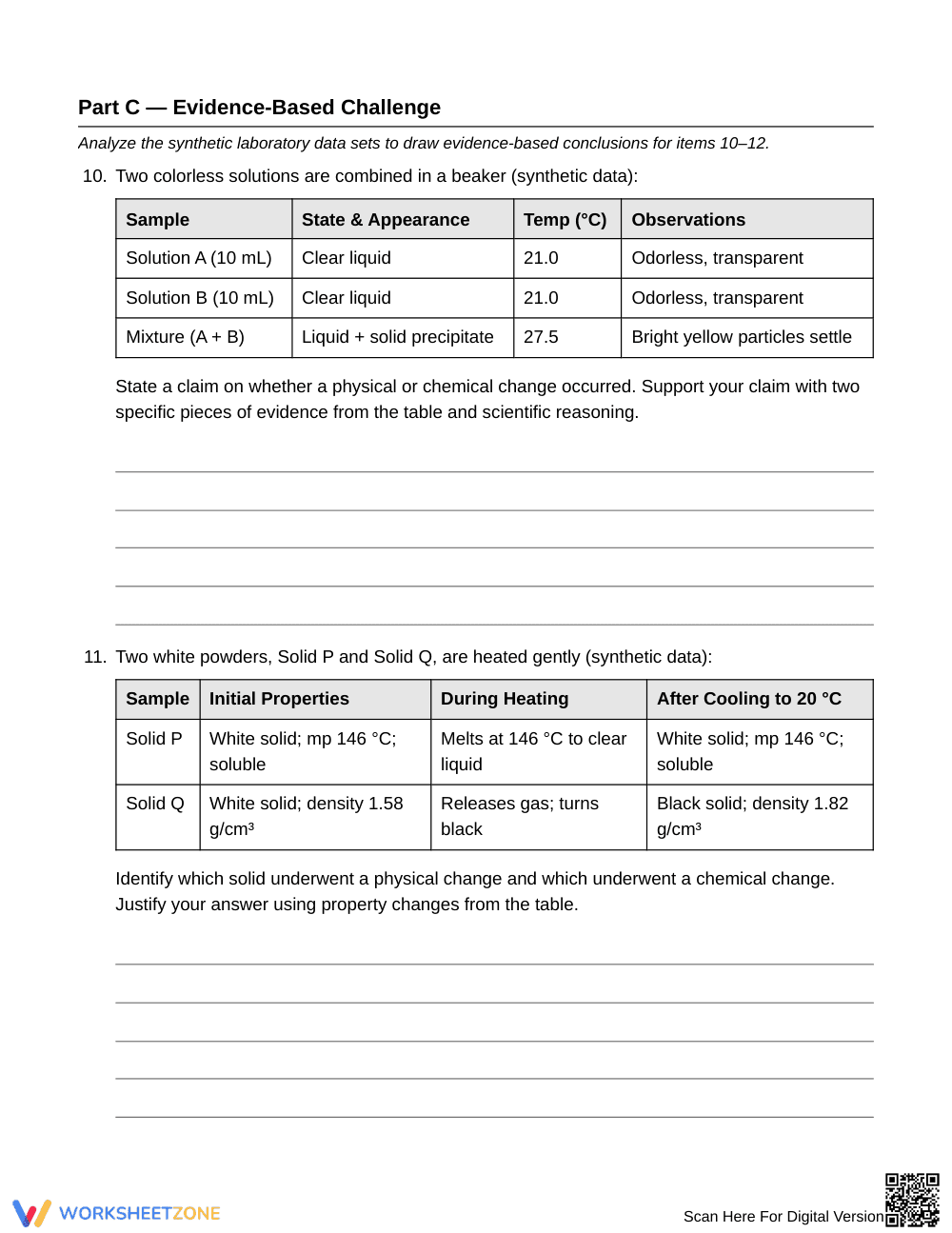
This 5-page resource includes 12 science tasks and a 2-page answer key. The worksheet features a Core Principles reference box, foundational multiple-choice questions, descriptive scenario analyses (such as candle combustion and rusting steel wool), and tabular laboratory data sets requiring evidence-based reasoning.
Skill Progression
- Guided practice (Part A, Items 1–3): Students review core definitions, evaluate reversibility limitations, and identify indicators of chemical reactions.
- Supported practice (Part B, Items 4–9): Students classify six real-world scenarios—including dissolving salt and candle burning—by providing observable evidence.
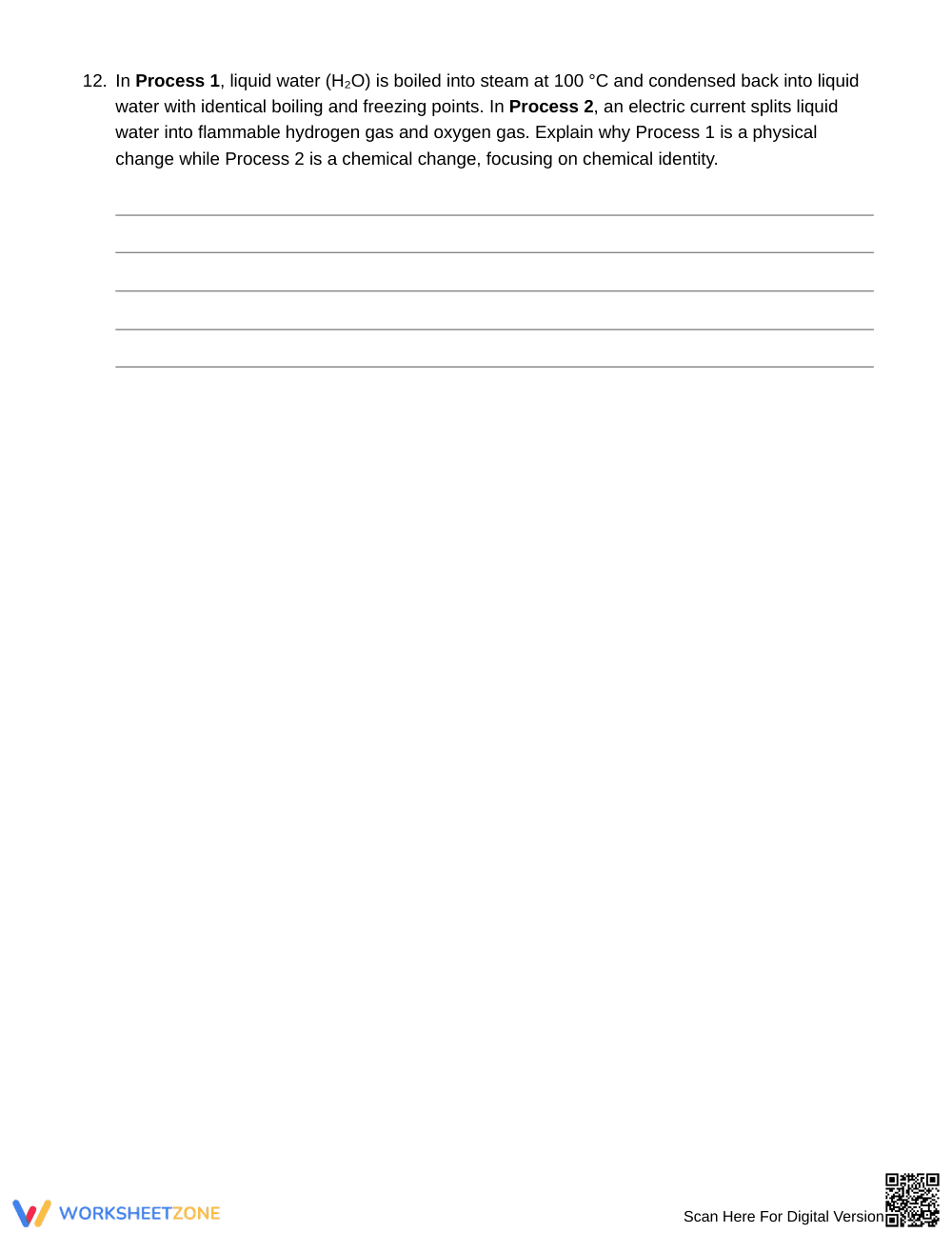
- Independent practice (Part C, Items 10–12): Students analyze synthetic laboratory data tables to construct scientific claims.
This sequence implements a gradual-release model from initial concept review to independent scientific evaluation.
Standards Alignment
This worksheet aligns with middle school physical science expectations for matter and its interactions. Students analyze and interpret data on substance properties before and after interactions to determine whether chemical reactions occurred. Standard descriptions can be copied directly into lesson plans, IEP goals, or district curriculum mapping tools.
How to Use It
Use this worksheet directly after introducing chemical reactions, or assign it as a formative assessment. During independent work, monitor Item 5 to ensure students recognize temperature drops in endothermic reactions as chemical evidence rather than physical cooling. Expected completion time is 40 to 50 minutes.
Who It's For
Designed for Grade 7 general science and physical science classrooms. Structured tables support English learners and developing readers, while the data challenge tasks provide rigor for advanced students. Pair this worksheet with an introductory chemical reaction demonstration or visual anchor chart.
Middle school science instruction requires structured opportunities for students to evaluate evidence and distinguish between physical and chemical processes. According to Fisher & Frey (2014), instructional frameworks that transition systematically from foundational knowledge recall to complex data interpretation significantly strengthen student conceptual understanding and disciplinary literacy. This 12-task physical and chemical changes worksheet provides Grade 7 students with targeted practice across 5 pages, actively engaging them in real-world scenario classification, mass conservation reasoning, and quantitative laboratory analysis. By examining observable criteria such as precipitate formation, thermal shifts, color changes, and gas production, learners construct a solid conceptual bridge between macroscopic laboratory observations and microscopic atomic rearrangements. The comprehensive 2-page answer key and scaffolded three-part progression make this resource an effective tool for mastery-based learning, classroom review, and standards-aligned physical science assessment.


