




























Views
Downloads


Free Nuclear Power Worksheet | Grades 9–12 Science

Paste this activity's link or code into your existing LMS (Google Classroom, Canvas, Teams, Schoology, Moodle, etc.).
Students can open and work on the activity right away, with no student login required.
You'll still be able to track student progress and results from your teacher account.
Opening
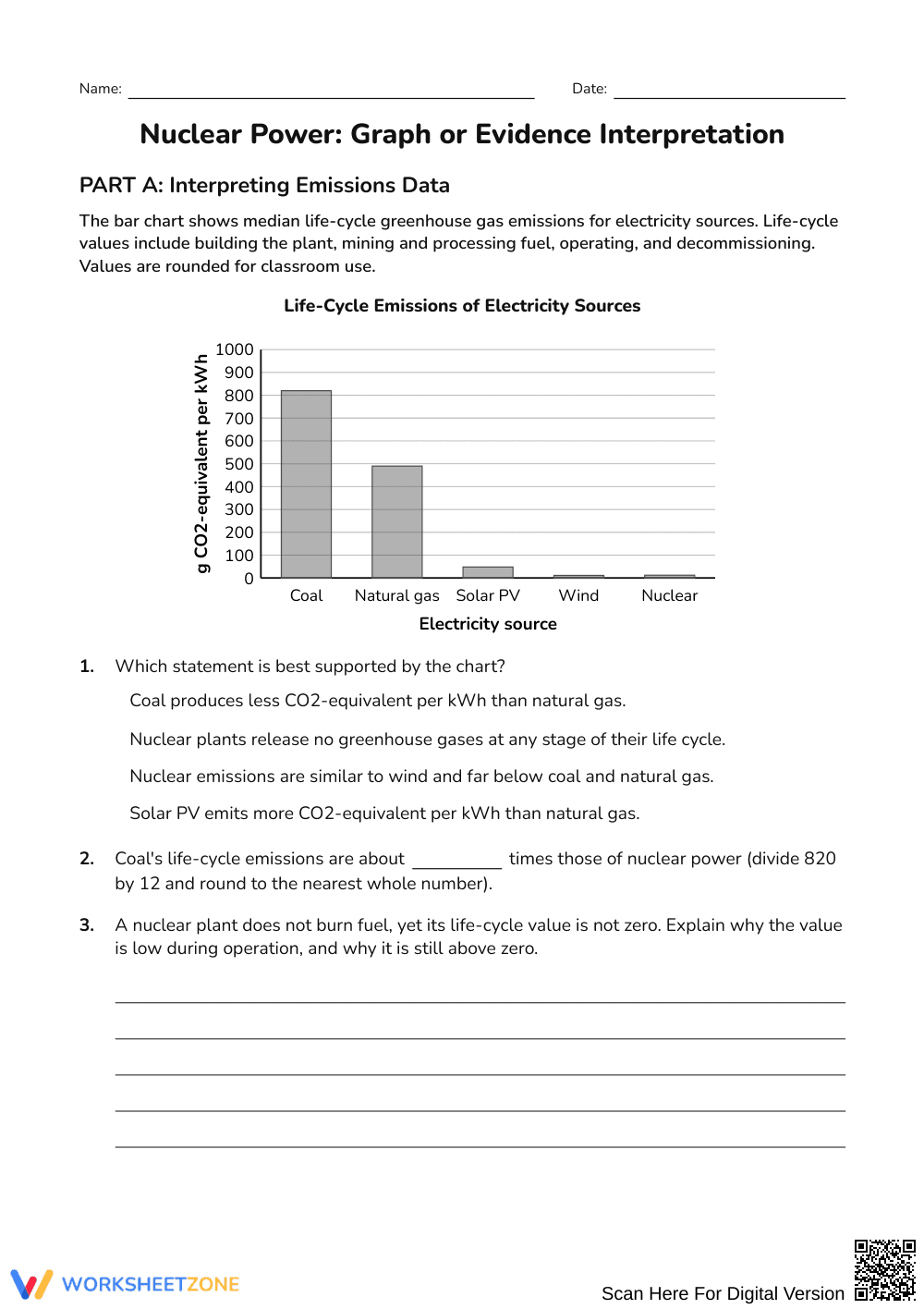
Students explore nuclear power through authentic data, calculations, and model‑based explanations. This worksheet guides them to read emissions graphs, compute conversion, and articulate the sequence from fission to electricity, building scientific reasoning and quantitative literacy essential for modern energy discussions.
At a Glance
- Grade: 9–12 · Subject: Science
- Standard:
— Interpret emissions data and explain nuclear energy processes, comparing lifecycle emissions across sources- Skill Focus: Data interpretation, mass‑energy calculation, energy‑flow explanation
- Format: 4 pages · 20 problems · Answer key included · PDF
- Best For: Data‑driven lessons on nuclear energy, suitable for classroom investigations and discussion
- Time: 20–30 minutes
What's Inside
The packet contains four pages of mixed‑format tasks: multiple‑choice questions, short‑answer prompts, quantitative calculations, and a diagram‑labeling activity for the pressurized‑water reactor model. A worked example opens Part A, sentence frames support Part D, and a concise word bank appears before Part B. The answer key mirrors the layout, providing quick grading.
Skill Progression
- Guided practice (6 tasks): includes a worked example and sentence frames to model data‑interpretation language.
- Supported practice (8 tasks): provides partial prompts and a word bank, encouraging students to apply the same reasoning independently.
- Independent practice (6 tasks): requires full written responses and calculations without scaffolds.
This three‑stage release follows the classic I Do, We Do, You Do structure, ensuring mastery before independence.
Standards Alignment
Primary standard: `` Students interpret scientific data, perform quantitative conversions, and construct explanations of nuclear energy transformations. Supporting standard: Students evaluate environmental impacts of energy sources. Both standard codes can be copied directly into lesson plans, IEP goals, or district curriculum mapping tools.
How to Use It
1️⃣ Before a unit on energy, assign the opening graph questions as a quick diagnostic (10 min). Use student answers to gauge prior knowledge and adjust the upcoming lecture.
2️⃣ During the nuclear‑power lesson, have groups complete Parts B–C as a hands‑on investigation (15 min). Collect responses and provide immediate feedback using the answer key.
Observe whether students correctly cite numerical evidence; this formative cue signals readiness for a summative quiz.
Who It's For
Designed for high‑school science learners, especially those in AP Environmental Science or general physics. The worksheet’s clear scaffolds make it accessible to mixed‑ability classes, while the extension questions in Part D challenge advanced students. Pair it with a printable Nuclear Energy anchor chart for visual reinforcement.
Research shows that explicit data‑driven tasks improve conceptual understanding of energy systems (Fisher & Frey, 2014). By requiring students to translate emissions graphs into written claims and to calculate mass‑energy conversion, this worksheet aligns with evidence‑based practices that boost scientific reasoning. The inclusion of a complete answer key streamlines grading, allowing teachers to focus on discussion of limitations such as cost, waste, and safety. Consequently, educators can confidently assign the worksheet to deepen students' grasp of low‑carbon energy options while meeting rigorous standards.


