































Free Nuclear Power Compare Worksheet | Grades 9–12 Science

Paste this activity's link or code into your existing LMS (Google Classroom, Canvas, Teams, Schoology, Moodle, etc.).
Students can open and work on the activity right away, with no student login required.
You'll still be able to track student progress and results from your teacher account.
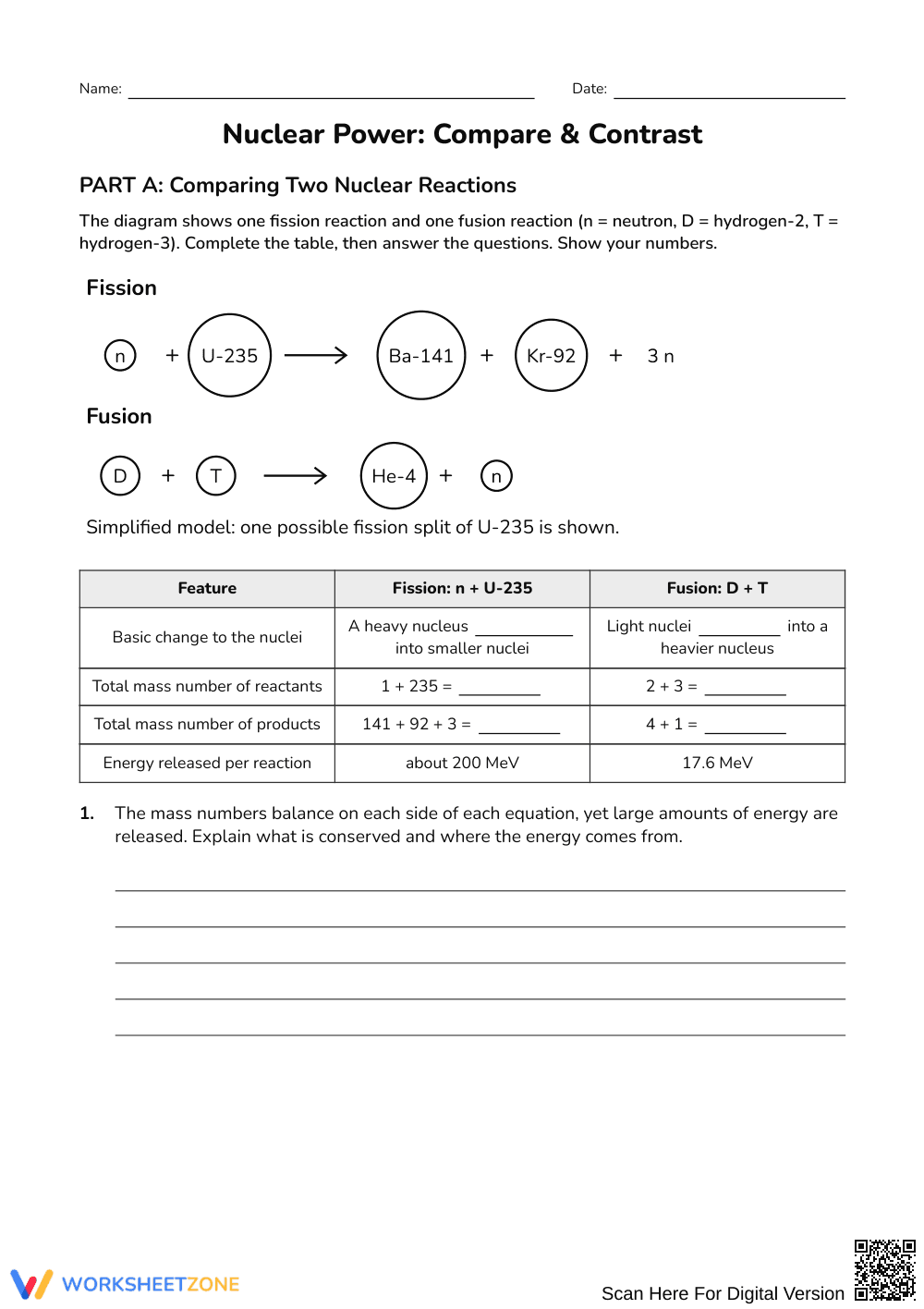
Students will compare nuclear fission and fusion reactions, evaluate a pressurized water reactor, and interpret life‑cycle emissions data, using tables, Venn organizers, and short reasoning to demonstrate deep conceptual understanding of nuclear power and communicate findings in written form for assessment.
At a Glance
- Grade: Grades 9–12 · Subject: Science
- Standard:
— compare nuclear processes using tables or Venn diagrams, including energy conversion and safety- Skill Focus: Compare nuclear reactions and reactor systems
- Format: 4 pages · 28 problems · Answer key included · PDF
- Best For: High‑school comprehensive unit on nuclear power
- Time: 30–45 minutes
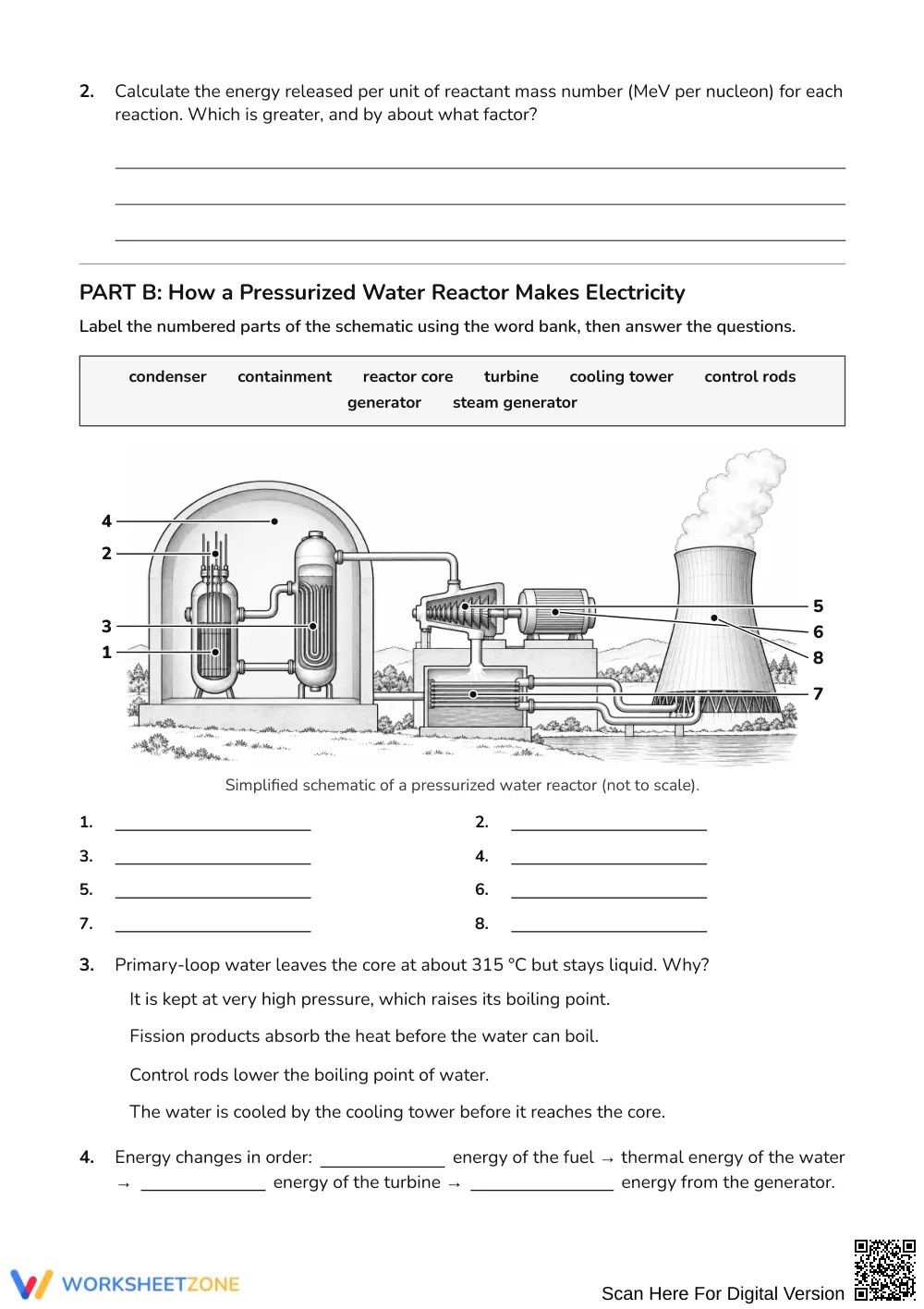
The packet spans four pages and contains 28 multi‑step problems across four parts: reaction comparison tables, reactor labeling with a word bank, emissions data analysis, and a Venn‑style sorting activity. An answer key on four additional pages provides detailed solutions.
- Guided practice (8 problems): Complete a partially filled comparison table with teacher modeling and sentence frames.
- Supported practice (10 problems): Label the reactor schematic using the provided word bank and answer short‑answer prompts.
- Independent practice (10 problems): Analyze emissions data, calculate energy ratios, and sort statements in a Venn diagram without prompts.
This progression follows the classic I Do, We Do, You Do release.
This worksheet aligns with the Next Generation Science Standards for high‑school physical science, specifically the standard that addresses energy transformations in nuclear reactions and the societal impacts of energy choices. It also supports the Common Core practice of analyzing and interpreting quantitative data. Both standard codes can be copied directly into lesson plans, IEP goals, or district curriculum mapping tools.
Use the table‑comparison tasks as a pre‑assessment before the unit on nuclear energy to gauge students’ baseline understanding of fission versus fusion. After the lecture on pressurized water reactors, assign the labeling activity as a guided practice; follow with the emissions analysis as a formative check during the discussion of climate impacts. Observe students’ ability to justify their energy‑ratio calculations with the provided data.
Designed for Grades 9–12 science students, especially those in AP or honors tracks. The worksheet includes built‑in scaffolds such as sentence frames and a word bank, making it accessible for mixed‑ability classes. Pair it with a short video on nuclear reactor operation for a multimodal lesson.
Research from RAND AIRS 2024 shows that high‑school students who engage in comparative analysis of nuclear processes develop stronger conceptual models of energy conversion and are better able to evaluate environmental trade‑offs. This worksheet targets the plain‑English skill of comparing nuclear reactions and reactor systems using tables or Venn organizers, directly supporting that finding. By guiding learners through quantitative calculations, diagram labeling, and evidence‑based reasoning, the tasks mirror the analytical practices highlighted in the study. The inclusion of real‑world emission data connects classroom learning to societal relevance, reinforcing the research‑based recommendation that authentic data improve motivation and retention. Teachers can confidently assign this resource, knowing it aligns with evidence‑based instructional strategies and prepares students for deeper discussions about sustainable energy futures. The comparative Venn activity also cultivates higher‑order thinking by requiring students to synthesize similarities and differences, a skill emphasized in the 2023 NAEP framework for science reasoning.


