


























Views
Downloads



Free Mix Graphing & Feature Worksheet | Grade 9 Algebra I
Paste this activity's link or code into your existing LMS (Google Classroom, Canvas, Teams, Schoology, Moodle, etc.).
Students can open and work on the activity right away, with no student login required.
You'll still be able to track student progress and results from your teacher account.
This worksheet targets ninth‑grade students’ ability to mix graphing techniques with feature interpretation for quadratic functions, guiding them to read vertices, axes, intercepts, and choose the most efficient graphing method.
At a Glance
- Grade: 9 · Subject: Algebra I
- Standard:
— Interpret quadratic graphs and choose graphing method- Skill Focus: Mix Graphing and Feature Interpretation
- Format: 4 pages · 16 problems · Answer key included · PDF
- Best For: Practice quadratic graph features
- Time: 15–20 minutes
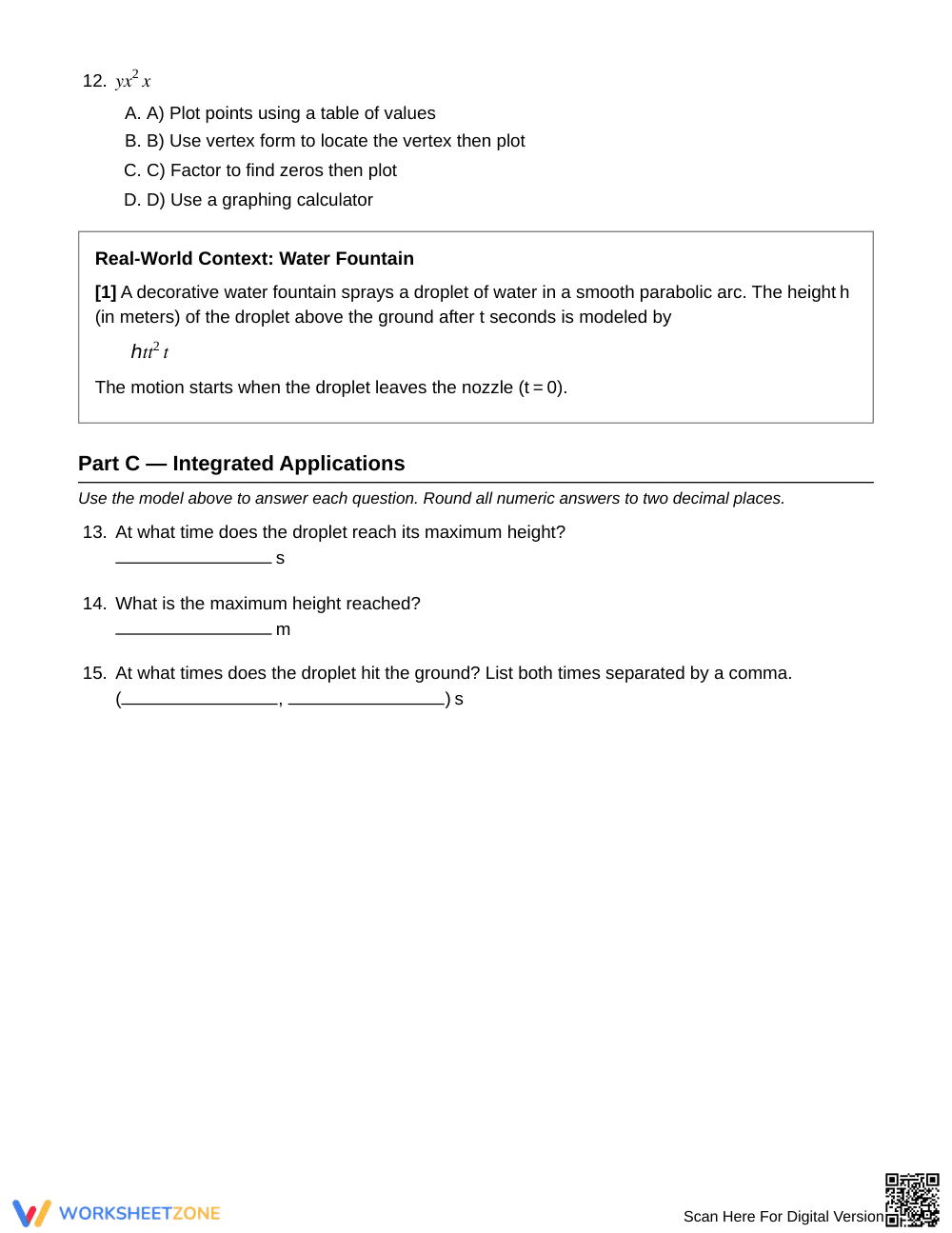
The four‑page packet contains three parts: foundational vertex and intercept calculations, a method‑selection multiple‑choice section, and a real‑world application with a water‑fountain model. An answer key occupies two pages, and the layout includes worked examples and space for student responses.
- Guided practice (6 tasks): Part A provides worked examples and sentence frames for finding vertices, axes, and intercepts.
- Supported practice (5 tasks): Part B asks students to select the most efficient graphing method, offering a word bank of strategies.
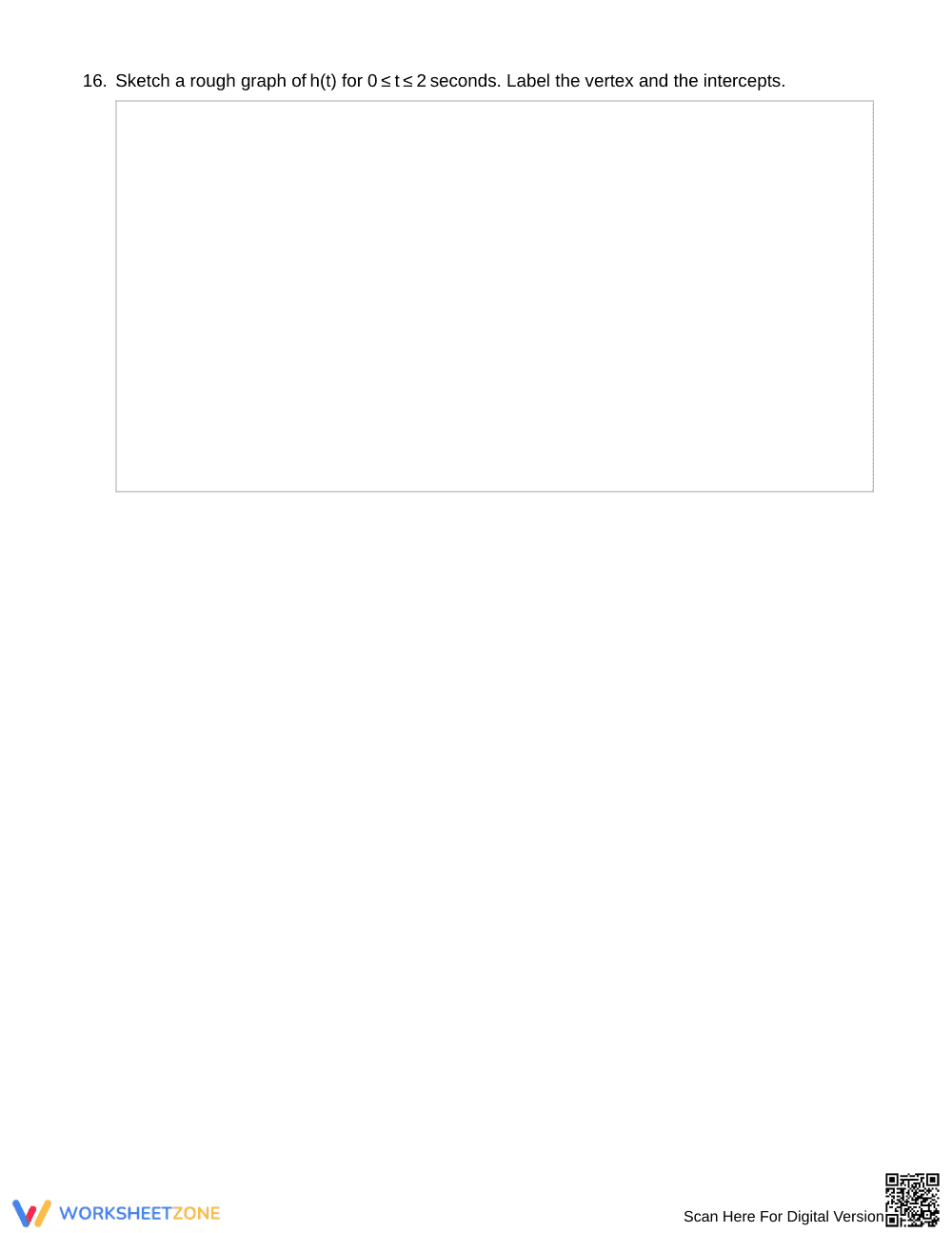
- Independent practice (5 tasks): Part C requires students to apply a quadratic model, compute vertex time, maximum height, and ground‑hit times without scaffolds.
This progression follows the classic I Do, We Do, You Do release model, moving from teacher‑led examples to autonomous problem solving.
Students interpret quadratic graphs, identify vertices, axes of symmetry, y‑intercepts, and determine the most efficient graphing approach for a given function. This aligns with the state’s high‑school algebra standards that emphasize functional representation and data interpretation. Both standard codes can be copied directly into lesson plans, IEP goals, or district curriculum mapping tools.
How to Use It
Use the worksheet as a quick diagnostic before a unit on quadratic functions to gauge students’ baseline graphing skills. Follow with a brief teacher‑led mini‑lesson, then have students complete Part B in pairs for collaborative practice. After the lesson, collect the answer sheets for immediate formative feedback, noting any misconceptions about axis selection.
Who It's For
Designed for ninth‑grade Algebra I learners, the worksheet supports mixed‑ability classes; the sentence frames in Part A help struggling students while the extension questions in Part C challenge advanced learners. Pair it with a standard textbook chapter on quadratic transformations or an anchor chart of vertex form.
Research shows that explicit instruction combined with guided practice improves students’ ability to translate algebraic expressions into accurate graphs (Fisher & Frey, 2014). This worksheet operationalizes that finding by providing a structured sequence of 16 tasks that move learners from concrete calculation to independent interpretation. The inclusion of a real‑world water‑fountain scenario adds relevance, encouraging deeper conceptual connections. Teachers can confidently assign this resource, knowing it aligns with rigorous standards and evidence‑based practice, and can immediately download and print for classroom use.


