





























Free Light/Dark Plant Processes Worksheet | Grade 9 Biology
Paste this activity's link or code into your existing LMS (Google Classroom, Canvas, Teams, Schoology, Moodle, etc.).
Students can open and work on the activity right away, with no student login required.
You'll still be able to track student progress and results from your teacher account.
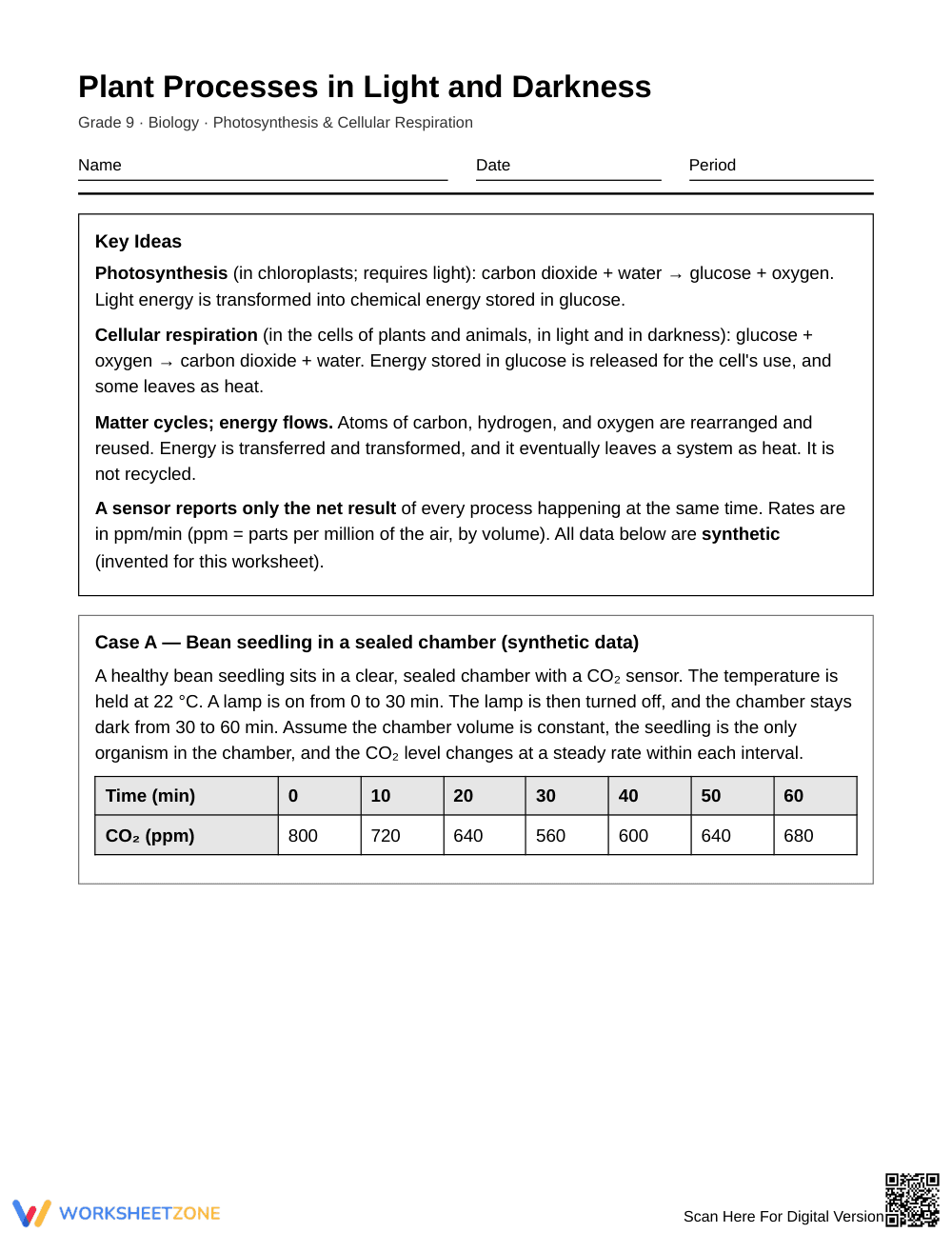
This worksheet helps Grade 9 biology students explain what plants do in light and in darkness. Using sealed-chamber data, they separate net gas changes into photosynthesis and respiration, then judge student conclusions about matter cycling and energy flow with evidence.
At a Glance
- Grade: 9 · Subject: Biology
- Standard: Explain what plants do in light and in darkness using data
- Skill Focus: Interpreting net gas data to separate photosynthesis from respiration
- Format: 5 pages · 10 problems · Answer key included · PDF
- Best For: Unit review and assessment practice
- Time: 45–60 minutes
What's Inside
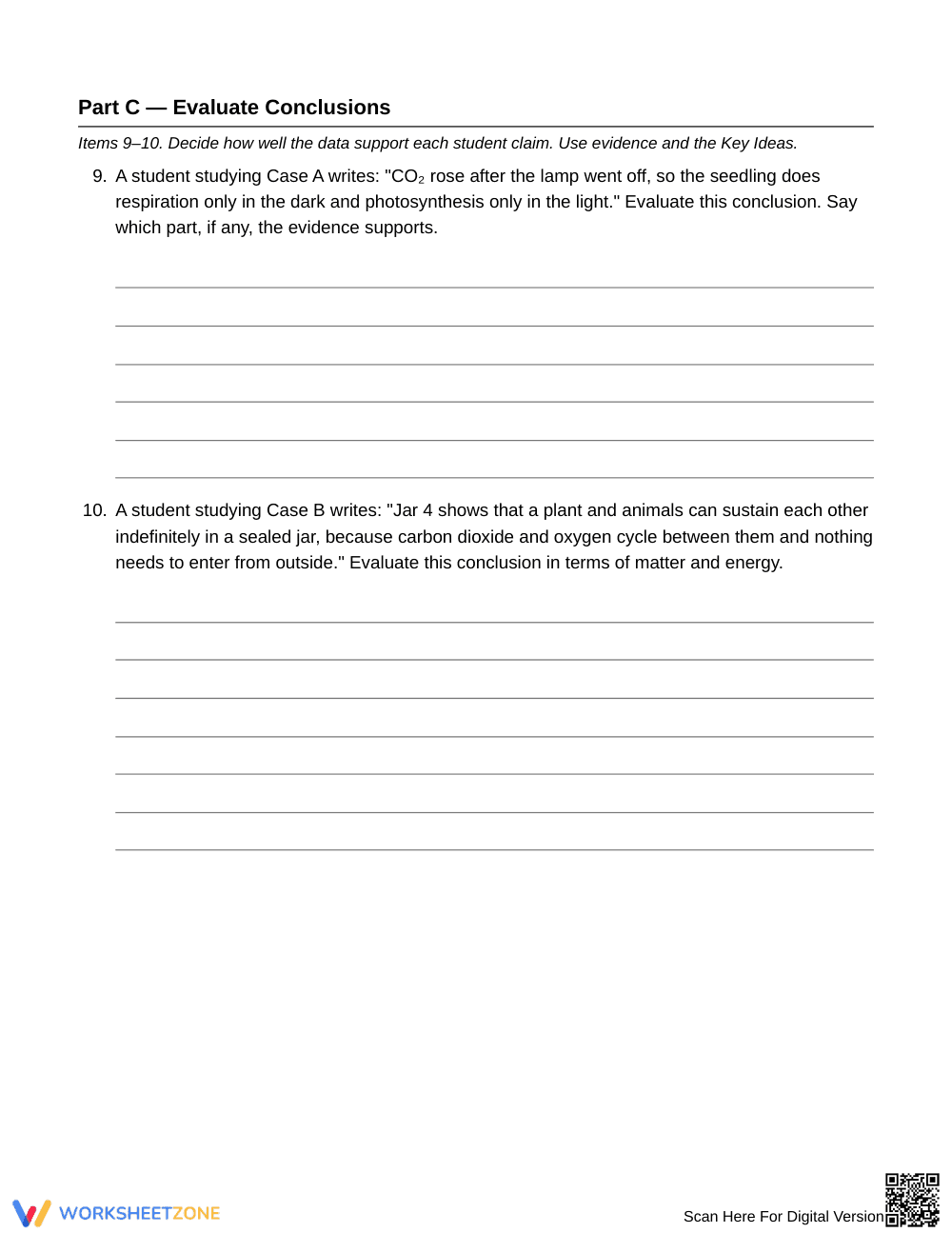
Three parts guide students through Identify Constraints (2 items), Apply Principles (6 items), and Evaluate Conclusions (2 items). They work from a Key Ideas box, a bean seedling CO₂ time series, and a four-jar O₂ table. Tasks include multiple choice, rate calculations with units, prediction, and written evaluation. A 2-page answer key shows worked steps.
Skill Progression
- Guided practice: Items 1–2 use the Key Ideas box and Case A, starting with multiple choice.
- Supported practice: Items 3–8 add rate calculations, a stated assumption, and prediction.
- Independent practice: Items 9–10 ask students to evaluate claims using evidence.
The sequence follows gradual release: I Do, We Do, You Do.
Standards Alignment
No standard code was supplied for this worksheet. It addresses the biology idea that photosynthesis and cellular respiration transform matter and energy in plants, in light and in darkness. Teachers can copy it into lesson plans, IEP goals, or district curriculum maps under their own state's matching standard.
How to Use It
Use it after direct instruction on both processes as a 45–60 minute practice set, or assign Parts A and B as homework and run Part C as a class discussion. While students work, watch Item 4: anyone who reports the light-period net rate as the photosynthesis rate is reading net change as gross change.
Who It's For
Designed for Grade 9 biology students in a photosynthesis and cellular respiration unit. Students who need support can start with the Key Ideas box and complete Items 1–3 first; advanced students can write extended answers for Items 9–10. Pair it with a direct instruction lesson or an anchor chart of both equations.
Plant Processes in Light and Darkness is a Grade 9 biology worksheet that teaches students to separate net gas readings into photosynthesis and respiration. Using synthetic CO₂ and O₂ data from a sealed seedling chamber and four jars, students calculate rates in ppm/min, apply the idea that matter cycles while energy flows, and judge student claims against evidence. The 10 tasks move from identifying constraints to applying principles to evaluating conclusions, with a 2-page answer key. Fisher & Frey (2014) describe gradual release of responsibility, in which teachers shift from modeling to guided to independent work, as a way to build durable understanding; this worksheet follows that structure across its three parts. No standard code was supplied, so teachers can align it to their own state's expectations for energy and matter in organisms. It suits unit review, formative assessment, and homework in a photosynthesis and cellular respiration unit.


