




























Views
Downloads

Free Imperial Gov Vocabulary Word Search | Grades 4–5

Paste this activity's link or code into your existing LMS (Google Classroom, Canvas, Teams, Schoology, Moodle, etc.).
Students can open and work on the activity right away, with no student login required.
You'll still be able to track student progress and results from your teacher account.
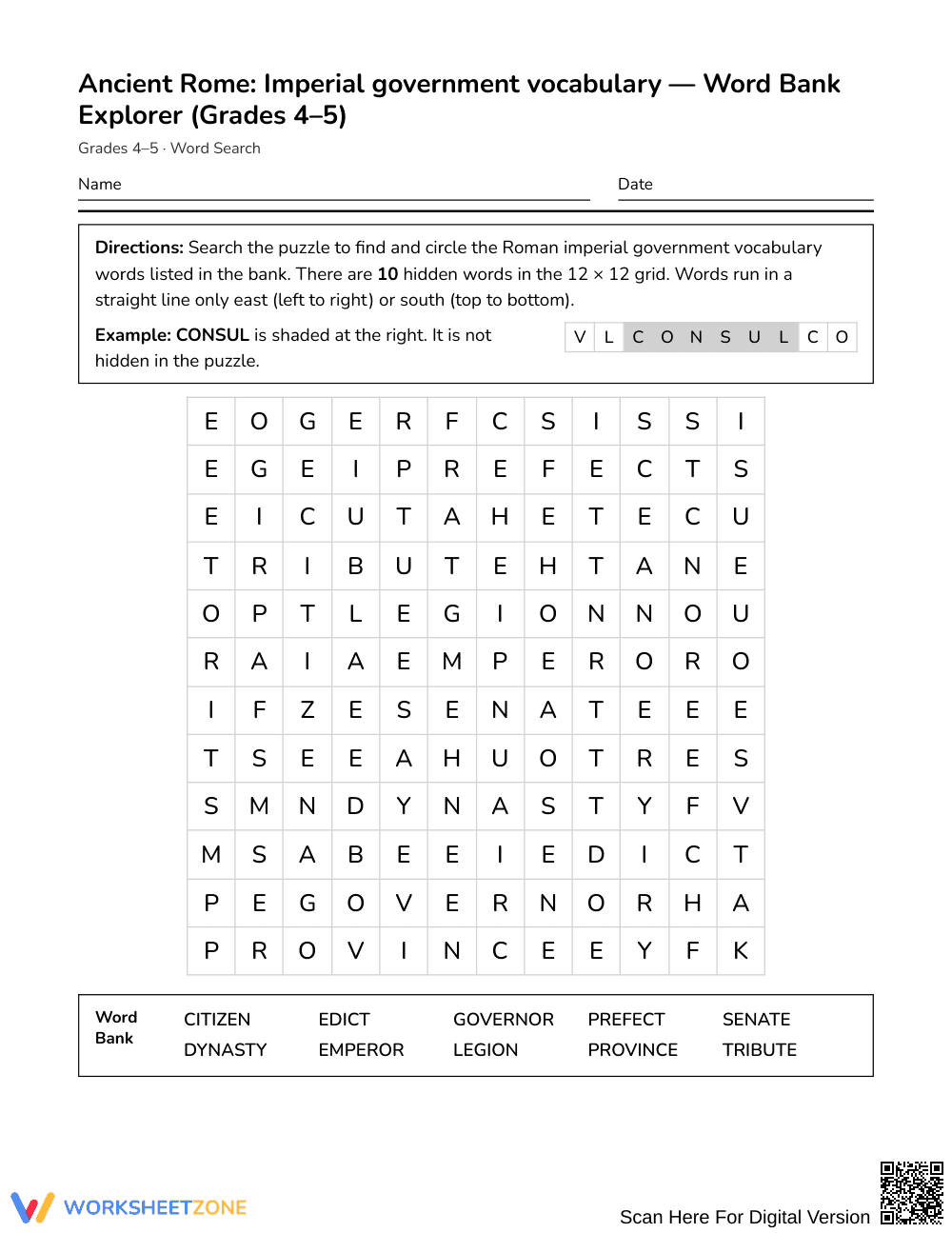
Boost learners’ mastery of ancient Roman imperial government vocabulary with this engaging word search. Students locate ten key terms, reinforcing definitions while building spelling fluency and historical context. The activity is self‑contained, printable, and ready for immediate classroom use today.
At a Glance
- Grade: Grades 4–5 · Subject: Social Studies (elementary) – ideal for mixed‑ability groups
- Standard:
Not standards-assessed — vocabulary enrichment for Roman civics, supporting language development- Skill Focus: Imperial government vocabulary (terms and definitions) to strengthen historical language
- Format: 1 page printable · 10 hidden words · Answer key included &midd; PDF file for easy distribution
- Best For: Quick vocabulary practice for Roman government units, perfect for review or warm‑up
- Time: Approximately 5–10 minutes for completion, allowing rapid reinforcement
What's Inside
The activity consists of a single 12 × 12 grid word search. Ten imperial government terms are hidden horizontally, vertically, and diagonally. An alphabetical word bank appears below the grid, and each term includes a concise definition as a clue. The answer key on a separate page reveals the exact locations of all words.
Zero‑Prep Workflow
- Print: Open the PDF and print the single‑page puzzle (under 30 seconds).
- Distribute: Hand copies to students or project the grid; the answer key stays with the teacher (about 15 seconds).
- Review: After completion, quickly scan the answer key to confirm accuracy (≈30 seconds). Total teacher prep stays under two minutes.
Standards Alignment
Because this resource is designed solely for vocabulary enrichment, it is not aligned to any state or national standard. It serves as a supplemental language activity that reinforces key Roman government terms without formal assessment requirements.
How to Use It
Use the word search as a warm‑up before a lesson on Roman political structures, allowing students to activate prior knowledge while you introduce new content. Alternatively, employ it as a quick review after a lecture; observe students as they locate each term and note any hesitations to inform immediate clarification. Completion typically takes five to ten minutes.
Who It's For
The puzzle targets Grades 4–5 learners studying ancient Rome, but the clear word bank and definitions make it accessible for a range of reading levels. It pairs well with a Roman government anchor chart or a short video on imperial authority, providing contextual support for deeper understanding.
Research shows that focused vocabulary activities, such as themed word searches, improve both word recognition and content comprehension for elementary learners (Fisher & Frey 2014). By embedding the ten imperial government terms of ancient Rome within a single‑page puzzle, this resource offers repeated exposure and contextual clues that support semantic mapping. The alphabetical word bank and concise definitions act as immediate scaffolds, enabling students to self‑monitor progress as they locate each word. When used before instruction, the activity primes students’ prior knowledge; when used after, it reinforces newly taught concepts, creating two opportunities for formative assessment. The quick, printable format aligns with best practices for low‑prep interventions, allowing teachers to allocate instructional time to deeper discussion rather than setup. Incorporating this word search can therefore boost vocabulary retention and reinforce historical understanding in a single, engaging session.


