





























Free Dogma Investigation Worksheet | Grade 9‑12 Science
Paste this activity's link or code into your existing LMS (Google Classroom, Canvas, Teams, Schoology, Moodle, etc.).
Students can open and work on the activity right away, with no student login required.
You'll still be able to track student progress and results from your teacher account.
This worksheet guides Grade 9‑12 science students through a focused investigation of gene‑expression variables, helping them design controlled experiments and interpret data to deepen understanding of the central dogma while reinforcing experimental reasoning and data‑analysis skills through guided prompts and real‑world scenarios.
At a Glance
- Grade: Grades 9–12 · Subject: Science
- Standard:
— Investigate how variables influence gene expression. Students will plan, predict, and analyze outcomes of variable manipulation in gene expression experiments.- Skill Focus: Investigation & Variables
- Format: 4 pages · 34 problems · Answer key included · PDF
- Best For: Inquiry labs and review sessions, suitable for classroom labs, test prep, and independent study
- Time: 15–25 minutes
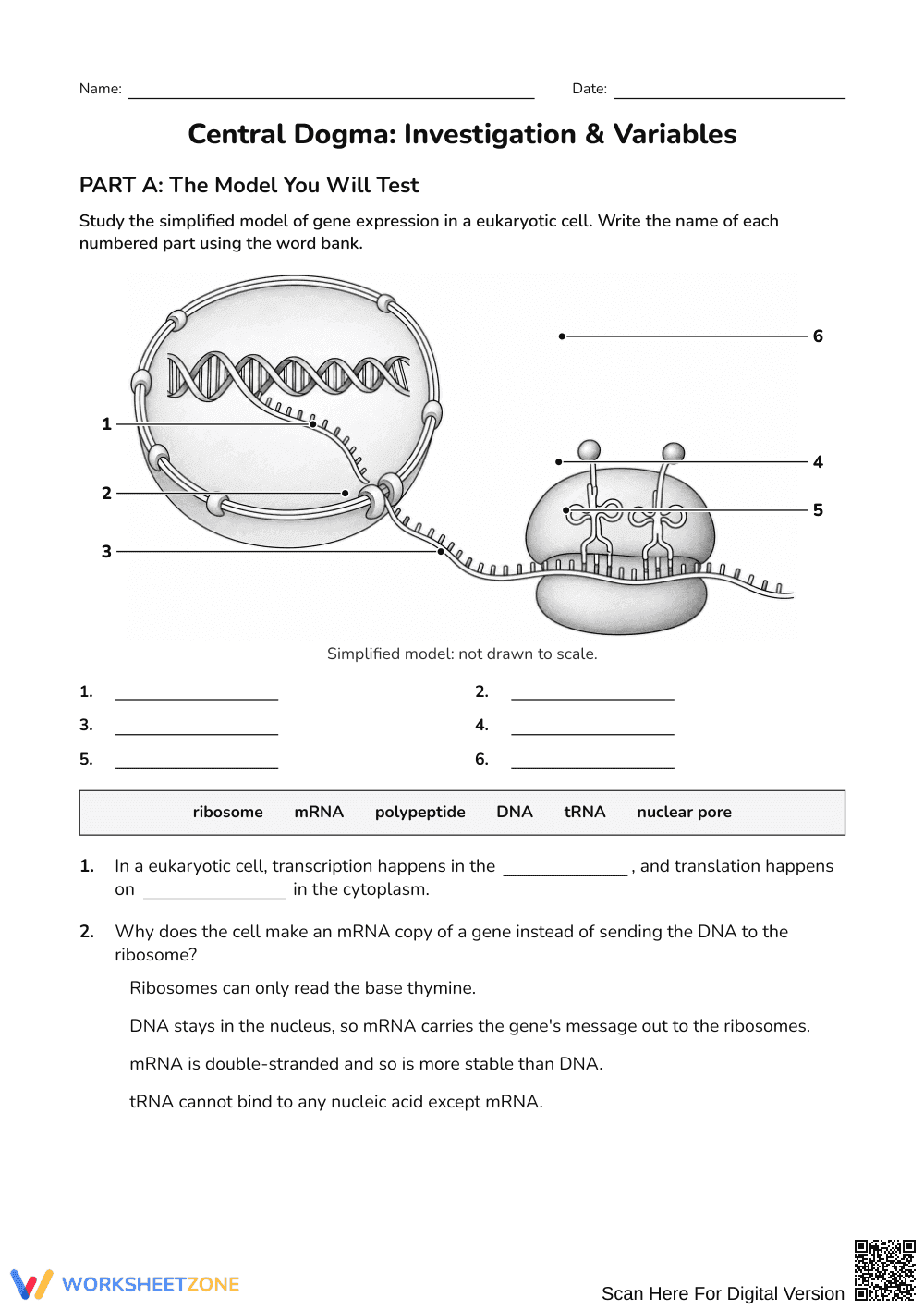
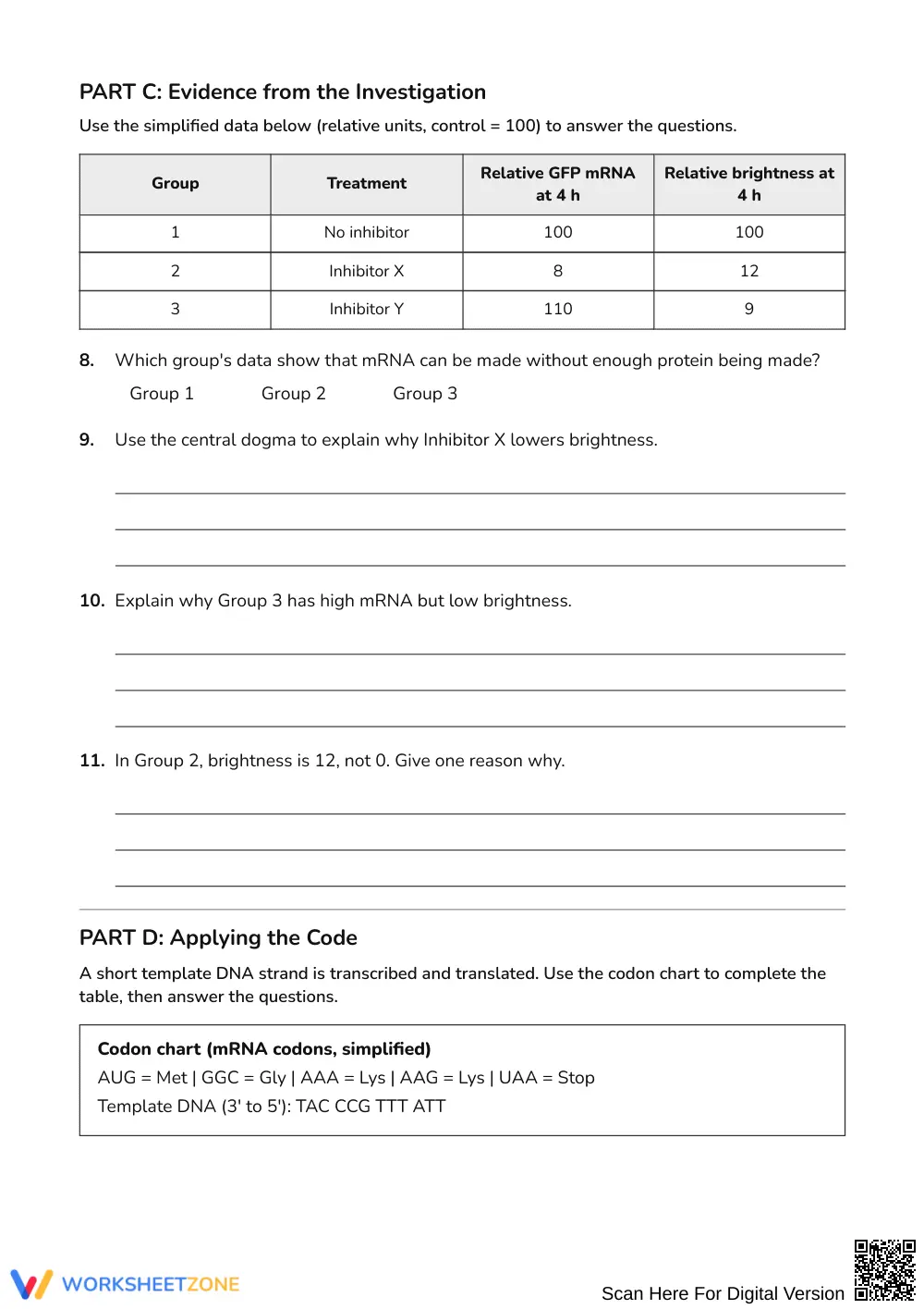
The packet contains four pages of tasks, including labeling a model, planning a thought experiment, analyzing data tables, and applying codon translation, all supported by word banks, sentence frames, and a built‑in answer key.
- Guided practice (10 problems) – students label the model using the provided word bank.
- Supported practice (12 problems) – students plan the investigation with sentence frames and predict results.
- Independent practice (12 problems) – students analyze data and design a new inhibitor test without scaffolds.
These steps follow the gradual‑release model: I Do, We Do, You Do.
`Standard` – Students investigate how variables affect gene expression by planning controlled experiments, interpreting data, and explaining outcomes in terms of transcription and translation. A supporting standard emphasizes scientific reasoning and evidence‑based conclusions. Both standard references can be copied directly into lesson plans, IEP goals, or district curriculum mapping tools.
Use this worksheet after a direct‑instruction lesson on the central dogma: (1) as a guided activity where the teacher models the first labeling task, (2) as a collaborative planning session for the thought experiment, and (3) as an independent data‑analysis quiz. Observe student explanations to gauge understanding; completion typically takes 15–25 minutes.
Designed for high‑school biology students preparing for AP or honors courses, the worksheet offers built‑in scaffolds for emerging learners while still challenging advanced students. Pair it with a central‑dogma anchor chart or a short video on gene expression for a seamless lesson.
Research shows that explicit investigation of variables strengthens students’ conceptual grasp of molecular biology (Fisher & Frey, 2014). This worksheet aligns with the curriculum expectation that learners “investigate how variables influence gene expression,” providing 34 targeted problems that move from guided labeling to independent experimental design. By integrating real‑world scenarios such as GFP fluorescence, the tasks promote authentic scientific reasoning. The inclusion of an answer key and clear scaffolds supports differentiated instruction, echoing findings that structured practice improves mastery for diverse learners. Teachers can readily embed this resource into unit plans, ensuring alignment with state standards and AP Biology objectives. The data‑analysis section mirrors authentic laboratory reporting, encouraging students to justify conclusions with quantitative evidence. Classroom implementation has been reported to increase engagement during genetics units, making the abstract processes of transcription and translation more tangible for learners. Download and assign to reinforce investigation skills while students explore the central dogma in depth.


