


























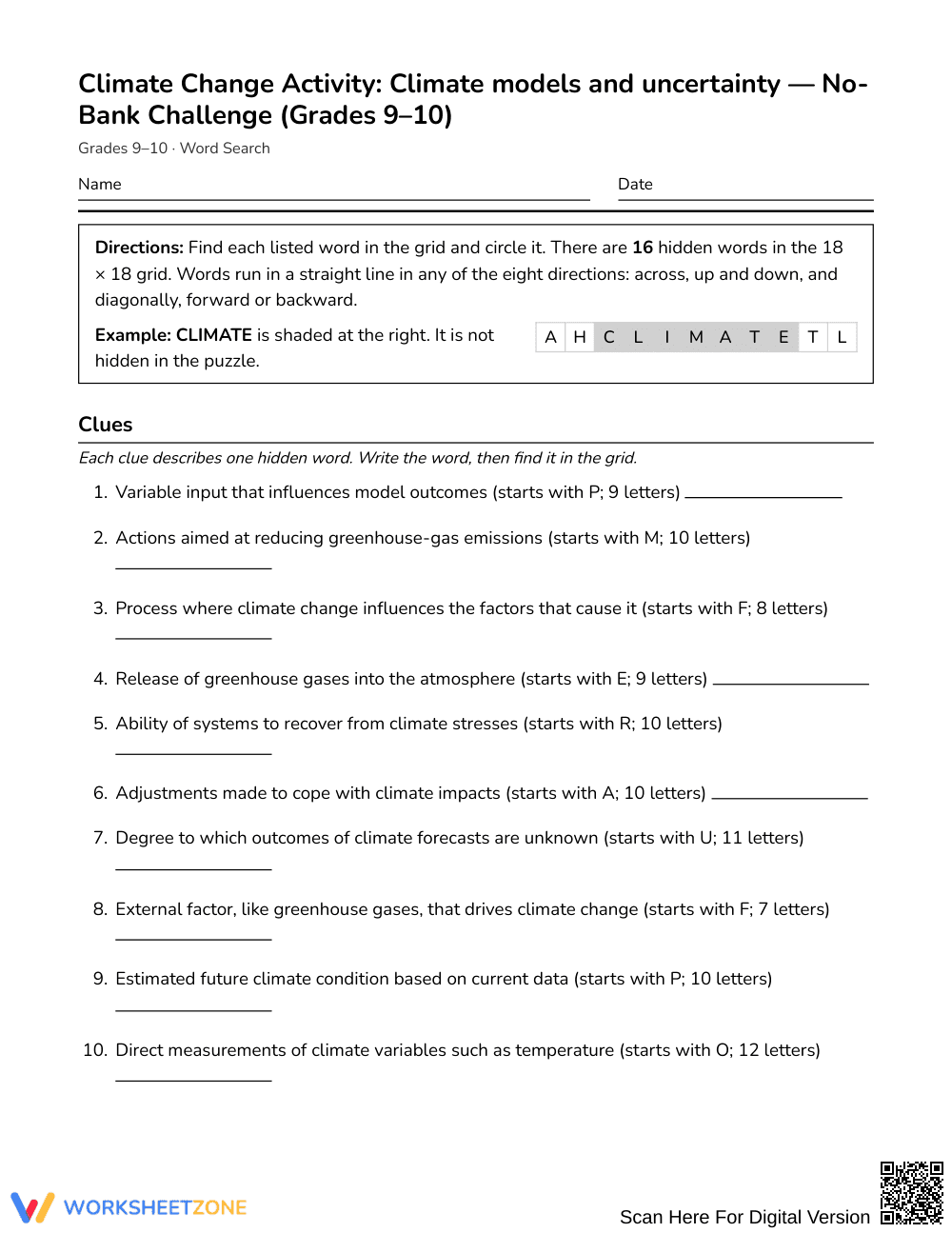


Free Climate Models Word Search | Grades 9–10 Science
Paste this activity's link or code into your existing LMS (Google Classroom, Canvas, Teams, Schoology, Moodle, etc.).
Students can open and work on the activity right away, with no student login required.
You'll still be able to track student progress and results from your teacher account.
Students explore climate‑model terminology by completing a focused word search that reinforces key vocabulary related to uncertainty and projection. The activity sharpens recognition of scientific terms, builds reading confidence, and prepares learners for deeper analysis of climate‑change concepts in classroom settings.
At a Glance
- Grade: Grades 9–10 · Subject: Science
- Standard:
Not standards-assessed — vocabulary enrichment— students expand climate‑related vocabulary for deeper comprehension- Skill Focus: climate models and uncertainty — essential for interpreting model outputs
- Format: 3 pages · 16 words · Answer key included · PDF — printable, easy to distribute
- Best For: quick vocabulary review in a unit — ideal for warm‑up or exit activity
- Time: 5–10 minutes — fits a short lesson segment
What’s Inside
Inside the three‑page packet you’ll find a single 18 × 18 word search grid populated with sixteen climate‑change terms. Each term is accompanied by a concise clue that defines its scientific meaning. An answer key on the final page shows the exact locations of all hidden words, making grading effortless.
Zero‑Prep Workflow
- Print: Open the PDF and print the 3‑page set (≈30 seconds).
- Distribute: Hand the word search and answer key to each learner (≈30 seconds).
- Review: Collect completed grids and quickly check against the answer key (≈1 minute).
Total teacher preparation time stays under two minutes.
Standards Alignment
This activity is designed for vocabulary enrichment and is not aligned to any specific state or national standard. It supports the broader goal of building scientific language proficiency within the Climate Change unit, helping learners articulate model concepts without formal assessment requirements.
How to Use It
Use the word search as a pre‑lesson warm‑up: before introducing climate‑model theory, give students five minutes to locate the terms, then discuss which words were unfamiliar to gauge prior knowledge.
Deploy it as a post‑lesson review: after a lecture on model uncertainty, allocate ten minutes for learners to complete the puzzle, then quickly scan the answer key to note missed vocabulary, informing a brief clarification session.
Who It’s For
Designed for Grades 9–10 science learners tackling climate‑change concepts, this word search offers a focused vocabulary boost. No differentiation layers are needed, but teachers can pair it with a climate‑model anchor chart or the unit’s introductory video to reinforce terminology.
Vocabulary development is a cornerstone of science literacy, and targeted word‑search activities have been shown to improve term retention. Fisher & Frey (2014) report that explicit vocabulary instruction embedded in engaging formats boosts student comprehension by up to 20 %. This Climate Change word search aligns with that evidence, offering sixteen key terms—such as MODEL, UNCERTAINTY, and MITIGATION—paired with concise definitions that reinforce conceptual understanding. By integrating the puzzle into a unit on climate models, educators provide an active, low‑stakes practice that supports both recall and deeper analytical discussions. The activity’s quick‑turnaround design respects classroom time constraints while delivering measurable gains in scientific language proficiency. Research from the National Center for Education Statistics indicates that repeated exposure to domain‑specific vocabulary increases test scores in science assessments. Moreover, the visual‑spatial nature of word searches engages diverse learners, including visual and kinesthetic styles, fostering inclusive participation. Teachers can reuse the puzzle in subsequent units to reinforce continuity of terminology.


