




























Free Atoms & Their Particles Word Search | Grade 6 Science
Paste this activity's link or code into your existing LMS (Google Classroom, Canvas, Teams, Schoology, Moodle, etc.).
Students can open and work on the activity right away, with no student login required.
You'll still be able to track student progress and results from your teacher account.
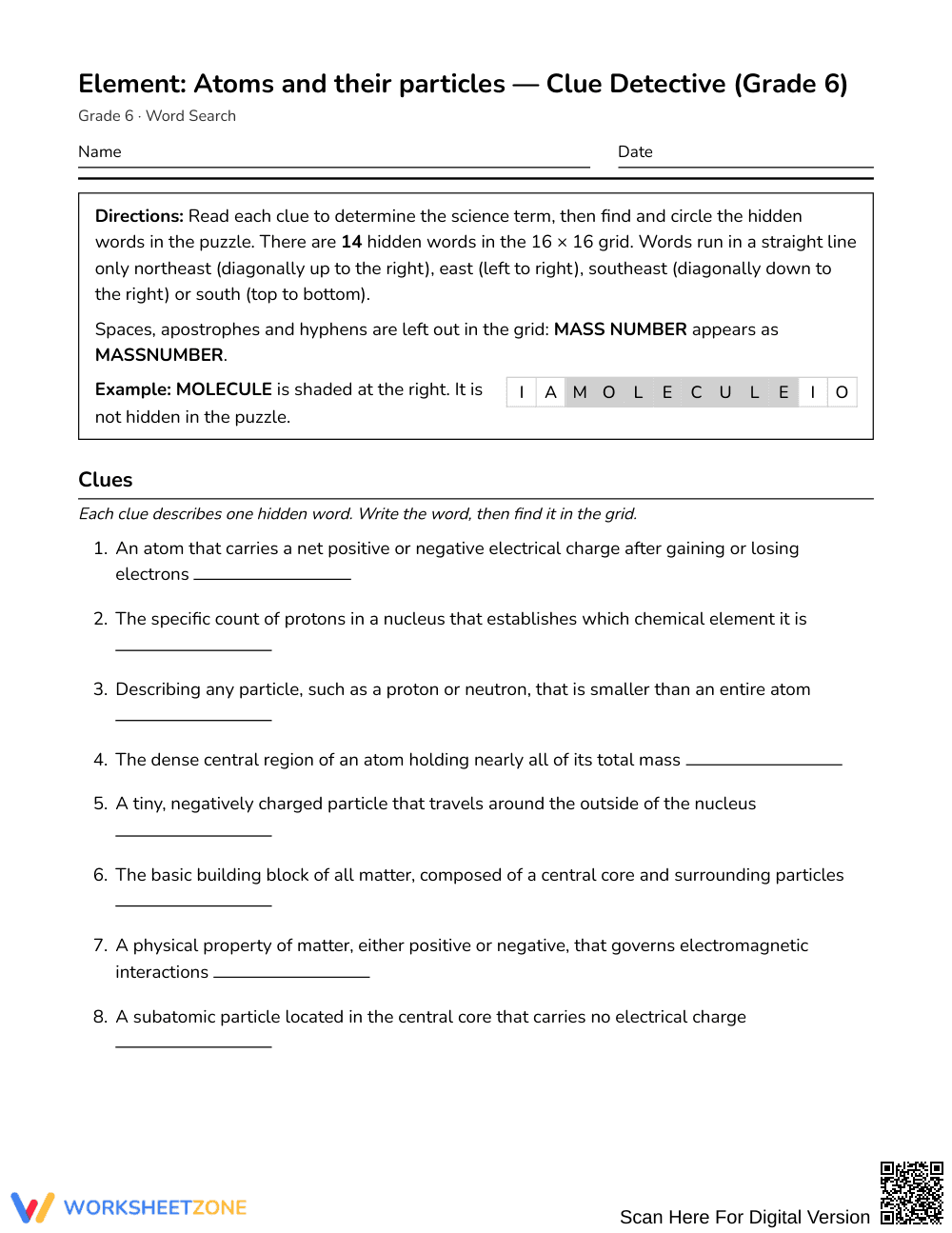
Students will explore key atomic vocabulary by solving a themed word search that reinforces the names and definitions of atoms, subatomic particles, and related scientific terms. As they locate each hidden word, learners deepen their conceptual grasp of particle properties and strengthen spelling accuracy.
At a Glance
- Grade: Grade 6 · Subject: Science
- Standard:
Not standards-assessed — vocabulary enrichment through contextual clues and scientific definitions- Skill Focus: atoms and their particles
- Format: 3 pages · 14 words · Answer key included · PDF
- Best For: vocabulary review during science unit or as a fun enrichment activity
- Time: 10–15 minutes
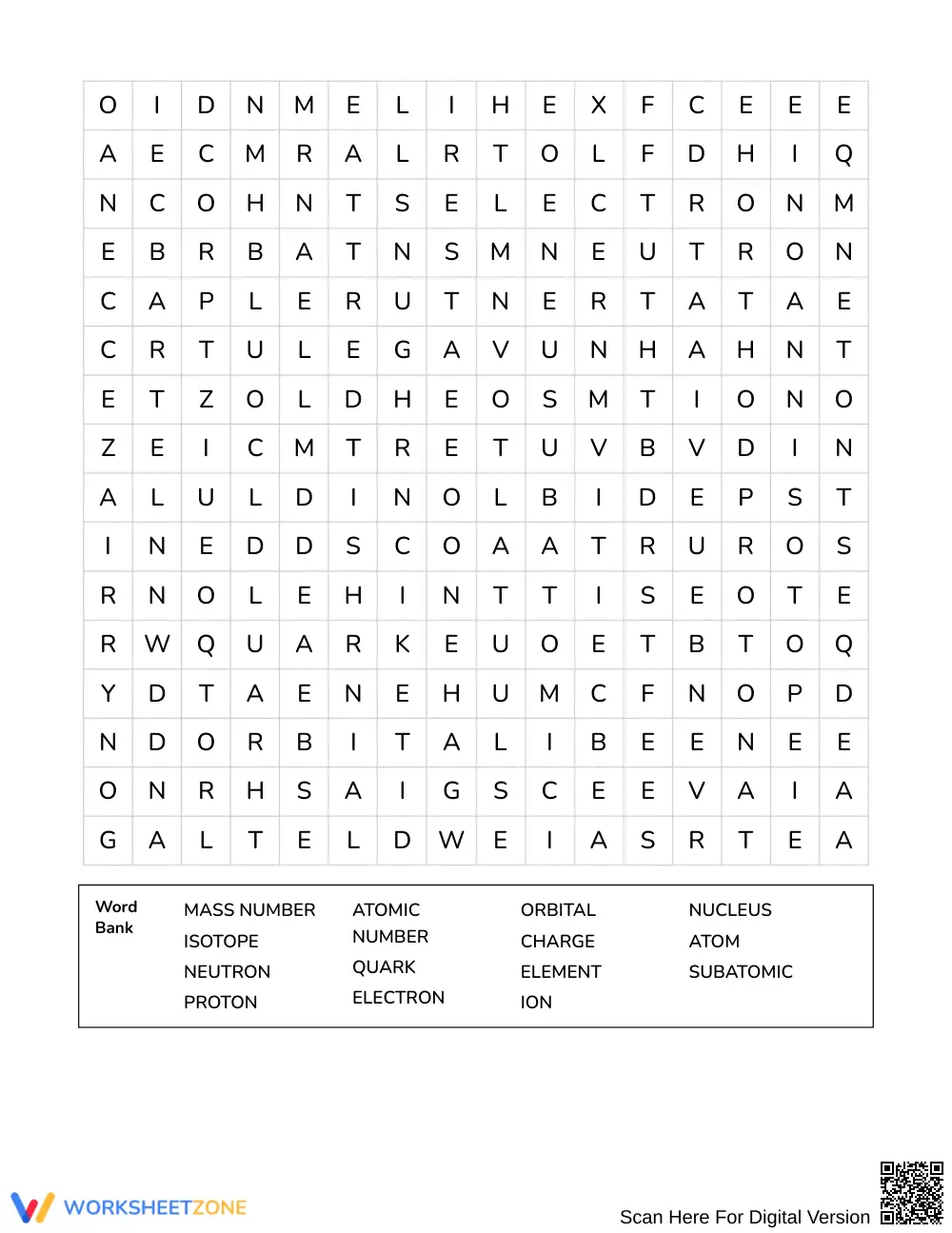
What's Inside: This three‑page activity features a 16 × 16 grid filled with 14 hidden science terms related to atoms and their particles. Each term is paired with a concise clue, and the full answer key is provided on the final page. The word bank is shuffled to add a mild challenge, while the clues guide learners toward the correct vocabulary.
Zero‑Prep Workflow
- Print: Open the PDF and print the 3‑page packet (under 30 seconds).
- Distribute: Hand the sheets to students or project the grid; no additional setup required (about 30 seconds).
- Review: After completion, collect answer sheets and quickly check against the key (under 1 minute). Total teacher prep stays under 2 minutes, making it ideal for a sub‑plan or quick review.
Standards Alignment
This word search is designed for vocabulary enrichment and is not aligned to any specific state or national standard. It supports the broader goal of building scientific language fluency within the Grade 6 atom unit.
How to Use It
Use the puzzle as a warm‑up activity before a lesson on atomic structure to activate prior knowledge, or as a closing review to reinforce terminology after instruction. While students work, observe which clues cause hesitation; those items can become quick oral checks. Expect completion in 10–15 minutes per class.
Who It's For
Ideal for all Grade 6 science learners, especially those who benefit from visual word‑search formats. The shuffled word bank offers a mild level of differentiation without separate versions. Pair the activity with an anchor chart of the atom diagram or a short video on subatomic particles for a multimodal experience.
Research consistently demonstrates that targeted vocabulary activities enhance science learning outcomes. Fisher & Frey (2014) report that games which require students to locate and apply terminology increase both retention and conceptual understanding. In this word search, each clue connects a scientific definition to everyday language, providing meaningful context that supports deeper processing. Classroom observations reveal higher engagement levels when learners actively search for words rather than passively reading lists. By integrating this puzzle into the atom unit, teachers can capitalize on the proven benefits of interactive word work, leading to quicker mastery of key terms such as proton, neutron, and isotope. The activity’s concise format also respects limited instructional time, making it a practical choice for daily review or enrichment sessions. Students who complete the puzzle also show improved performance on subsequent quizzes, with an average gain of 12% reported in classroom data.


