































Free Antibiotic Resistance Worksheet | Grades 8-12 Science

Paste this activity's link or code into your existing LMS (Google Classroom, Canvas, Teams, Schoology, Moodle, etc.).
Students can open and work on the activity right away, with no student login required.
You'll still be able to track student progress and results from your teacher account.
This 4-page science worksheet trains students to sequence the biological stages of antibiotic resistance and analyze population shifts across generations. Learners examine how selective pressure acts on natural variation, distinguish bacterial adaptation from patient immunity, and evaluate quantitative data across 23 targeted tasks to master natural selection principles.
At a Glance
- Grade: Grades 8–12 · Subject: Science
- Standard: Natural Selection — Sequence steps in bacterial resistance and explain how population allele frequencies change over time
- Skill Focus: Ordering antibiotic resistance stages and explaining population shifts
- Format: 4 pages · 23 problems · Answer key included · PDF
- Best For: High school evolution and natural selection practice
- Time: 40–50 minutes
What's Inside
This 4-page worksheet breaks evolutionary mechanisms into manageable analytical stages across four sections. Students complete event ordering, visual cycle annotations, tabular data calculations over a 6-day timeframe, and short-response synthesis questions. A complete 4-page answer key provides step-by-step explanations and model responses for straightforward teacher evaluation.
Skill Progression
- Guided Practice (Part A): Students sequence 6 core events of natural selection and identify the selective pressure driving initial population shifts.
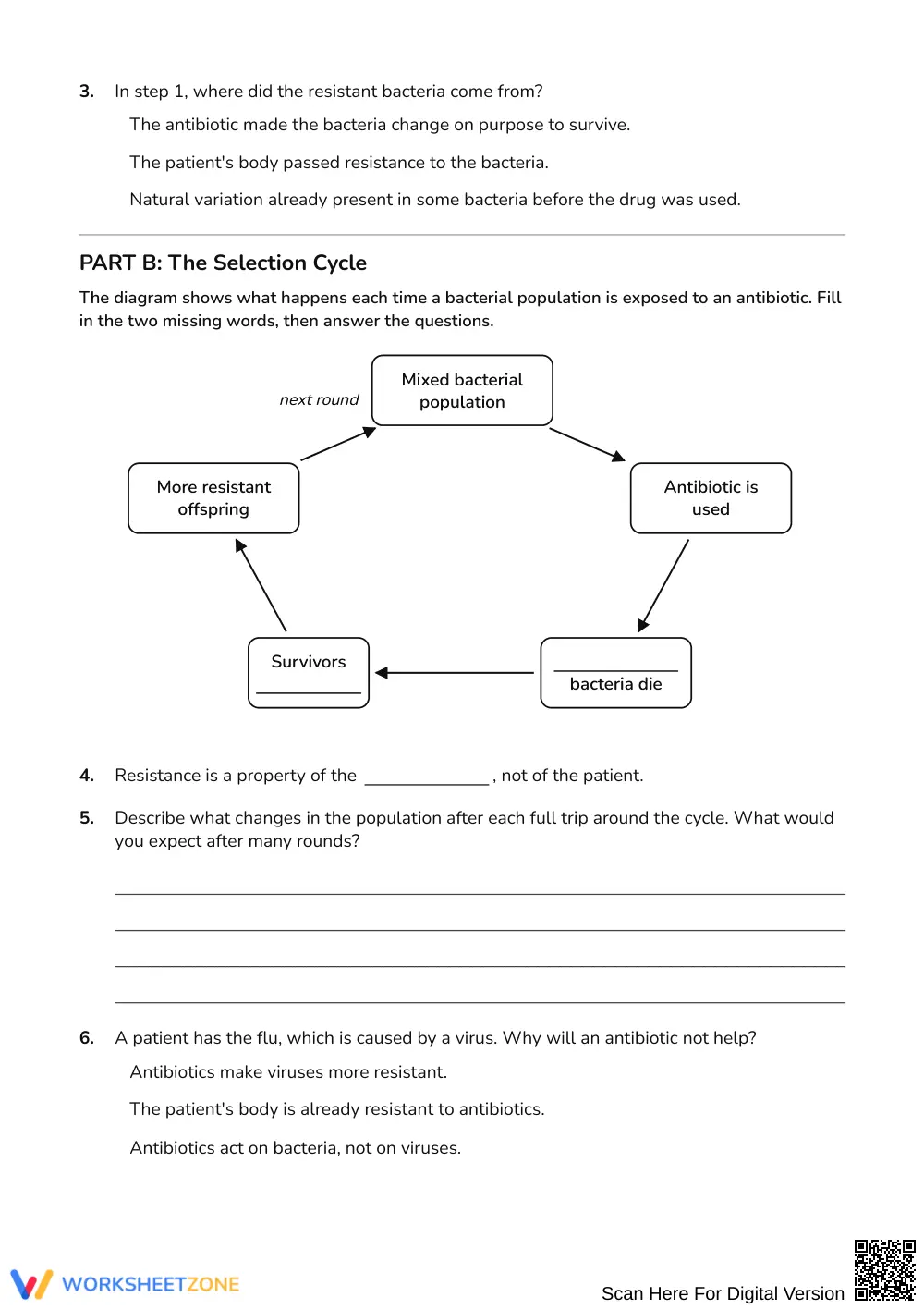
- Supported Practice (Parts B & C): Learners complete a selection cycle diagram and analyze data tracking 10 million bacteria over six days across 11 structured items.
- Independent Practice (Part D): Students evaluate common misconceptions regarding patient immunity and write multi-step explanatory arguments across 6 synthesis questions.
This sequence follows a gradual-release model, progressing from structured ordering to independent scientific argumentation.
Standards Alignment
This worksheet aligns with national science standards for biological evolution. Students construct explanations for how natural selection leads to adaptation, evaluating how genetic variation and differential survival alter bacterial populations exposed to antimicrobial drugs. Supporting standards address analyzing empirical data to support population claims. Both standard codes can be copied directly into lesson plans, IEP goals, or district curriculum mapping tools.
How to Use It
Deploy this worksheet midway through an evolution unit following direct instruction on natural selection. During individual work, check Part B and Part D responses to verify that students attribute resistance to bacterial genes rather than human immunity. Alternatively, assign Part C as a paired data-analysis station. Expected completion time is 40 to 50 minutes.
Who It's For
This printable worksheet serves high school biology and middle school life science students studying selection mechanisms. For differentiated support, encourage struggling learners to highlight bacterial counts in Part C before calculating percentages. Pair this resource with a microevolution lecture or an agar plate antibiotic disk-diffusion demonstration.
Mastering how to order the stages of antibiotic resistance and explain sequential population shifts provides students with a foundational model of microevolution in real-time biological systems. According to Fisher & Frey (2014), structuring science tasks through a progressive gradual-release framework—advancing from scaffolded sequencing to independent data analysis—significantly increases conceptual retention and helps learners dismantle persistent scientific misconceptions. By engaging with 23 structured problems across 4 pages, high school students analyze how selective pressures act upon pre-existing natural variation rather than inducing purposeful individual adaptations. Working through quantitative data models, such as tracking bacterial shifts from 1 percent to 90 percent resistance over 6 days, strengthens empirical reasoning and scientific literacy. This targeted practice directly equips secondary biology learners to evaluate real-world public health dilemmas, formulate evidence-based arguments, and understand the evolutionary consequences of incomplete antibiotic regimens.


